
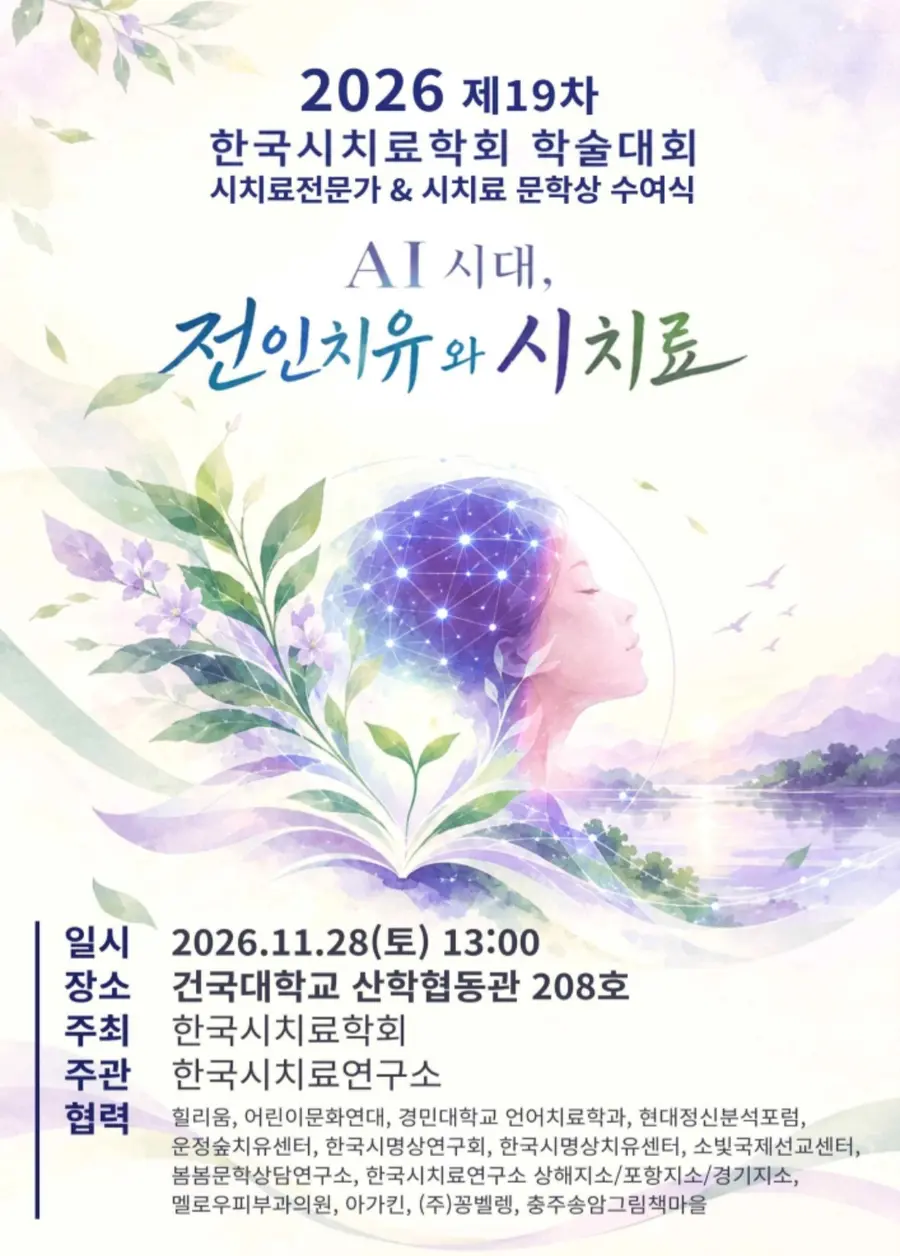
The Korean Poetry Therapy Association, chaired by Choi So-young, will hold its 19th academic conference at 1pm on Saturday 28 November in Room 208 of the Industry-University Cooperation Building at Konkuk University. Its theme is holistic healing and poetry therapy in the age of AI. The event is organised by the Korean Poetry Therapy Research Institute, in partnership with a number of organisations, including Healium, the Department of Speech-Language Therapy at Kyungmin University and the Korean Poetry Meditation Research Society.
In an age of talking to machines, why read poetry?
The association describes the conference as a place to discuss inner healing and growth, and how they can help restore human dignity and agency. Just as poetry is a composite art shaped through language, poetry therapy can reach beyond caring for the mind to encompass holistic health — body and mind, spirit and relationships, and the environment.
In her welcome message, chair Choi So-young said the age of AI was accelerating hyper-individualisation, the decline of family ties and social disconnection. As people became absorbed in communicating with machines rather than talking to one another, isolation and loneliness were deepening, while depression, anxiety and lonely deaths were increasing, she said. Choi described poetry therapy’s role as “finding quiet in a noisy age”, saying it could help people find their own voices and live with agency as part of a community.
Poetry meditation as a way beyond the inflated ego
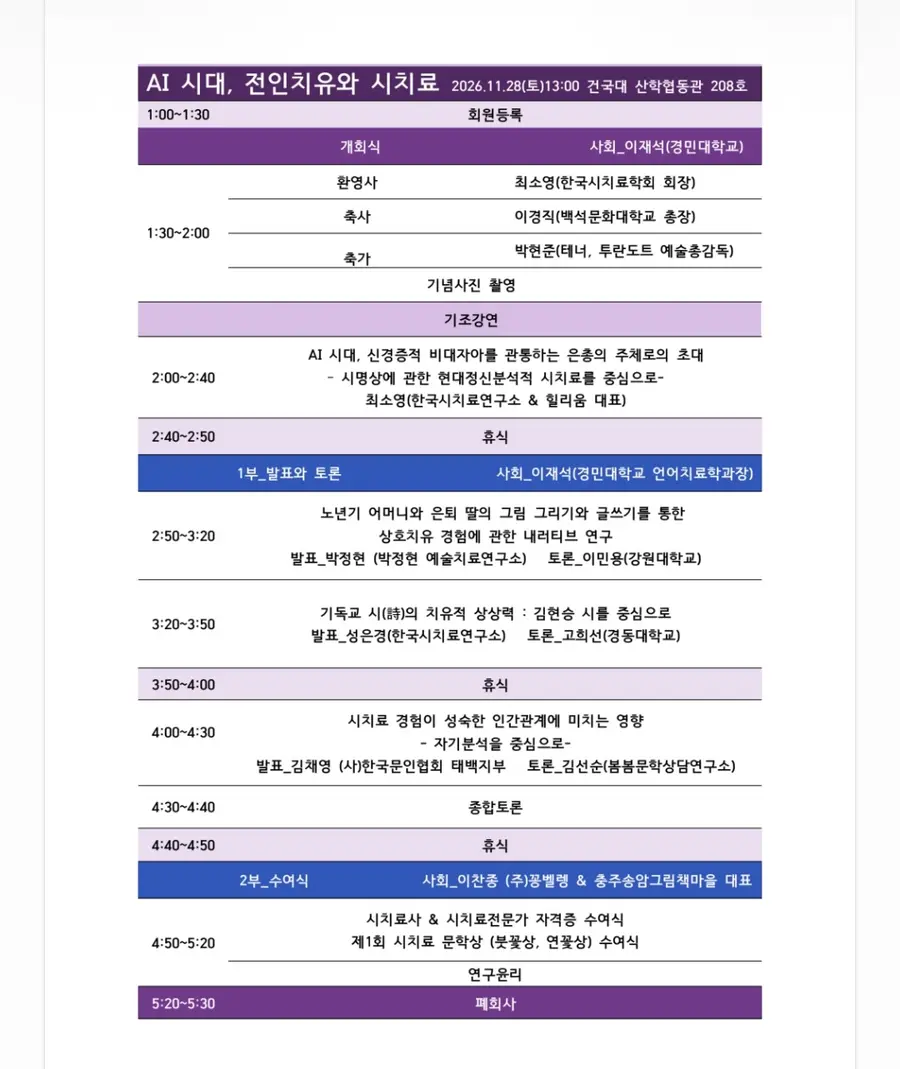
The keynote will be delivered by Choi So-young, head of the Korean Poetry Therapy Research Institute and Healium. Titled “In the Age of AI: An Invitation to Become an Agent of Grace Beyond the Neurotic Inflated Ego”, it will explore a path beyond an ego that has grown too large and towards a deeper self, with a focus on modern psychoanalytic poetry therapy and poetry meditation.
Poetry meditation involves reading a poem slowly and observing where its words settle in the mind. It has something in common with meditation: pausing the rush of thought and staying with a single line. The keynote may therefore be of particular interest to those drawn to meditation.
A record of healing written by a mother and daughter
The first session will feature presentations and discussion of three studies. Park Jeong-hyeon of the Park Jeong-hyeon Art Therapy Research Institute will present a narrative study of how an older mother and her retired daughter healed through drawing and writing.
Seong Eun-gyeong of the Korean Poetry Therapy Research Institute will examine the healing imagination of Christian poetry, focusing on poems by Kim Hyeon-seung. Kim Chae-yeong of the Taebaek branch of the Korean Writers’ Association will present on how the experience of poetry therapy can affect mature relationships, drawing on self-analysis. Each presentation will be followed by discussion, before a plenary discussion.
Iris and lotus awards: who will win the first Poetry Therapy Literary Awards?
The second session will be a presentation ceremony. Certificates will be awarded to poetry therapists and to the 22nd cohort of poetry therapy specialists, followed by the inaugural Poetry Therapy Literary Awards, with Iris and Lotus prizes. The event will close at 5.30pm.
Registration available on the day; five hours of association activity recognised
Registration on the day costs 50,000 won for members, 60,000 won for non-members and 40,000 won for undergraduate students. Advance registration — 40,000 won for members, 50,000 won for non-members and 30,000 won for undergraduates — closed at 6pm on Wednesday 25 November. Participants will receive conference materials and will be credited with five hours of association activity.
The venue is Room 208, Industry-University Cooperation Building (Building 14), Konkuk University, 120 Neungdong-ro, Gwangjin-gu, Seoul, near Konkuk University Station on subway Lines 2 and 7. The underground car park at the Industry-University Cooperation Building is available. For enquiries, contact the association secretary on 010-9575-1764 or 010-3292-7132.
Press enquiries: fare3041@naver.com