

On the subway ride home, fingers do not stop; they just keep swiping through short clips. The screen goes on, stretching ten minutes into thirty, yet your body feels heavier than ever. This familiar fatigue—when you have “rested” but do not feel rested—will be tackled head-on in a course that opens in Mia-dong, northern Seoul, this coming autumn.
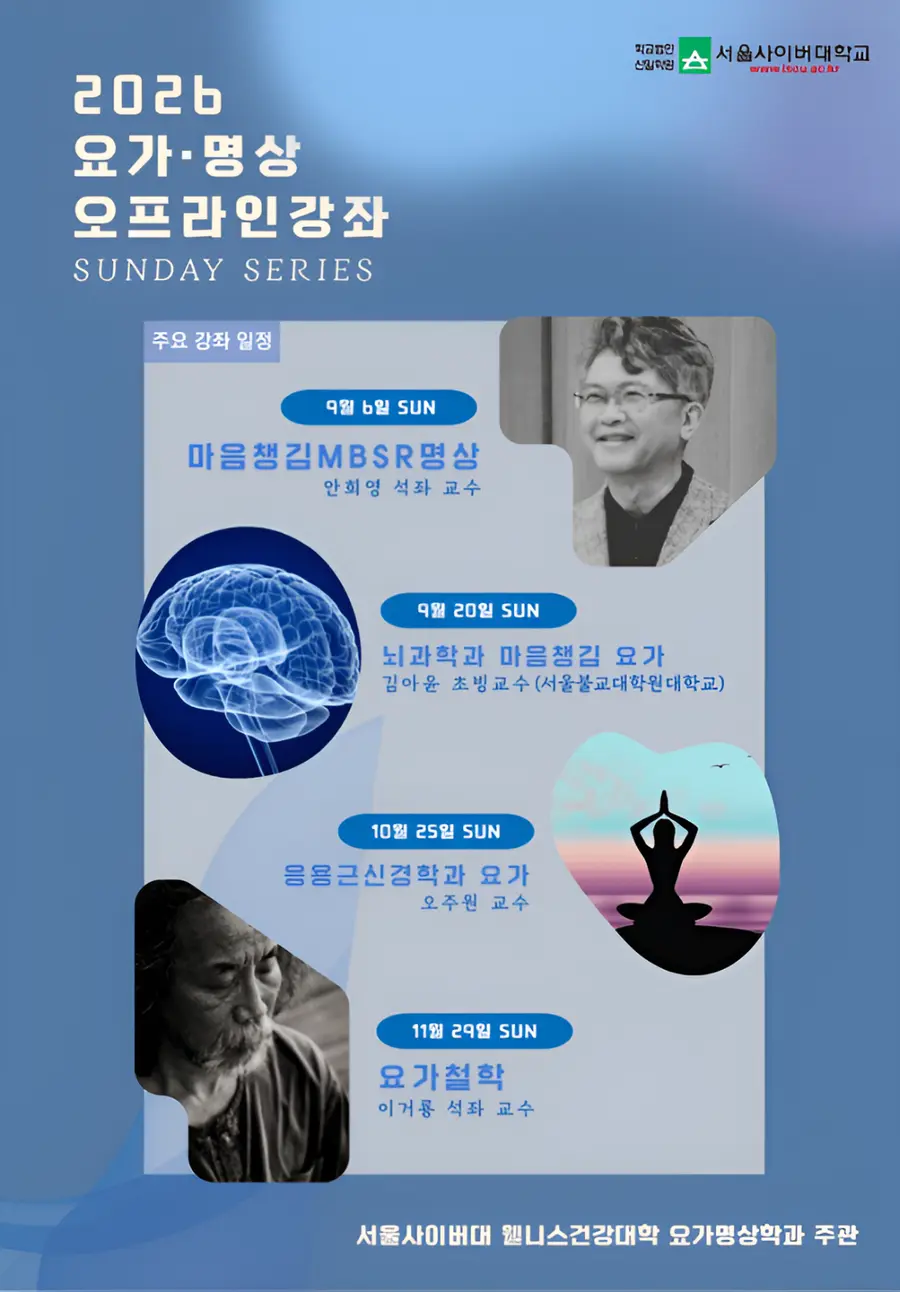
Seoul Cyber University (President Lee Eun-joo) says its Wellness Health College’s Department of Yoga and Meditation will hold a six-session programme, “2026 Yoga and Meditation Offline Course Series”, from 6 September to 29 November. The venue is Room 501 in Building A of Seoul Cyber University, and advance registration began on 3 August. Participation is open not only to students of the Department of Yoga and Meditation, but to anyone interested in yoga, meditation and the wellness field. Details can be checked on the department’s website.
Why an online university rolls out an offline mat
This series targets areas that are difficult to fill with online lectures alone. The length of your breathing, the subtle angles of seated postures, and the sensations when muscles truly release are hard to convey beyond the screen.
Lee Min-young, head of the Department of Yoga and Meditation, said: “We prepared this so that students can experience and practise real yoga and meditation beyond online lectures.” She added that, through programmes that reflect the latest trends—including mindfulness meditation (MBSR), a fusion of neuroscience and mindfulness yoga, and yoga applying applied neuromuscular physiology (AK)—students will be able to experience both theory and practice in a balanced way.
The first session is led by An Hee-young, the ‘MBSR No. 1’ chair professor
In the first session on 6 September, Chair Professor An Hee-young will run “From burnout to vitality: Mindfulness MBSR meditation”. MBSR is an eight-week programme created by Dr Jon Kabat-Zinn in 1979 at the University of Massachusetts Medical School in the United States for patients dealing with chronic pain and illness. It takes an approach that combines Eastern mindfulness practice with Western mind-and-body medicine.
Professor An received MBSR instructor certification in South Korea as the first Korean person at the Center for Mindfulness (CFM) in the United States, and currently serves as director of the Korea MBSR Mindfulness Research Institute. She previously worked as vice president at the Seoul Buddhist Graduate University. She also translated several of Jon Kabat-Zinn’s books into Korean.
“Dopamine reset”, re-reading “true rest” through neuroscience
For the second session on 20 September, the visiting professor Kim A-yoon from Seoul Buddhist Graduate University will lead “Dopamine reset: True rest and mindfulness yoga, unpacked through neuroscience”. The school says the programme covers ways to let the brain, overloaded by stimulating short-form videos and media exposure, rest.
This topic has drawn rapidly growing interest in recent years. In a report, the University of Seoul’s student newspaper cited a keyword analysis service, Sumtrend, saying that online mentions of “dopamine detox” increased more than fivefold compared with the previous year. The so-called popcorn brain phenomenon—where the brain responds only to strong stimuli—and a decline in concentration, where it becomes hard to return to whatever you were doing after watching short videos, have also been pointed out together.
Three practical sessions from sitting posture to breathing
In October and November, courses led by Professor Oh Ju-won are scheduled in concentrated blocks. On 11 October, “Hatha yoga practice: Yoga for comfortable seated postures” will help build the physical foundation for meditation by creating a posture that does not come undone even after long sitting. On 25 October, “Yoga applying applied neuromuscular physiology (AK): Stomach and spleen” follows. AK is an approach that looks at the body’s structural, chemical and mental balance through muscle testing, and starts from the premise that long-term functions and weakening of specific muscles are linked. On 22 November, “Hatha yoga practice: Yoga deepened through breathing” will cover deep relaxation and awakening the senses.
The final chapter is handled by yoga philosophy
The final session on 29 November is “Yoga philosophy: Understanding human beings in yoga and a system for practice”, led by Chair Professor Lee Geo-ryong. The series concludes by moving from movements and breathing to how yoga views human beings, and by laying out the system on which practice stands.
New in 2025, the only Department of Yoga and Meditation at a cyber university
The Department of Yoga and Meditation at Seoul Cyber University was launched in 2025. It treats yoga and meditation not as hobbies or exercise, but as an academic discipline grounded in scientific evidence, with a goal of training experts in healing yoga and healing meditation.
The faculty includes Professor Lee Geo-ryong, who teaches chakra meditation; alongside Professor An Hee-young of MBSR; and a Juseung monk who practised in Sri Lanka for 10 years, teaching early Buddhist meditation. Professor Jang Ji-sook, who systematised somayoga in South Korea, is also taking part.
Three months in autumn and six evening sessions are being prepared. Only those who sit down on the mat themselves know what kind of rest it becomes to set the screen aside and sit in practice.
SEO package
Meta description (156 characters)
Seoul Cyber University’s Department of Yoga and Meditation will hold six sessions of the 2026 Yoga and Meditation Offline Course Series from 6 September to 29 November. It sets out the schedule and how to apply, covering MBSR by An Hee-young, dopamine reset, applied neuromuscular physiology yoga, and yoga philosophy by Lee Geo-ryong.
URL slug
Korean:
/서울사이버대-요가명상-오프라인-특강-2026English:
/seoul-cyber-university-yoga-meditation-lecture-series-2026
Keyword structure
Core keywords Department of Yoga and Meditation at Seoul Cyber University, yoga and meditation special lectures, meditation courses
Supporting keywords dopamine reset, MBSR meditation, Professor An Hee-young, Professor Lee Geo-ryong, hatha yoga, applied neuromuscular physiology yoga, mindfulness meditation, wellness lectures, yoga philosophy, offline meditation programme
Long-tail keywords how to apply for Seoul meditation special lectures, short-form dopamine detox meditation, workplace burnout meditation programme, free yoga and meditation lectures in Seoul, places to learn meditation for beginners, what an 8-week MBSR programme is, how to become a meditation instructor, the curriculum of the Department of Yoga and Meditation at a cyber university, the autumn 2026 wellness lectures, methods to recover from brain fatigue
Instagram hashtag set of 20
#SeoulCyberUniversity #YogaMeditationDepartment #YogaMeditation #MeditationSpecialLecture #DopamineReset #DopamineDetox #MBSR #MindfulnessMeditation #ProfessorAnHee-young #ProfessorLeeGeo-ryong #HathaYoga #YogaPhilosophy #AppliedNeuromuscularPhysiology #Wellness #MeditationClass #BurnoutRecovery #BrainRest #SeoulMeditation #MeditationClass #HealingNews
WordPress tags
Seoul Cyber University, Department of Yoga and Meditation, meditation special lectures, MBSR, dopamine reset, hatha yoga, yoga philosophy, An Hee-young, Lee Geo-ryong, wellness, mindfulness, meditation programme