

A song someone has heard throughout their life can be comforting one day and make their heart feel heavier the next. The song stays the same, but the listener’s state of mind changes. What might the same song sound like if listeners first spent 10 minutes meditating to settle their minds?
A research team from the School of Music at Sichuan Normal University in China—He Xuanlin, Zheng Chao, Li Haijiao and Sui Heng—published the results of an experiment exploring this question on November 6 in the international journal Frontiers in Psychology. Older adults who meditated briefly before listening to music felt more peaceful and less sad while listening to the same songs.
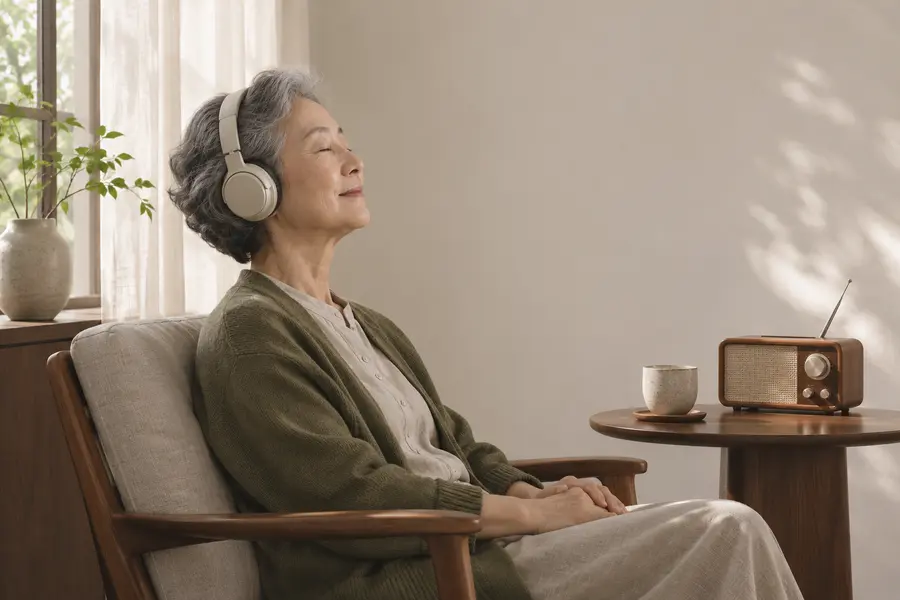
191 older adults meditated for 10 minutes before listening
The research team recruited adults aged 60 and older living in communities in China. The participants’ average age was about 69; 102 were women and 89 were men. The team divided them into two groups. Before listening to music, 96 participants followed a recorded body scan meditation for 10 minutes, while 95 rested quietly for the same amount of time without guidance.
In a body scan meditation, you settle into a comfortable position and slowly notice sensations in your body, moving from head to toe, along with your breathing. Rather than judging sensations as good or bad, you simply notice them. When your thoughts wander, you bring your attention back to your body and breath.
Both groups then listened through headphones to five two-minute musical selections. The selections were chosen at random from instrumental recordings of 25 Chinese pop songs. After listening, participants rated nine emotions they had felt while hearing the music.
They felt more peaceful and less sad
Older adults who meditated before listening to music felt greater peace and transcendence. Transcendence refers to the feeling, while listening to music, of being connected to something greater beyond everyday life. Of the nine emotions, this was where the difference between the two groups was greatest. Participants who listened without meditating first felt more sadness while hearing the same songs.
The meditation group also reported greater awareness of the present moment after finishing the music. That suggests the 10 minutes of meditation stayed with them through all five songs.
The research team said brief meditation and music listening are accessible activities that can be expanded in communities without complex equipment. The findings suggest music and meditation may help enrich the range of emotions that can become more limited with age.
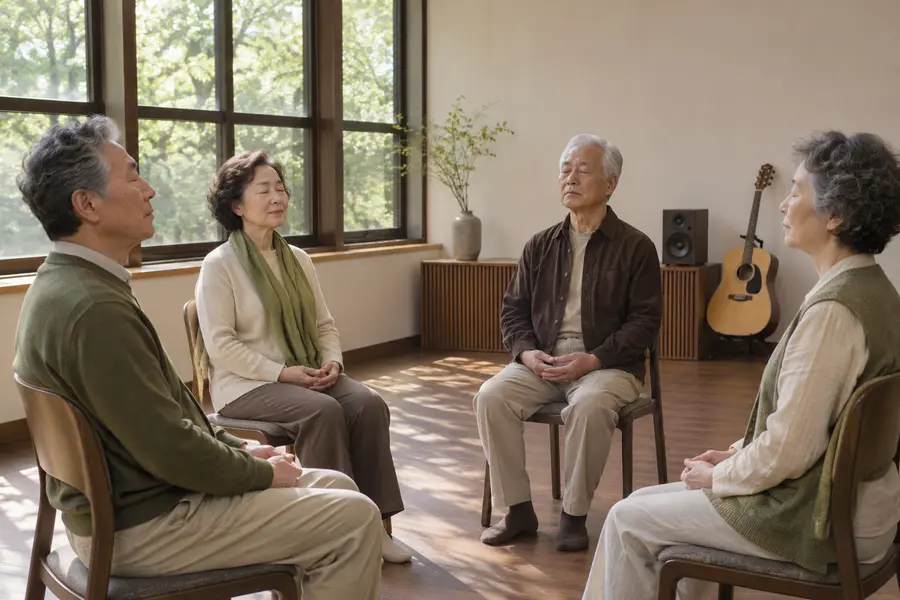
Meditation before a concert is already part of the program in Korea
There have also been efforts to bring music and meditation together in Korea. Before its regular Yeongsanhoesang concerts on November 12 and 13, the National Gugak Center’s Jeongak Ensemble offered an accompanying experience called “Opening Yeongsanhoesang Through Meditation.” It made time to calm the mind before listening part of the concert experience. This study shows, through older adults’ emotional responses, why that sequence may matter.
For people who find it difficult to sit still and focus for a long time, music can be a good way in. There are familiar songs, and the body can naturally relax while listening. It can start with something as simple as adding a 10-minute meditation to places where older adults already enjoy music, such as singing classes, senior centers or welfare centers.
Try a 10-minute music meditation with your parents
Here’s one way to try it at home. Choose a favorite song; an instrumental piece may be best at first. Before playing it, spend 10 minutes leaning back in a comfortable chair with your eyes closed. Slowly notice sensations in your body, moving from the crown of your head to your shoulders, stomach, legs and toes. If thoughts arise, don’t blame yourself—simply return your attention to your breath. Then play the music and listen, noticing where the sound seems to reach in your body.
If you’re doing this with your parents, you could suggest that you each listen to the same song after a phone call to catch up. Simply sharing how the same song sounded to each of you today can deepen the conversation. If following a body scan on your own is difficult, start with a free guided meditation recording, then move on to music when it ends.
Media inquiries: fare3041@naver.com