

Researchers at the University Hospitals of Geneva had 26 adults with no meditation experience complete a 17-minute self-compassion meditation; their response time on a perspective-shifting task was 68 milliseconds faster
People who practiced self-compassion meditation while looking at an avatar modeled on themselves in virtual reality responded faster on a task requiring them to shift into another person’s perspective than those who performed the same meditation with their eyes closed. The experiment was conducted by researchers in the Department of Clinical Neuroscience at the University Hospitals of Geneva and was published Aug. 5 in the international journal Mindfulness.
Data analyzed from 26 people with no meditation experience
The researchers recruited 30 people and analyzed data from 26. The group included 13 men and 13 women, ranging in age from 20 to 49, with an average age of 27.15 years (standard deviation, 8.15). All were healthy adults with no meditation experience. People with a history of neurological or psychiatric disorders or substance abuse were excluded.
The study used a within-subjects design. Each participant experienced both conditions, with the order randomized. One was an avatar-based self-compassion condition, and the other was a standard self-compassion condition.
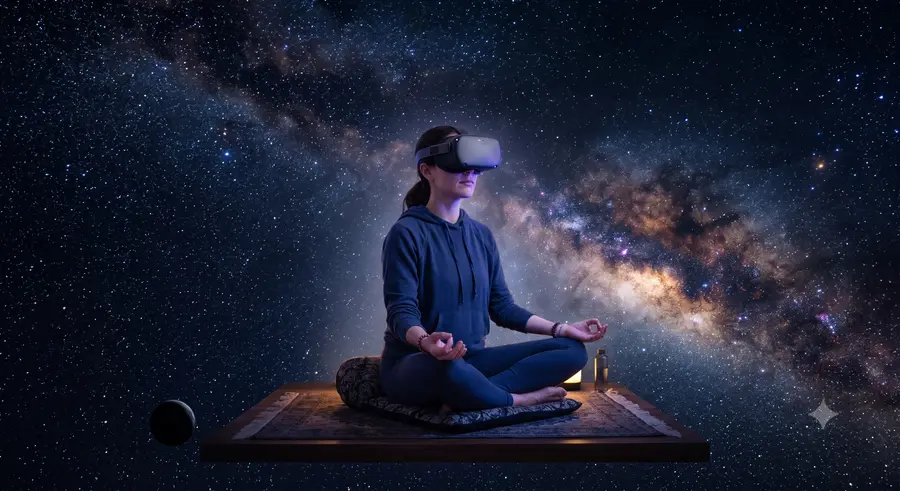
17 minutes beneath a night sky
Both conditions involved an audio-guided meditation lasting about 17 minutes. After an introductory phase, the scene shifted to a nighttime sky, and participants spent five minutes focusing on bodily sensations and their breathing before the two conditions diverged.
In the standard condition, participants continued the guided meditation with their eyes closed. In the avatar condition, they kept their eyes open and looked at an avatar whose movements were synchronized with their own. The experience also included a stimulus in which the avatar’s light flashed in time with the participant’s heartbeat. The approach overlaid visual and cardiac sensations.
The researchers used an HP Reverb G2 headset with a 107-degree field of view and a resolution of 2160×2160 per eye. Four Azure Kinect cameras scanned each participant’s body in real time to create the avatar.
Self-compassion increased in both conditions
On the State Self-Compassion Scale (SSCS), an 18-item measure using a five-point scale, the main effect of measurement time was significant (χ²(2)=29.46, p〈0.001). Scores in the avatar condition rose significantly from baseline (t=6.68, p〈0.001, Cohen's d=0.94), as did scores in the standard condition (t=5.53, p〈0.001, d=0.80). The difference between the two conditions was not significant (p=0.25).
On the SOFI scale, which measures four forms of boundless compassion directed toward oneself and others, positive traits were highest in the avatar condition (4.07), followed by the standard condition (4.01) and baseline (3.85). Negative traits were lowest in the avatar condition (1.44).
The difference emerged on the perspective-shifting task
The two conditions diverged most clearly on the “Own-Body Transformation task” (OBT). Participants viewed drawings of a person facing forward or backward for 200 milliseconds and completed 192 trials identifying whether the displayed hand was the left or right hand. The task measures the ability to place oneself in another person’s body.
In the avatar condition, response times fell by an average of 68.24 milliseconds (t(25)=-4.33, p=0.002, Cohen's d=-0.85). The 23.39-millisecond decrease in the standard condition was not significant (p=0.28). A direct comparison also found that the reduction was significantly greater in the avatar condition (χ²(1)=10.53, p=0.001). Accuracy did not differ between the conditions.
There were no differences between the conditions in heartbeat intervals, heart rate or heart-rate variability measured by electrocardiography.
Avatar condition leads on perspective-shifting ability
The researchers concluded that multisensory perceptual cues may support perspective shifting while encouraging empathic engagement toward oneself. Both meditations increased self-compassion, but the avatar condition produced greater gains in perspective-shifting ability.
The study also had clear limitations. The sample was small, at 26 participants, and the researchers did not systematically collect data on race and ethnicity or socioeconomic status. The study was not preregistered. Because all participants lacked prior meditation experience, it is unclear whether the same results would apply to people with meditation experience. Internal consistency for the self-compassion scale at baseline was somewhat low (McDonald's ω=0.64).
The findings should also be understood as short-term changes observed after a single 17-minute session. As meditation programs using VR devices continue to grow domestically, more experiments like this are likely to examine what produces the effects.
#VRMeditation #SelfCompassion #Mindfulness #VirtualReality #PerspectiveShifting #MeditationResearch #InternationalResearch #DigitalMeditation