

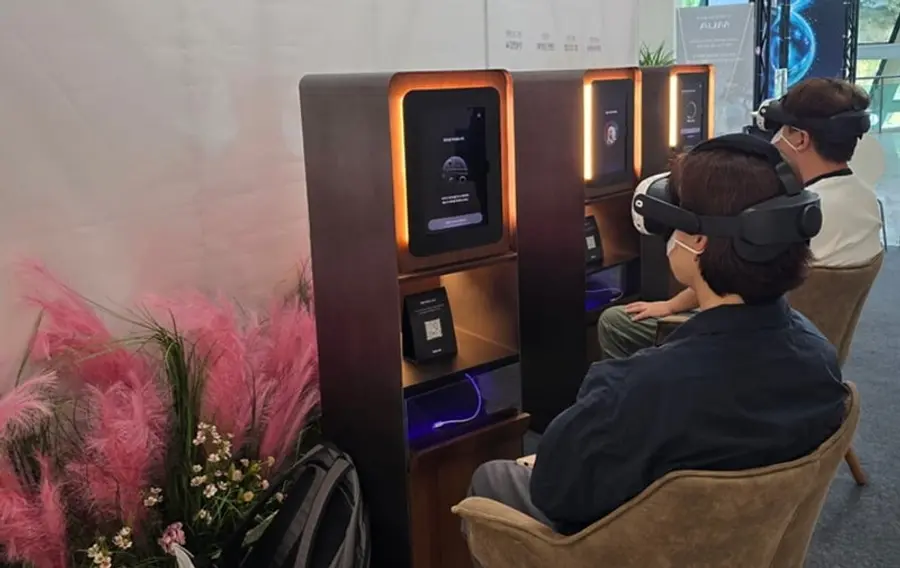
A lightweight version of MUAHOME, which required an independent booth of roughly 3.3 square metres, offers biometric signal-based emotion inference and personalised XR meditation content, unveiled for the first time at the Jeju AI International Film Festival.
Corporate mind-care devices are gradually abandoning the assumption that meditation requires a quiet room. On 17 September, Com2uS N unveiled MUAO, a lightweight version of its AI meditation solution MUA. It made its debut at the 2026 Jeju AI International Film Festival & Global Content Forum.
From booth to furniture
The existing MUAHOME came in the form of a standalone pod. It could be installed only if a separate space of about 3.3 square metres was secured, creating a significant barrier to adoption.
MUAO does away with that structure. It is designed to be placed like a piece of furniture in everyday spaces such as a corner of an office, a staff room or a lounge. Reducing the space and operational burden required for installation is the key feature of the new model.
Reading users’ states through biometric signals
MUAO incorporates AI emotion-inference technology that uses biometric signals. It reads the user’s state and provides personalised XR meditation content. The device also includes a sanitising function for environments where it is used by several people in turn.
With MUAO joining its personal app MUA and spatial solution MUAHOME, Com2uS N now has a three-pronged product line-up.
Teachers, soldiers, firefighters and athletes
Com2uS N has been conducting trials involving teachers, soldiers, firefighters and sportspeople. The company says its products are already being used in practice by businesses, public institutions and educational organisations.
A company official said: “This event confirmed the potential uses of MUAO, which can be easily used in everyday life without a separate dedicated space.” The official added: “We plan to expand our product line-up and areas of application so that MUA can be used in a wide range of settings requiring mind care, including businesses and public institutions.”
The target markets identified for the products include businesses and public institutions, medical institutions and sports facilities.
First validation begins in medical settings
The MUA line-up has also expanded into medical settings this year. On 24 July, Com2uS N partnered with Hallym University Kangnam Sacred Heart Hospital to begin field testing MUAHOME in a medical environment. The programme is aimed at supporting psychological recovery among burn patients and high-risk groups for post-traumatic stress disorder, including firefighters.
Baek Seung-up, head of Com2uS N’s MUA division, said at the time: “This agreement is an important attempt to verify the potential for MUAHOME to be used in medical settings. Through partnerships with medical institutions, we will improve the service’s credibility and continue developing it so that more people can use mind-care solutions in their everyday lives.” Lee Byung-chul, a clinical director in the hospital’s department of psychiatry, took part in the partnership on behalf of the hospital.
The device’s results in medical settings cannot be assessed until the trials are complete. Even so, the effort stands out because it seeks to test a mind-care device in a clinical environment rather than treating it solely as a consumer product for use outside hospitals.
A trend towards lowering the barrier to adoption
Devices and services focused on the mental wellbeing of office workers have steadily increased in recent years. But products requiring a dedicated space have often struggled at the adoption stage, because most offices find it difficult to set aside a separate meditation room.
That is the gap MUAO is targeting. If a device can be placed in an existing break area instead of requiring a new space, the barrier to adoption falls considerably.
A device cannot substitute for the depth of meditation. Following the breath and bringing wandering attention back remains the user’s responsibility. Technology’s role lies in the step before that: reducing the distance between intending to meditate and actually beginning. If it provides a reason to set aside 10 minutes in the middle of an office, that alone gives it practical value.