

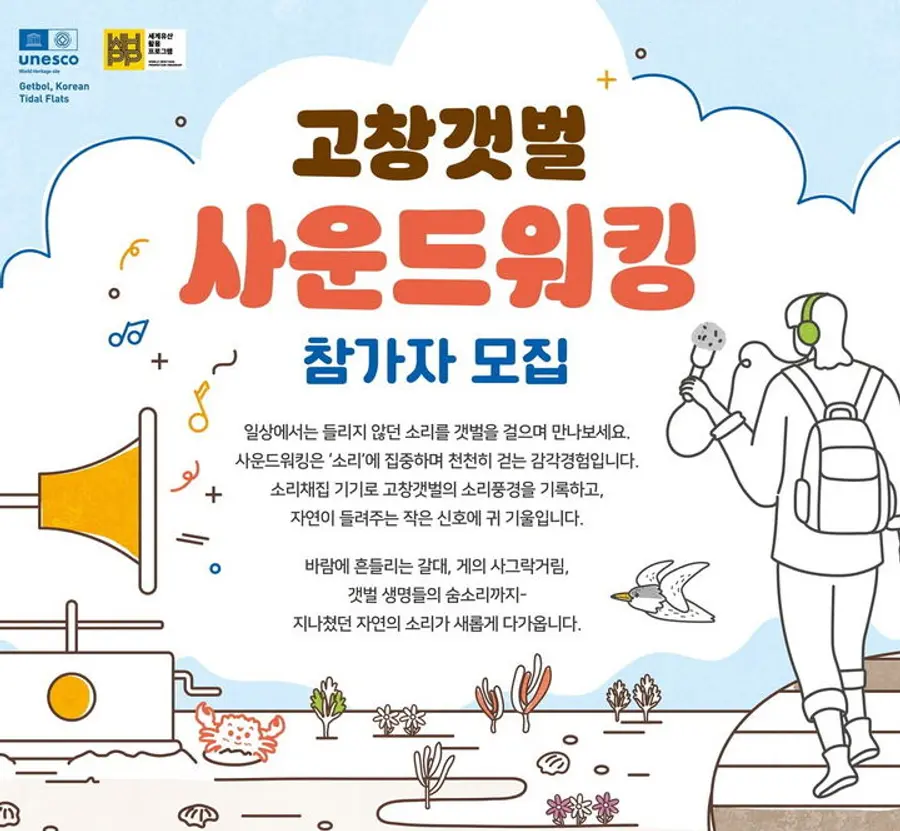
The tidal flats of Gochang in Jeonbuk are remembered more deeply by their sounds than by photographs. The subtle vibration of sand sinking slightly underfoot, the gentle friction sound made as the wind brushes the tips of reeds, all the way to the breathing of waves arriving from afar—this is the kind of scene that’s hard to come across anywhere in the middle of a city.
In May, Gochang County will run the hands-on eco-tourism program ‘Gochang Tidal Flat Sound Walking’ twice, inviting participants to lend their ears to these tidal-flat sounds. Session 1 is on the 17th, and Session 2 is on the 24th, taking place at the Ramsar Gochang Tidal Flat Center and the surrounding area of the Tidal Flat Plant Garden.
New Eco-Tourism Content Away From Sight-Centered Viewing
Sound Walking differs in character from the existing way of simply scanning the tidal flats with your eyes. It is a program designed so that, by interacting with nature through hearing and sensory experience, participants can truly feel the value of the ecosystem with their own bodies.
At the site, participants first learn the meaning of Sound Walking and how to use the recording device. Afterwards, while walking slowly across the tidal flats, they directly collect the sounds created by the wind, waves, and tidal-flat creatures. The sounds captured on the recorder connect to the subsequent Sound Meditation and Coloring Book activities, creating a setup in which a single stroll expands into a more sensory experience. It’s not just a matter of ‘seeing the tidal flats’—the flow is crafted so that what remains is the memory of ‘hearing the tidal flats.’
A Stage Called the Ramsar Tidal Flat of Gochang
The Gochang tidal flats where the program unfolds are protected areas of 45.5㎢, designated as Ramsar wetlands under the Ramsar Convention in 2010. In 2021, when Korea’s tidal flats were added to UNESCO’s World Natural Heritage list, the Gochang tidal flats were also recognized as part of that global value.
The Gochang Tidal Flat Center serves as a hub for conservation, ecological education, and eco-tourism of these tidal flats. The four-story building includes exhibition rooms, a tidal flat library, and an observatory, and it becomes the starting point for this Sound Walking event. Along the route leading to the Tidal Flat Plant Garden, salt-tolerant plant communities such as glasswort (Salicornia) and seashore lawn grass (Zoysia) come into view along with auditory stimulation.
A Time When the Sounds of Nature Reach the Heart
Activities focused on listening and interacting with nature are assessed as contributing to stress relief and psychological stability for participants. In everyday life filled with screens and notifications, simply putting visual stimulation on pause for a moment and opening your ears can lead to a small restoration of the mind.
The process of listening to the sounds of tidal-flat organisms and the environment can also become an opportunity to re-verify the value of the ecosystem and reflect on the need for environmental protection. The program’s structure, which ends with Sound Meditation, provides an approachable entry point even for those who want to bring meditation or mindfulness into daily life without burden.
Na Yoon-ok, Head of the World Heritage Division at Gochang County, said, “Sound Walking is a new kind of eco-tourism content that breaks away from the simple way of viewing tidal flats—allowing people to directly listen to and experience the sounds of nature, and to interact with them.” She added, “We will continue to provide ongoing support so that the Gochang tidal flats can develop into a space that offers a variety of eco-tourism contents, using the living sounds of nature as a bridge.”
With two sessions beginning in the first half of the year, attention is on what kind of listening landscape Gochang Tidal Flat Sound Walking will leave in people’s hearts. Participants can check event guidance and detailed operating information through the Ramsar Gochang Tidal Flat Center.