

More than 500 attend Sept. 22 event at the National Assembly Members' Office Building in Yeouido, Seoul; Monk Maga joins discussion on meditation-based healing
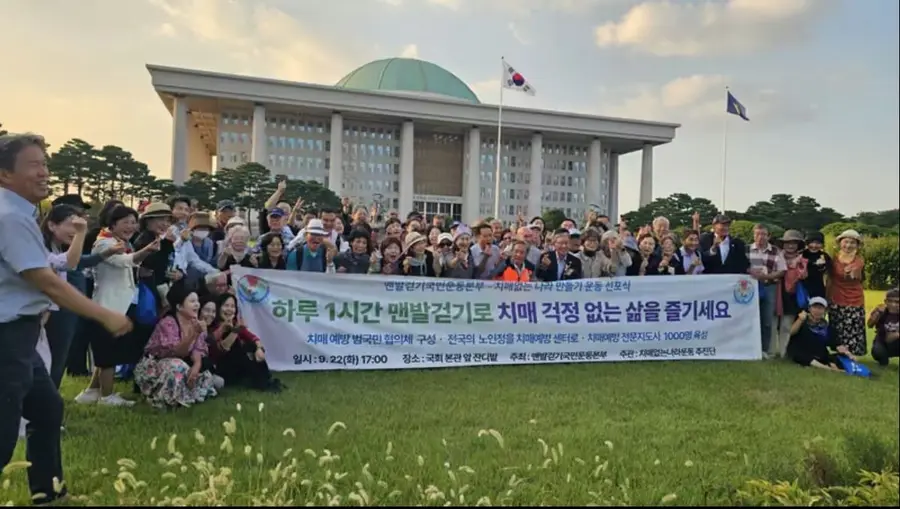
The Act on the Promotion of the Healing Tourism Industry took effect in April, accelerating policy discussions aimed at linking healing and tourism. The “2026 National Assembly Policy Forum on Promoting and Developing K-Healing Tourism,” held Sept. 22 at the National Assembly Members' Office Building in Yeouido, Seoul, was the first large-scale public forum on the issue. In addition to forests, the sea, agriculture and food, meditation and yoga were presented as separate discussion areas.
Event co-hosted by 15 lawmakers
The forum was co-hosted by 15 lawmakers, including Jung Joon-ho and Jo Kye-won. The National Barefoot Walking Movement Headquarters and the Graduate School of Smart Medical and Wellness Tourism at Kongju National University organized the event, which was sponsored by the Ministry of Culture, Sports and Tourism.
More than 500 people attended, including representatives from the National Assembly and government, academics, officials from various fields and members of the public. Eleven lawmakers, including National Assembly Speaker Cho Jung-sik, sent video congratulatory messages, while lawmakers Joo Ho-young, Park Hee-seung and Kim Seong-beom delivered remarks in person. Kim Na-na, director of the Convergence and Complex Tourism Division at the Ministry of Culture, Sports and Tourism, also attended.
Lawmakers' bill sponsor Kim Yoon-duk, who introduced the 「Bill on Promoting the Healing Tourism Industry」, said in a video message that “barefoot walking is K-healing tourism's strongest and finest content.”
Turning about 2,000 barefoot walking trails nationwide into healing tourism infrastructure
Park Dong-chang, chairman of the National Barefoot Walking Movement Headquarters, delivered the first presentation. Park proposed linking about 2,000 barefoot walking trails across the country with other healing resources to usher in an era of 50 million healing tourists. His vision is to connect walking, the most accessible form of activity, with healing programs in forests, along the coast, in rural areas and at temples.
Targeting 17 trillion 500 billion won in economic benefits by 2030
Lee Yong-geun, a professor at Kongju National University, presented a national strategy for promoting K-healing tourism. Lee set a target of 17 trillion 500 billion won in economic benefits and 190,000 new jobs by 2030, and proposed the “K-Healing Index,” or KHI, a three-axis evaluation system that measures brain waves, the autonomic nervous system and bioenergy. He also introduced a blockchain-based digital healing passport and a community-based settlement model centered on young creators.
Lee stressed the need to develop programs tailored to each region. He proposed establishing an integrated control tower for healing tourism under the presidential office, along with budget and tax support through the National Assembly and training for healing tourism professionals.
Park Min-geun, a professor at Shinhan University, presented a strategy for integrating healing agriculture and the healing industry, emphasizing the need to bring together fragmented healing sectors. “K-healing tourism, which provides physical and mental recovery to people living in the AI era, is a future core industry that will drive regional economic growth and create new jobs,” Park said. “I hope healing tourism takes root as a national strategic industry.”
Monk Maga joins meditation-based healing discussion
Nine people took part in sector-specific discussions. Park Beom-jin, a professor at Chungnam National University, represented forest healing; Jang Tae-soo, a professor at Dankook University, marine healing; Ha Kyung-hee, a professor at Semyung University, tourism; Park Min-geun, a professor at Shinhan University, agricultural healing; Min Hyung-ki, chairman of the Central Association for Whole-Grain Natural Foods, food healing; Kim Seong-won, chairman of the International Society of Integrative Therapy, yoga healing; Lim Na-young, a professor at Gachon University, arts healing; and Choi Won-yoo, chairman of the Korea AI Beauty Tech Association, medical tourism.
The discussion on meditation-based healing featured Monk Maga. It marked a moment when meditation was recognized as an independent healing resource on the same level as forests, the sea and medical care, with a representative of the meditation community directly taking part.
The panelists agreed on the need to combine resources from each sector with barefoot walking to develop healing tourism products and programs tailored to local characteristics. They also agreed that training professionals known as “healing tourism guides” is an urgent task.
What it means for meditation to reach the policy table
Participants agreed that healing tourism should go beyond expanding the scope of the tourism industry and contribute to healthier lives, preventive health care and improved quality of life for the public.
The fact that meditation was discussed as a component of national tourism policy, rather than simply as an individual practice or temple program, was a notable development. As the government continues selecting wellness tourism destinations and expanding healing forests, facilities offering meditation programs may have greater opportunities to receive institutional support. The forum also addressed institutional tasks such as establishing an integrated implementation system, designating healing tourism industry zones and introducing healing tourism vouchers.
The Act on the Promotion of the Healing Tourism Industry took effect in April. The fact that meditation was designated as an independent discussion area at the first large-scale public forum held after the law was enacted shows that policymakers' view of the sector is changing.
National proclamation ceremony follows forum
After the event, participants moved to the National Assembly's lawn for a “National Proclamation Ceremony to Build a Dementia-Free Country.” The gathering underscored how discussions about healing tourism intersect with health issues in an aging society.
Contact: fare3041@naver.com