

Many people want to learn meditation but hesitate because they don’t know where to start. A Kyung Hee University research team found an answer at a local lifelong learning center. The team ran an eight-week mindfulness meditation class for 35 adults at Seoul Citizens’ University’s Southeast Campus. Thirty-one participants stayed through the program, and those who completed it reported greater vitality and happiness, along with less depression, fatigue and anxiety. The findings were published October 28 in the international journal Frontiers in Public Health.
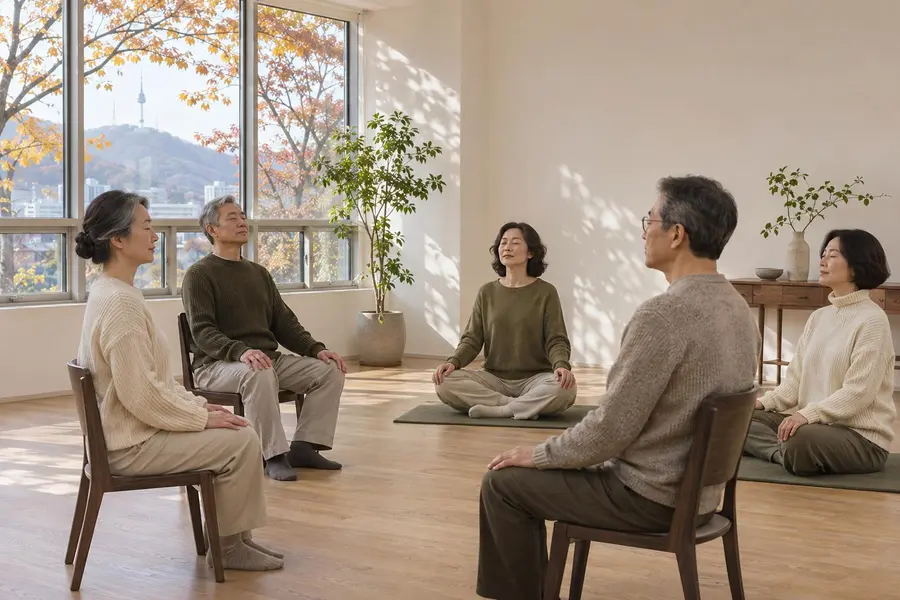
From age 28 to 79, 35 people gathered in a citizens’ university classroom
The class was called the Mindfulness-based Vitality Promotion program (MVP). It was developed and led by researchers Seok-In Yoon, Hui-Yeong Park, Jae-Hong Yoo and Sun-Yong Chung of Kyung Hee University, along with Professor Jong Woo Kim, the corresponding author. Seoul Citizens’ University’s Southeast Campus, operated by the Seoul Metropolitan Institute for Lifelong Education, hosted the classes.
Participants were adults aged 19 or older who experienced difficulties such as depression, fatigue or stress. They ranged in age from 28 to 79, with an average age of 53.74; 13 were 60 or older. Of the 35 participants, 32 were women, and homemakers were the largest occupational group. Two classes were held from October to December 2024, followed by one from February to March 2025, with no more than 15 people in each class.
Notably, the classes were held not at a meditation center or hospital, but at a neighborhood learning center where residents take a variety of courses. It shows how a learning space close to home can offer a first step into meditation.
From breathing to walking meditation: The eight-session sequence
The class met once a week for eight 90-minute sessions. Each session included 20 minutes of instruction, 40 minutes of practice and 30 minutes sharing experiences.
The first session began with breathing meditation. In the second week, participants practiced mindfulness yoga and a body scan; in the third, they tried eating meditation, slowly tasting food and focusing on their senses. The fourth week focused on paying attention to the breath and bodily sensations, and the fifth on walking meditation. In the sixth week, participants practiced breathing meditation while reflecting on values important to them. The seventh week featured loving-kindness meditation, in which participants extended warm feelings to themselves and others. In the final, eighth week, they returned to breathing meditation.
Rather than focusing only on sitting still and observing the breath, the course offered a sequence of practices that engaged the body and everyday life, including yoga, eating and walking. The format gave meditation beginners a chance to try several approaches and choose what suited them.
An average of 6.4 sessions attended; 93% would take the class again
Of the 35 participants, 31 (88.6%) completed the program, attending an average of 6.37 of the eight sessions. Comparing responses before and after the class, vitality and happiness increased, while depression, fatigue and anxiety decreased.
Among the 30 people who completed a satisfaction survey, 28 (93.3%) said they would like to participate again, and all 30 said they would recommend the class to others. Participants cited the time spent sharing experiences and the practical techniques they could use in everyday life as highlights.
Finding time each week for eight weeks can be difficult amid a busy daily routine. Participants’ emphasis on sharing with others suggests that learning and talking together, rather than practicing alone, helped them stick with the class. If you want to maintain a meditation practice, finding a class or group that meets at a regular time may help more than opening an app on your own.
At home, practice once a day and find the meditation that suits you
The research team gave participants audio guides and asked them to practice once a day at home. The approach combined weekly lessons in the classroom with brief practice at home on the other days.
The class sequence can also guide people who want to start meditating on their own. In the first week, begin by focusing on your breath for a few minutes a day. If your body feels stiff, add gentle yoga and a body scan. You can also try eating meditation by slowly savoring a meal, or walking meditation by taking a lap around the neighborhood while focusing on the sensations in the soles of your feet. After trying several approaches, make the one you can continue most comfortably your own practice.
If you’re looking for a place to learn with others, check course listings at a nearby citizens’ university, lifelong learning center or district cultural center for meditation or mindfulness classes. A classroom close to home can be your first step into meditation.
For inquiries about this article: fare3041@naver.com