

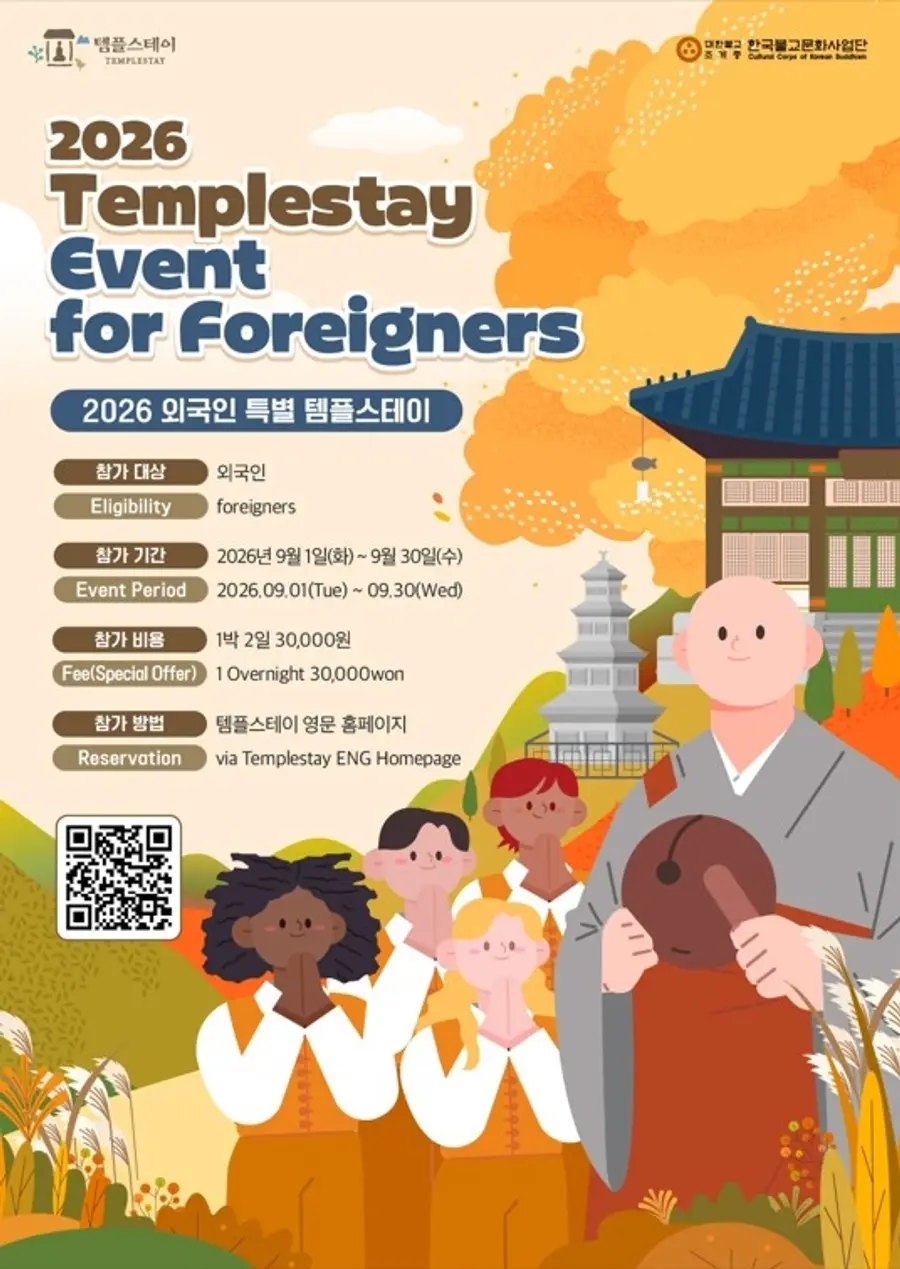
The Korea Buddhist Culture Promotion Agency runs a Foreigners’ Special Temple Stay programme at 19 temples nationwide from 1 to 30 September. It allows foreign tourists visiting Korea and foreigners living in the country to experience a 1-night, 2-day schedule for 30,000 won.
1 night and 2 days for 30,000 won, lowering the barrier to entering the mountainside sanctuaries
The key to the programme is cost. The culture promotion agency set the participation fee at 30,000 won, cutting the existing experience fee by more than half. The measure is designed to help foreigners who hesitated in the face of language and information barriers experience a day at a temple without burden.
Participants follow daily life at the temples for two days. Early morning chanting sessions and the meal offering with bowls, sitting meditation and meditation, and tea talks with monks form the core of the programme. Depending on the temple, additional experiences such as 108 prostrations and making prayer beads, and walking around the temple grounds are offered. Detailed schedules are run differently from temple to temple.
From Jogyesa to Haeinsa, 19 sites around the country open their doors
The participating temples are evenly distributed across nine provinces and regions nationwide. In Seoul, Jogyesa, Hwaeomsa and the International Seon Center take part. In Gangwon, the participating sites are Naksan-sa and Woljeong-sa; in Gyeonggi, Myeojeok-sa and Yongjoo-sa, and Seongnam Daegwang-sa are included.
In South Gyeongsang, Tongdosa, Haeinsa and the Buddha Sunwon join, while Beomeosa in Busan and Donghwasa in Daegu are also included. In South Jeolla, Daheung-sa and Yeongok-sa participate; in North Jeolla, Seonunsan is included. In South Chungcheong, Magok-sa and Seogwang-sa, and Sudeok-sa were confirmed as participating temples.
The programme includes both city-centre temples and large temples in the mountains. Travellers visiting Korea on short itineraries can choose a day that suits them in Seoul’s city temples, while those seeking the atmosphere of deep mountain sanctuaries can pick a day at a major regional temple.
Booking opens via the English website on a first-come, first-served basis
Applications are accepted on a first-come, first-served basis from 1pm on 12 August through the official English temple stay website (www.eng.templestay.com). If recruitment capacity for each temple is filled, bookings close. More detailed information, including operating schedules by participating temple and programme, can be checked on the booking page.
With the programme having won over foreign participants every year, early closing is expected.
Guide to Foreigners’ Special Temple Stay 2026
Category | Details |
|---|---|
Operating period | Tuesday, 1 September 2026 ~ Wednesday, 30 September 2026 |
Who it is for | Foreigners |
Participation cost | 30,000 won for 1 night and 2 days |
Participating temples | 19 locations nationwide |
How to book | Online booking on the Temple Stay English website (www.eng.templestay.com) |
Booking page opens | 1pm on Wednesday, 12 August |
“A route to feel the breath of Korean Buddhism from 1,700 years ago”
Il-hwa, head of the Korea Buddhist Culture Promotion Agency, said: “Against the backdrop of growing global interest in Korean culture, temple stays are the most special route for people to feel the breath of Korean Buddhism from 1,700 years ago with their whole body. I hope it will be a time to share a cup of tea in the beautiful mountain temples of September, look after yourself across nationalities and languages, and share the deep charm and warmth of Korean Buddhism.”
Temple stays began in the wake of the 2002 Korea-Japan World Cup and have taken root as a traditional culture experience programme that represents Korea. In recent years, amid rising interest in K-culture, the number of foreign participants has continued to increase.
In September, the mountainside temples are just starting to cool after the heat of summer. At that time, when the sound of water in the valley becomes less frequent and the air before dawn turns crisp, people from unfamiliar countries sit on the same floor and share a cup of tea. The figure of 30,000 won will open not just a night’s lodging, but a kind of time like that.”