
When you steady your breathing and close your eyes, there comes a moment when the boundary of the familiar “self” gradually starts to blur. Explaining this shift—not as a mysterious experience, but as the brain’s precise workings—is something world-renowned neuroscientist Olaf Blanke addresses in person.
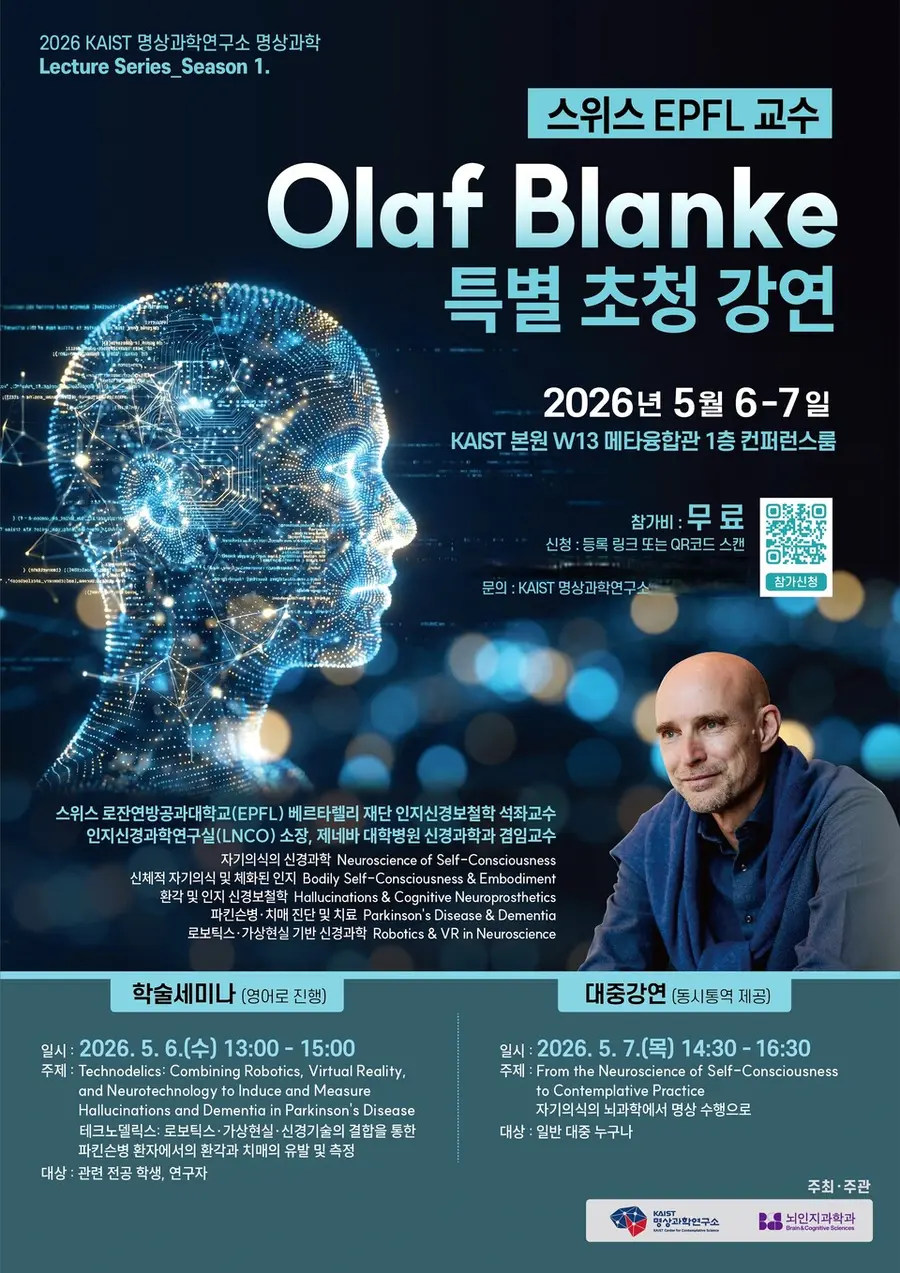
KAIST (President Lee Kwang-hyung) announced that, with the co-organization of the Institute for Meditation Science and the Department of Brain and Cognitive Sciences, it will invite Professor Olaf Blanke of the Swiss Federal Institute of Technology Lausanne (EPFL) to deliver a special lecture for two days, from Wednesday, May 6, to Thursday, May 7, at the KAIST main campus Meta-Convergence Hall Conference Room.
A Pioneer Who Opened Up the Neuroscience of Self-Awareness: Olaf Blanke
Professor Blanke is the director of EPFL’s Laboratory for Neuroscience and Cognition (LNCO) and an endowed chair professor of cognitive neuroprosthetics-philosophy at the Bertarelli Foundation. He is regarded as a leading figure in the field of the neuroscience of self-consciousness, which scientifically investigates how humans perceive their own bodies and selfhood.
He has explained phenomena such as hallucinations and altered sensations in which one’s own body feels like it belongs to someone else, using the language of neuroscience. Research demonstrating that by delivering specific stimuli to the brain with robotic devices and virtual reality (VR), even healthy individuals can experience hallucinations of someone being nearby—created a strong wave of attention in the academic community. This achievement has become key evidence for objectively measuring hallucination symptoms in Parkinson’s disease patients and for developing digital therapeutics.
Currently serving as an adjunct professor in the Department of Neuroscience at Geneva University Hospitals, he is also deeply involved in clinical practice. He continues to produce outstanding results in cognitive neuroprosthetics, a field that connects foundational laboratory research to real patient treatment.
Lectures Split into Two Tracks Over Two Days
This event will be held in two tracks: an academic seminar for professional researchers and a public lecture for general citizens.
ScheduleTimeSubjectAudienceMay 6 (Wed) 1:00 PMTechnodelics: Hallucinations and Dementia Induction and Measurement in Parkinson’s Patients Through the Combination of Robotics, Virtual Reality, and NeurotechnologyProfessional ResearchersMay 7 (Thu) 2:30 PMFrom the Neuroscience of Self-Awareness to Meditation PracticeGeneral Citizens
“Technodelics,” covered on the first day, is a portmanteau of Technology and Psychedelics. It points to a new research stream in which advanced technologies artificially recreate specific sensory experiences in order to analyze their underlying causes.
The Deep Place of Meditation, Interpreted in the Language of Science
The public lecture on the 7th begins from experiences that anyone who practices meditation has likely encountered at least once. When you enter deep meditation, there comes a moment when your sense of self changes, or when you perceive internal sensations such as breathing and heartbeats differently from usual.
Professor Blanke finds the cause of these changes in differences in how the brain integrates various sensory information from inside and outside the body. The lecture is also expected to introduce the latest research findings on how meditation practice reorganizes the brain’s networks for self-awareness and enhances mental health. It is a chance to hear directly on site how meditation, once considered a subjective experience, is expanding into the realm of objective neuroscience research.
Kim Wan-doo, director of KAIST’s Institute for Meditation Science, said, “This lecture, in which Professor Olaf Blanke explains the meaning of meditation firsthand from the perspective of a neuroscientist, will offer citizens who are interested in meditation scientific and deeply insightful perspectives.”
The lectures will be conducted with simultaneous interpretation in Korean, and the general public can attend at no additional cost.
Applications can be made via the KAIST Institute for Meditation Science guidance link and the QR code on the poster.