

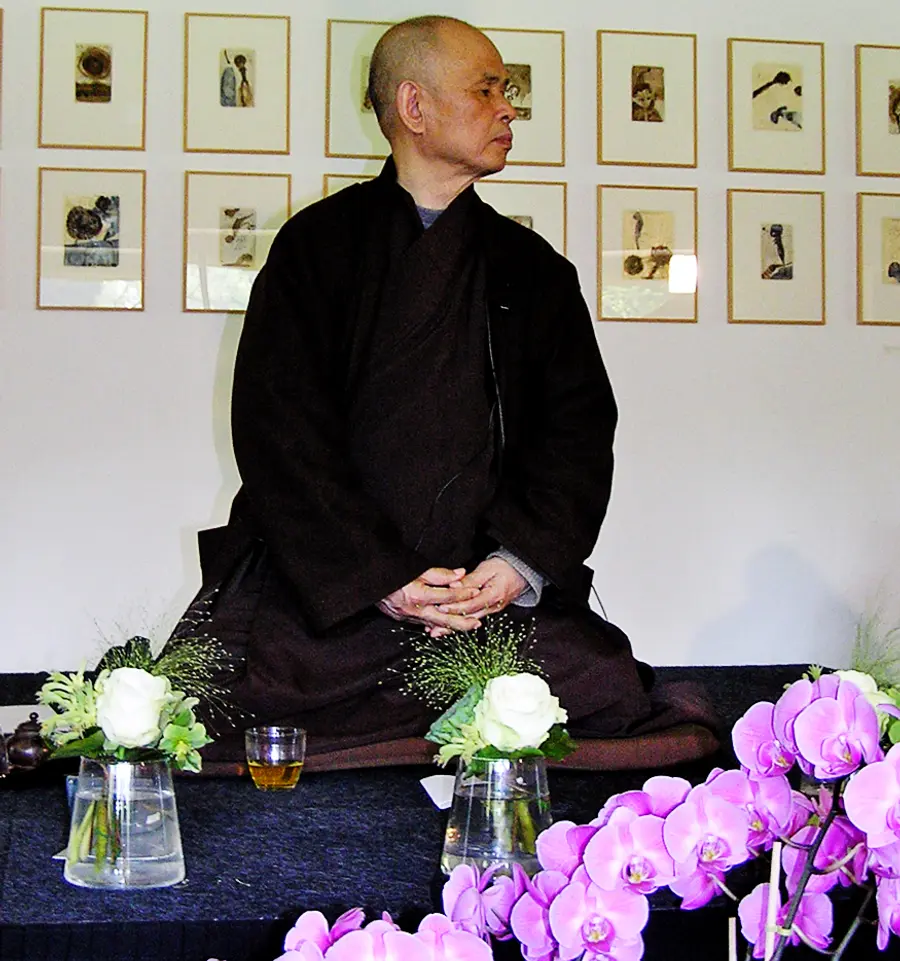
October 11 marked 100 years since the birth of Vietnamese monk Thich Nhat Hanh (1926–2022).
Thich Nhat Hanh has been described in many different ways.
Living Buddha, human rights activist, poet, Nobel Peace Prize nominee, bestselling author—seeing so many descriptions makes you realize just how much he accomplished.
Born in central Vietnam in 1926, he was ordained at 16. In 1961, he moved to the United States, where he studied comparative religion at Princeton and Columbia universities. After the Vietnam War broke out, he held gatherings opposing the war and launched peace campaigns. With Martin Luther King Jr.’s endorsement, he was nominated for the Nobel Peace Prize. He published more than 100 books, many of which became bestsellers in South Korea.
What are the two ways of washing dishes that the monk described?
One of his books recounts a conversation with his American friend Jim Forest. The monk said there are two ways to wash dishes. One is washing them to get clean dishes. The other is “washing the dishes to wash the dishes.”
It sounds like wordplay, but the idea is simple. The first person’s mind is already on what comes next: the tea they’ll drink after washing up, or tomorrow’s tasks. The second person is aware of their hands as they wash the dishes.
Mindfulness refers to this second state: knowing that you are doing what you are doing right now. The monk used dishes and water to explain this difficult idea.
The monk didn’t always enjoy washing dishes. According to a recollection shared by Plum Village, as a young monk he sometimes shared the work of preparing meals and washing dishes for more than 100 monks with just one other person. With no soap, they scrubbed with ash, rice husks and coconut shells; in winter, they had to heat cold water in a large pot. The task he once disliked later became one of his signature examples for explaining meditation.
Why did he send young people in wartime letters about meditation?
The book that popularized the dishwashing story was The Miracle of Mindfulness, first published in English in 1975. It began as a letter. While in exile, the monk wrote a long letter in 1974 to a colleague at the School of Youth for Social Service in Vietnam. The school was a relief organization he had helped establish, where young people working to help war victims came together.
The young people working amid the chaos of war didn’t need difficult theories. The letter offered practical things they could try right away, such as washing dishes, answering the phone and peeling an orange. For people facing urgent demands every day, being told to find a separate place to meditate would likely have been hard to put into practice.
The monk himself combined meditation and relief work during the war. He believed meditation was not a way to escape society. In 1966, he traveled around the United States and Europe to appeal for peace. Afterward, unable to return to his homeland, he spent 39 years in exile. King, whom he met that year, nominated him for the Nobel Peace Prize in 1967.
Thich Nhat Hanh, the father of mindfulness
In 2022, Mark Williams, an emeritus professor at the University of Oxford, told The Guardian that the monk was there at the very beginning, bringing mindfulness from East to West. He also said that mindfulness in the West would be different today without the monk’s influence. Williams is a psychologist who founded the Oxford Mindfulness Centre.
The Guardian also described how that influence spread. American psychologist Marsha Linehan carried the monk’s books in her pocket and drew on them in her research. Linehan’s work and advice influenced Professor Williams’ team as it incorporated mindfulness into a program to prevent depression from recurring. The letter sent to young people had made its way into psychology labs.
That does not mean the whole movement can be credited to one person. Researchers developed and tested the programs. The monk’s contribution was closer to translating meditation into everyday language and putting it in the hands of more people. Religious studies scholar Jeff Wilson also saw the pairing of everyday mindfulness with action in the world as an influence on the early mindfulness movement.
These days, meditation is also presented as a tool for doing your job better. The monk’s approach was somewhat different. Professor Brooke Schedneck of Rhodes College explained that, for him, mindfulness was not a way to make the day more productive.

What did he tell Google employees?
In 1982, the monk opened Plum Village, a meditation community in southwestern France. According to its official website, more than 10,000 people still visit each year. People meditate together there regardless of their religion or denomination.
Meditation also reached beyond the monastery. The monk’s community has provided mindfulness training to schoolteachers in Europe, the United States and Asia. He also led sessions for members of the U.S. Congress and lawmakers from the United Kingdom, Ireland, India and Thailand.
In 2013, he visited Google’s headquarters in the United States. According to The Guardian, he told employees that although we feel overwhelmed by information, we don’t need so much of it. That was 13 years ago. Those words sound even more resonant now, with AI producing answers nonstop.
In an age of information overload and less physical work, many people may find the idea of starting with long, silent meditation a high hurdle. The monk’s meditation begins with the hands, feet and breath. That is why it remains a useful entry point for modern people today.
The monk lost the ability to speak after a stroke in November 2014. He returned to Vietnam in 2018 and died on January 22, 2022, at the monastery where he had been ordained.
Why did people in front of Seoul City Hall walk slowly together?
His name is familiar to South Korean readers, too. The 2002 Korean translation of his book Anger became a bestseller, bringing his name to wide public attention. On March 22, 2003, he led a walking meditation with members of the public in a plaza in front of Seoul City Hall, praying for peace. The event was organized by civic groups including the Korea Green Foundation and People’s Solidarity for Participatory Democracy. It was a meditation with the public in a downtown plaza, not inside a temple. Some have said his visit helped spark a wave of walking meditation. He also returned to South Korea in May 2013 to give public talks and lead a retreat at Woljeongsa Temple.
This is what South Korea’s meditation community can learn from the monk: turning difficult ideas into simple language and sharing them in ways anyone can try today. If the many forms of Korean meditation are to meet the world under the name K-meditation, this attitude is essential. I hope the movement grows in that spirit.
How to begin a dishwashing meditation tonight
Based on the monk’s explanation, here’s a version tailored for beginners. It takes just three minutes.
1. Turn off your phone and music, and roll up your sleeves. If the water is cold, warm it up.
2. Put your hands in the water and notice its temperature.
3. Wash one dish slowly. Notice its weight and the movement of your hands.
4. As you breathe in, know that you are breathing in; as you breathe out, know that you are breathing out. Don’t deliberately control your breath.
5. When your mind wanders, don’t scold yourself. Return your attention to your hands and breath.
It cannot be said for certain that this meditation will eliminate anxiety or stress. Nor is it the right answer for everyone. If washing dishes feels like a chore, you can try brushing your teeth or walking instead. Give it a try and choose a meditation that works for you.
How about starting with three dishes tonight?
Article inquiries: fare3041@naver.com