

There’s always a book on the shelf like that. You’ve flipped through the first pages again and again, but you never get to the last page. Someday, when your mind quiets down, you promise yourself you’ll read it properly—so you pack that one book in your bag and sit down beside strangers to open it side by side for the evening.
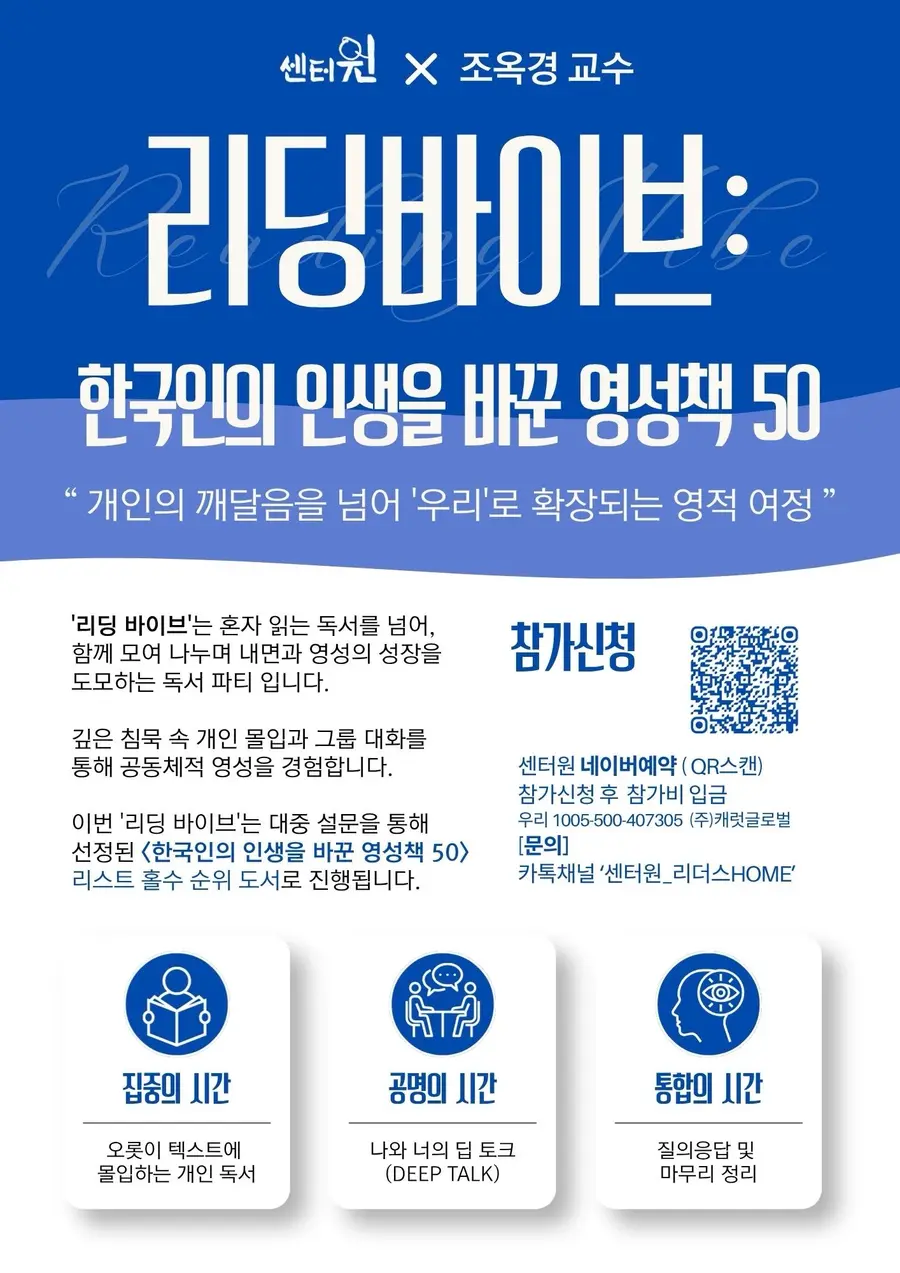
Center One Meditation Leadership Society is hosting a reading group, “Reading Vibe,” together with Professor Jo Ok-kyung. The event will take place on Friday, Aug. 28, from 7 p.m. to 9 p.m., on the third floor of Center One at 11 Sinheung-ro, Yongsan-gu, Seoul, and it will be guided by writer Kang Min-ji, author of the meditation “taste spot.”
Unfolding the books you read alone beside the breath of a stranger
Reading Vibe isn’t a format where people read in advance and then present their impressions. Instead, at the venue, each person takes out the book they brought, opens it and reads in silence, and then shares that afterglow with the person sitting next to them before the feeling fades. Organizers describe the gathering as a reading party that goes beyond reading alone—bringing people together to share and promote growth in inner life and spirituality.
The lack of any burden to finish the book lowers the threshold significantly. It also means that books you’ve been putting off for a long time fit this setting. An evening where you can start again from the pages you stopped at—no one asks you about it—is rarer than you might think.
An 1,300-plus response-chosen list: 〈The 50 Spiritual Books That Changed the Lives of Koreans〉
This round comes with the 〈The 50 Spiritual Books That Changed the Lives of Koreans〉 list selected by a public survey. Thirty organizations, including the meditation “taste spot” and Center One, co-hosted and collaborated. The list was created based on survey results conducted by Korea Research with more than 1,300 respondents.
Participants only need to choose one book among the odd-numbered ranks on that list and bring it with them. Among the odd-numbered ranks are Neal Donald Walsch’s 〈Conversations with God〉, Michael A. Singer’s 〈The Untethered Soul〉, David Hawkins’s 〈Letting Go〉 and 〈Revolutionary Awakening〉, Hermann Hesse’s 〈Demian〉, monk Beopjeong’s 〈無所有〉 (“Nothing to Possess”), Paramahansa Yogananda’s 〈Autobiography of a Yogi〉, Kim Sang-woon’s 〈Wahching〉 and 〈Mirror Meditation〉, and Kahlil Gibran’s 〈The Prophet〉, among others. Translations and domestic works, old classics and more recent buzz titles are all mixed together within a single list.
The moment you choose a book, the gathering is already under way. Some people will pick one up because the title catches their eye. Others will do it because, at a bookstore, their hands reached for the book several times before—only to put it back.
Three strands that flow through two hours: focus, resonance, and integration
The two hours are divided into three strands. The first 30 minutes is time when the group takes turns introducing the book each person plans to read. Then, for the next 30 minutes, individual reading—fully immersing in the text—continues, as a time for focus.
After a short break, participants split into small groups of two to three and share the passage they just read. This is the time for resonance, which the organizers have named “DEEP TALK.” The final 20 minutes fills up with integration, when everyone comes back together to share Q&A and wrap up the session.
The structure itself—read, speak, and then come back together—is designed like a single meditation practice. This gathering’s tagline, a spiritual journey that expands from individual realization into “us,” compresses that flow as-is.
Jo Ok-kyung, who has dealt with the language of the body, and Kang Min-ji, who found the taste for meditation
Professor Jo Ok-kyung, who leads the program, previously taught at the Seoul University of Buddhism Graduate School and served as an adjunct lecturer at the Catholic University College of Medicine. She has also served as chairperson of the Korea Meditation Society and the Korea Yoga Association. She currently serves as chairperson of the Korea Body-Mind Education Association. She is also a translator who rendered into Korean Ken Wilber’s 〈Integral Psychology〉, 〈Grace in the Everlasting Light〉, 〈Ken Wilber’s The Divine?〉, 〈The Most Beautiful Courage in the World〉, 〈Sung Saek Ecology and Spirituality〉, and 〈Eye of the Spirit〉. She is cited as one of the figures who helped create the language used in domestic spirituality discourse.
Writer Kang Min-ji became known for her meditation “taste spot,” 〈Meditation Taste Spot〉, where she compares and introduces the practices of world meditation teachers. She completed a master’s program in Seonhak (Seon Buddhism Studies) at Dongguk University. She is qualified as a meditation professional instructor through the Korea Meditation Leader Association and as a yoga teacher through the Korea Yoga Training Institute. She has worked as club manager for the Trevari reading group “Meditation, I’m Into This Taste” and as IPKU community director for the Mind Lab, and previously served as coordinator for the Wisdom 2.0 Korea community. The hands-on planner who has long worked on planning meditation gatherings is also behind this session.
On the hillside near Namsan, on the third floor where a different time flows
Center One, where the gathering will be held, is a meditation space that opened in August 2024 in Haebangchon. It’s only a few steps away from the noise of downtown, but once you open the door and walk in, it leaves you with the impression that the density of the air has changed. The space started with stillness and insight as its themes, which also aligns with the character of this reading group.
Imagine a Friday evening at the end of summer: climbing the hill, opening the third-floor door, taking a book out of your bag. The brief moment when reading you used to do alone becomes something you do together with others—when the sound of turning pages overlaps—that tightness is likely the sensation the gathering wants to deliver.
It’s okay even if you can’t finish the book
The word “spirituality” often feels far away. But when you look closely at the list of books that more than 1,300 people say changed their lives, you see that within it there are novels, memoirs, and also old collections of essays. In other words, experiences in life where your heart was shaken deeply at some point became another name for spirituality.
Reading Vibe is a place that says you don’t have to carry that shaking alone. On Aug. 28 in Haebangchon, an evening awaits where you can bring one book you couldn’t finish and a mind that hasn’t been put in order yet—just as it is.
Application link