

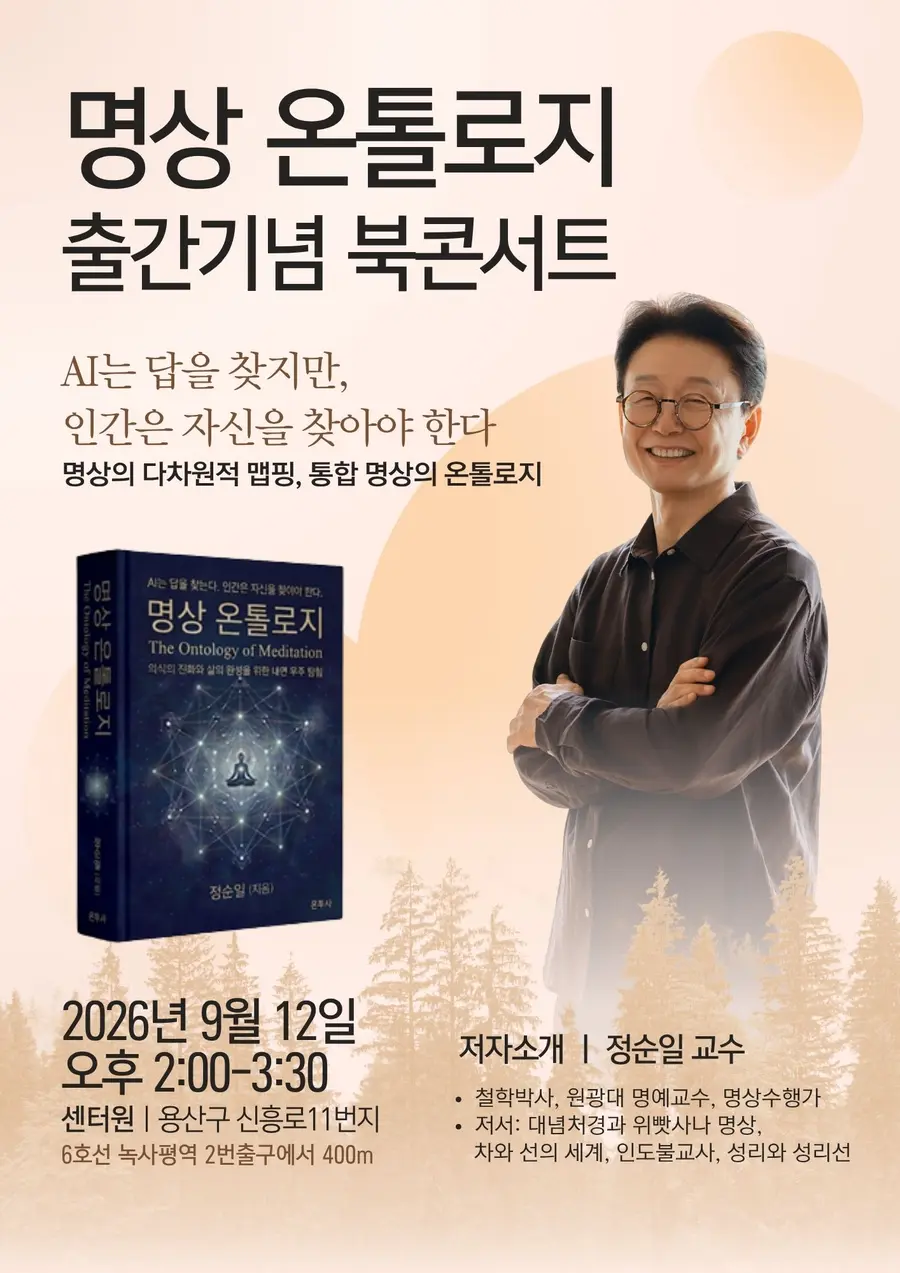
Meditation has become less unfamiliar. When you open an app, a voice guides your breathing; mindfulness has also made its way into corporate training and hospital programmes. Yet the longer you sit on the cushion, the more often you reach a point where you pause—at least once. Where is this practice heading? Where, in the whole map, does the seat I am sitting in right now belong? Even as you stand on the side that guides meditation, questions like these can make you fall silent for a moment.
『Meditation Ontology』(Unjusa), a new book by Jeong Sun-il, an honorary professor at Wonkwang University, is the book placed at that paused point. The subtitle is an inner-universe exploration for the evolution of consciousness and the completion of life. A philosophy doctor specialising in Buddhist studies and a long-time meditator, the author does not treat meditation purely as a technique for calming the mind. Instead, he puts the old question—who am I and how should I live?—at the very front. The book concert celebrating the book’s release will be held on 12 September at Wonhyo Village Centre One in Haebangchon, Yongsan-gu, Seoul.
A lifetime’s first question begins at a train station
It started with one scene. As a second-year high school student, he had an intense inner experience at the train station in his hometown and that moment left him with questions beyond it: what is the world over there, and who am I? Since then, he began practising danjeon breathing and mantra recitation and learned a range of meditation methods. As a Buddhist scholar, he has explored Buddhist practice theory alongside ideas from the East and the West, and meditation systems as well.
In his sixties, he set up a special vow and entered 1,000 days of vigorous practice. 『Meditation Ontology』 is the result of weaving together experiences and academic study that had been scattered before and after that practice into a single structure. In effect, the whole life of one person becomes the table of contents. That is also why the first sequence of the book concert is the narrative of the author’s journey of seeking.
Mapping meditation as existence, not as a technique
Ontology is an area of philosophy that explores the fundamental structure of existence, and today it is also used in the field of artificial intelligence as a concept for connecting scattered data to form a structure of meaning. The author believes that meditation also needs such work. There is no map that shows how practice methods, theory, and a person’s personal experiences link up, even though those elements are abundant.
So the book does not begin directly with breathing or concentration techniques. Only after looking first at the creation and change of the great universe, the structure of the human—this small universe—various layers of the mind, causation and karma, and life and death does it move into the world of meditation proper. In places where many meditation books ask what meditation is for, this book asks first what kind of being the person who meditates is.
Sati, samadhi, and the body
The author reorganises a complexly differentiated meditation theory back into two axes. One is sati, the power of wakeful observation; the other is samadhi, the power that gathers consciousness in one place. He then combines the issues of the body, energy and chakras to view meditation not as an activity of the mind alone, but as a practice in which body and mind, consciousness and energy move together. He calls this viewpoint “Bomind”, saying it does not split body and mind.
If you have ever practised, you will nod at this point. At every moment when consciousness changes, breathing changes too; the tension in your shoulders loosens; and the temperature in your body alters.
Emergence, reduction, and manifestation
The book’s distinctive composition lies in systematising meditation into three directions. Emergent meditation is a path that brings forth happiness and beauty in everyday life through kindness, compassion and creativity. Reductive meditation is a route that strips away obsession and a fixed ego, restores pure consciousness and energy, and returns to the source. One direction is to fill and unfold; the other is to empty and go back. Yet the author argues that the two paths together form a single whole. Manifestation meditation is the ultimate practice that becomes one with reality beyond that journey, covering the teachings of stillness and extinction, bodhisattvas, tonggak (equivalence in awakening), and myogak.
The author analysed early Buddhist sati practice in 『The Sutra on the Mindfulness of the Four Establishments and Vipassana』(Unjusa, 2021), and discussed the essence of ganhwa Seon in 『Seongri and Seongri Seon』. In 『The World of Tea and Seon』, he dealt with the cultural transmission of Seon Buddhism. 『History of Indian Buddhism』 is also one of his works. With this book, he has broadened that horizon to the cosmos and human beings, and to life and death.
AI may find answers, but humans must find themselves
The line the book concert puts forward is “AI may find answers, but humans must find themselves”. It is a moment that asks again who owns the question, at a time when no human can outpace a machine in the speed of finding answers.
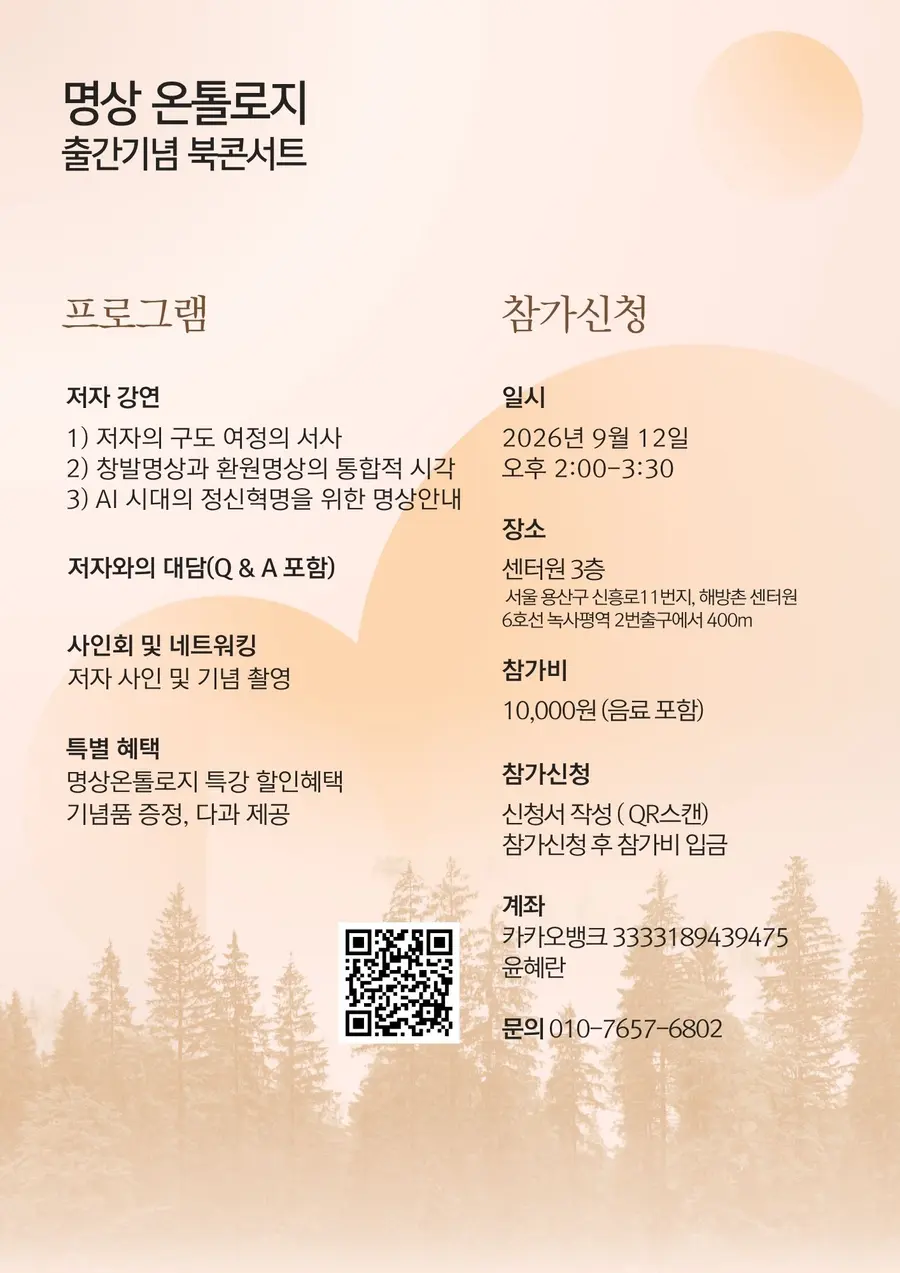
The event opens with a lecture by the author. It unfolds into three strands: the narrative of the author’s journey of seeking, an integrated perspective on emergent meditation and reductive meditation, and a meditation guide for a spiritual revolution in the age of AI. After the lecture, there will be a conversation with the author, including a question-and-answer session, and it will conclude with a signing session and a networking time. Participants will be provided with a discounted lecture pass on Meditation Ontology, a souvenir and refreshments.
The completion of meditation happens in the thick of life
Where the book ultimately leads is not the experience itself, in isolation. The author makes all life’s connections a field of kindness, and emphasises the horizon of daily-line practice that removes attachment amid the noise of everyday life. It is a story about how the completion of meditation is made not on a cushion, but right in the middle of the place where you live your life.
For readers encountering meditation for the first time, the book becomes a map for looking out to a wider world. For those who have practised mindfulness and vipassana, and experienced Seon and samadhi, it becomes a set of coordinates to place their own experiences back into the whole structure. The author says the same problem-consciousness also reaches middle-aged and older readers, who begin to ask again about the meaning of life as a whole beyond achievement. At the end of the book, he leaves one sentence: “We are not beings who must endlessly add what is lacking; we are beings who already hold the possibility of wholeness deep within. You are Whole.”
『Meditation Ontology』 book concert to celebrate the publication will take place from 2:00pm to 3:30pm on 12 September 2026 at the third floor of Wonhyo Village Centre One, 3 Sinheung-ro 11beon-gil, Haebangchon, Yongsan-gu, Seoul. It is 400m from Exit 2 of Noksapyeong Station on Subway Line 6. The participation fee is 10,000 won, including drinks. Registration is completed by writing the application form using the poster’s QR code, then paying the participation fee.
Event details
Date and time 12 September 2026, 2:00pm–3:30pm
Venue Centre One, 3rd floor (Sinheung-ro 11beon-gil, Yongsan-gu, Seoul, Haebangchon)
Participation fee 10,000 won (including drinks)
Apply via QR—fill in the application form and then pay the participation fee
Contact 010-7657-6802
