
In an era when meditation feels less foreign, opening an app can play a voice that guides your breathing, and mindfulness is now included in corporate training and hospital programs. But the longer someone sits on a meditation cushion, the more often they pause at some point. Where is this practice headed? Even while sitting in a place that offers guidance on meditation, the questions can make you go quiet for a moment.
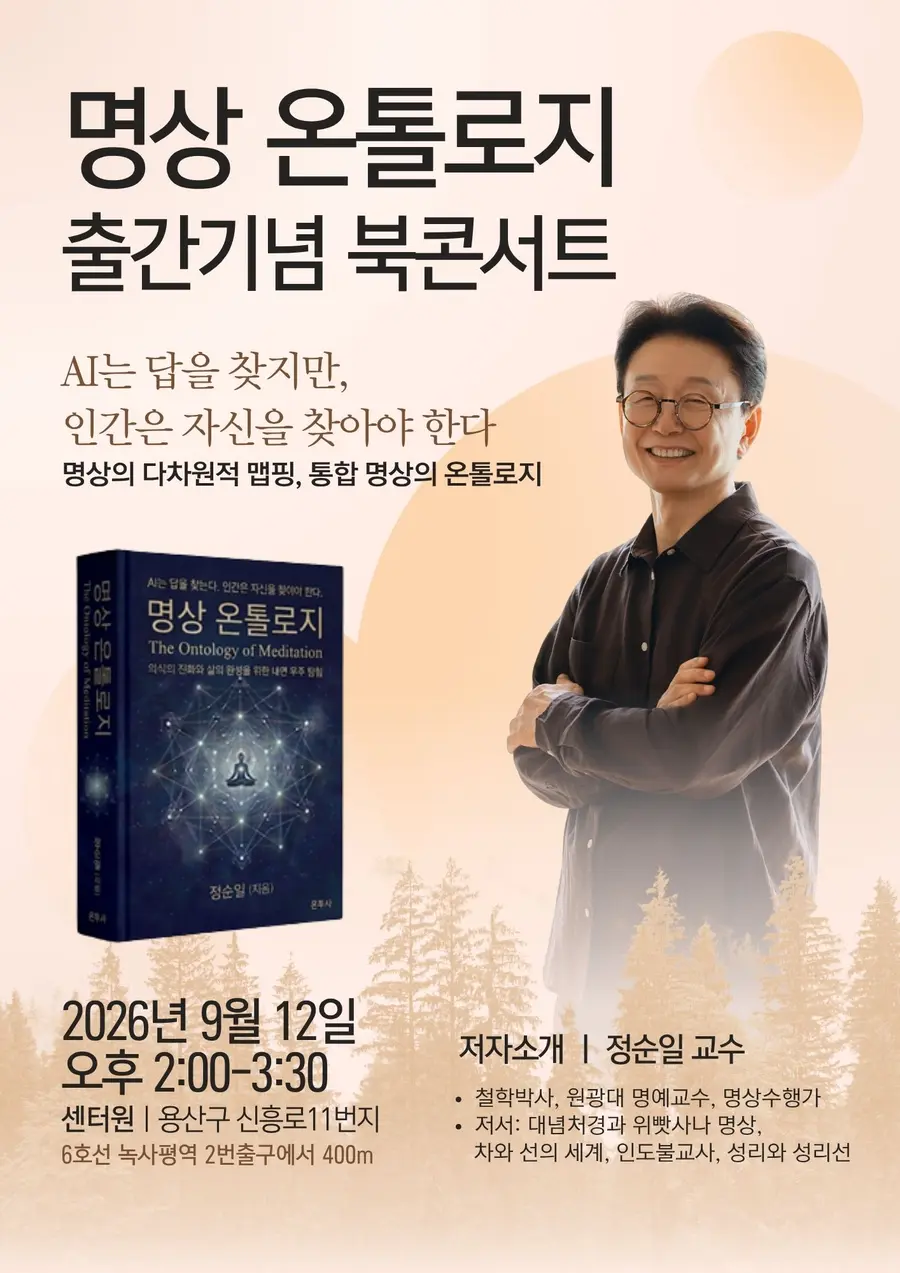
Meditation Ontology (Unjusa), authored by Jeong Soon-il, an emeritus professor at Wonkwang University, is a book set down on that paused spot. Its subtitle reads: an inner-universe expedition for the evolution of consciousness and the completion of life. The author, a philosophy Ph.D. who majored in Buddhist studies and has long been a practitioner of meditation, does not treat meditation as merely a technique for making the mind calm. Instead, she places a centuries-old question front and center: who am I, and how should I live? The book’s launch event will take place at Center One in Haebangchon, Yongsan District, Seoul on Sept. 12.
A Lifetime of Preoccupations Begun at a Train Station
The starting point was a single scene. When she was in the second year of high school, she had an intense inner experience at the train station back in her hometown, leaving behind questions for the author: what is the world beyond, and who am I? After that, she began danjeon breathing and mantra practice, learning several meditation methods, and as a scholar of Buddhism, she has explored Buddhist practice theory, East-West thought, and meditation systems together.
Around the age of 60, she made a special vow and entered a 1,000-day rigorous effort. Meditation Ontology is the result of weaving together the experiences and scholarship that had been scattered before and after that practice into a single structure. In effect, her entire lifetime became a table of contents. That is also why the first order of the book concert is a narrative of the author’s journey of spiritual cultivation.
Meditation as a Map of Being, Not a Tool
Ontology is an area of philosophy that explores the fundamental structure of existence, and today it is also used as a concept for connecting dispersed data in the field of artificial intelligence to create a structure of meaning. The author believes meditation also needs this kind of work. Her problem awareness is that although practice methods and theory abound, and personal experiences are plentiful, there is a lack of a map showing how they connect.
So the book does not jump straight into breathing or concentration techniques. It examines first the creation and changes of the great universe, the structure of the human being, a small universe, the various layers of the mind, causality and karma, and life and death—before entering the full-fledged world of meditation. In contrast to many meditation books that ask how to meditate, this book asks first what kind of being the human who meditates is.
Sati and Samadhi, and the Body
The author reorganizes a complexly differentiated theory of meditation into two axes. One is sati, the power to observe while awake. The other is samādhi, the power to gather consciousness in one place. She then combines the body, energy, and the issue of chakras, viewing meditation not as an activity of the mind alone, but as a practice in which body and mind, consciousness and energy move together. She calls this perspective, which does not separate body and mind, the philosophy of Bomind.
Anyone who has practiced will nod at this point. Whenever consciousness changes, breathing always changes too, the tension in your shoulders loosens, and the temperature of your body shifts.
Emergence and Reduction, and Manifestation
The book’s unique composition systematizes meditation into three directions. Creative meditation is a path that helps cultivate happiness and beauty in everyday life through compassion and mercy and through creation. Reduction meditation is a path that eases attachment and a fixed sense of self, restoring pure consciousness and energy and returning to the source. One direction is to fill and unfold, while the other is to empty and return—but the author argues that the two paths form one totality. Manifestation meditation is the ultimate practice that becomes one with reality beyond that journey, and it covers transcending suffering, the bodhisattva, engyo-gak, and myo-gak.
The author previously analyzed early Buddhist sati practice in
AI May Find Answers, but Humans Must Find Themselves
The line the book concert is built around is: AI may find answers, but humans must find themselves. In an era when humans cannot outrun the speed of finding answers, it is a chance to ask again who holds the steering wheel of questions.
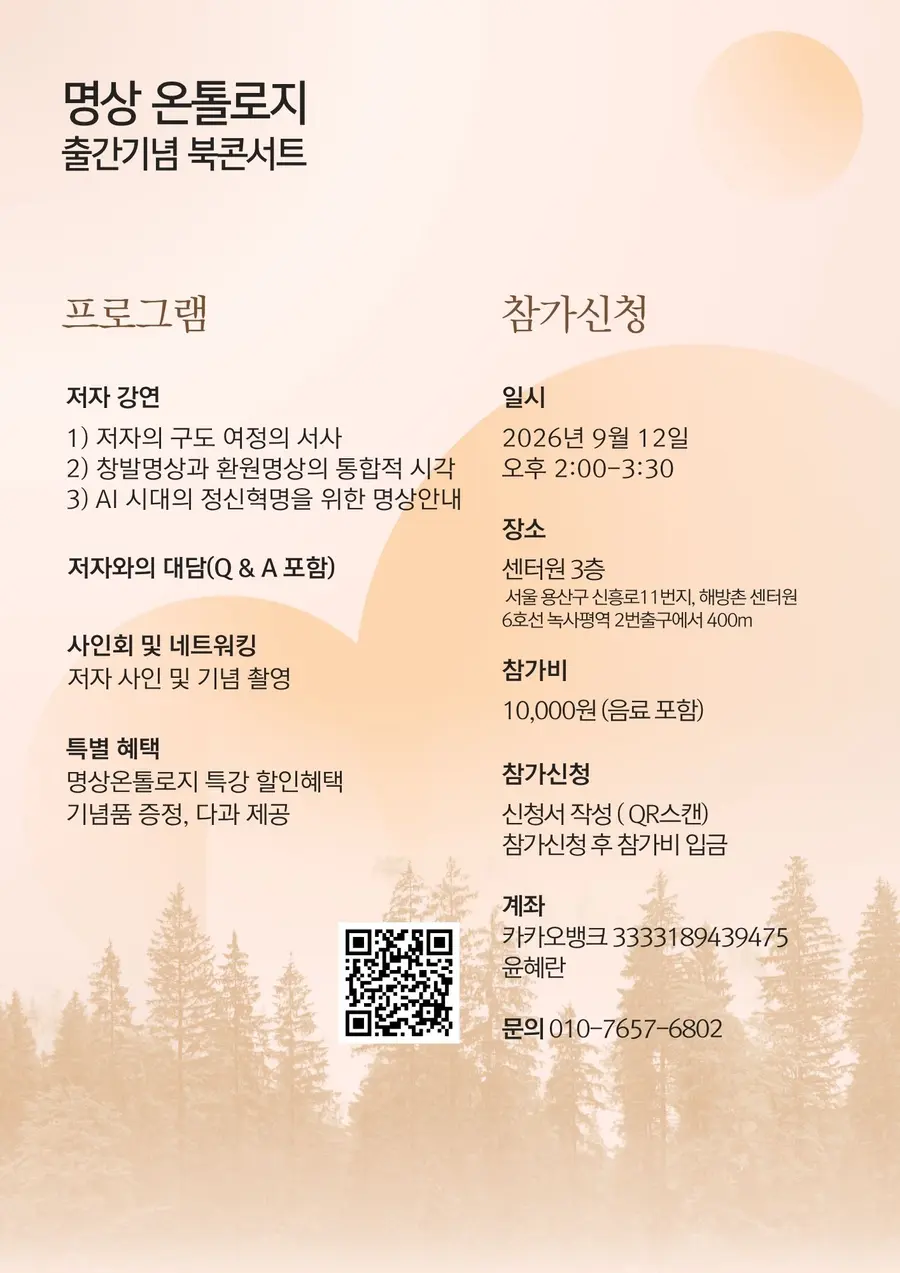
The event opens with a lecture by the author. It flows through three strands: a narrative of the author’s journey of spiritual cultivation, an integrated perspective on creative meditation and reduction meditation, and meditation guidance aimed at a mental revolution in the AI era. After the lecture, a dialogue with the author follows, including a question-and-answer session, and the program ends with a signing session and networking time. Participants are provided with a discount benefit for a special lecture on Meditation Ontology, as well as commemorative items and refreshments.
The Completion of Meditation Happens at the Heart of Life
What the book ultimately points to is not the experience itself. The author uses all the connections of life as fields of compassion, and emphasizes the horizon of living practice—removing attachment amid the noise of daily life. This is a story that meditation’s completion is achieved not on a cushion, but in the very center of where you live.
For readers encountering meditation for the first time, the book becomes a map for looking at a bigger world. For practitioners who have experienced mindfulness and Vipassana, Seon, and samadhi across the board, it becomes coordinates that let them place their own experience back into the entire structure. The author says even middle-aged and older readers who, after achievement, are drawn again to the meaning of life as a whole will find the issue awareness close at hand. At the very end of the book, the author leaves one sentence: We are not beings who must endlessly add on what is lacking; we are beings who already carry the possibility of wholeness deep within. You are Whole.
Event Information
Date and Time Sept. 12, 2026, 2:00 p.m.~3:30 p.m.
Location Center One, 3rd Floor (11-Il Sinheung-ro, Yongsan District, Seoul, Haebangchon)
Participation Fee 10,000 won (includes beverages)
Sign up after filling out the QR application form, then transfer the participation fee
Inquiries 010-7657-6802
