

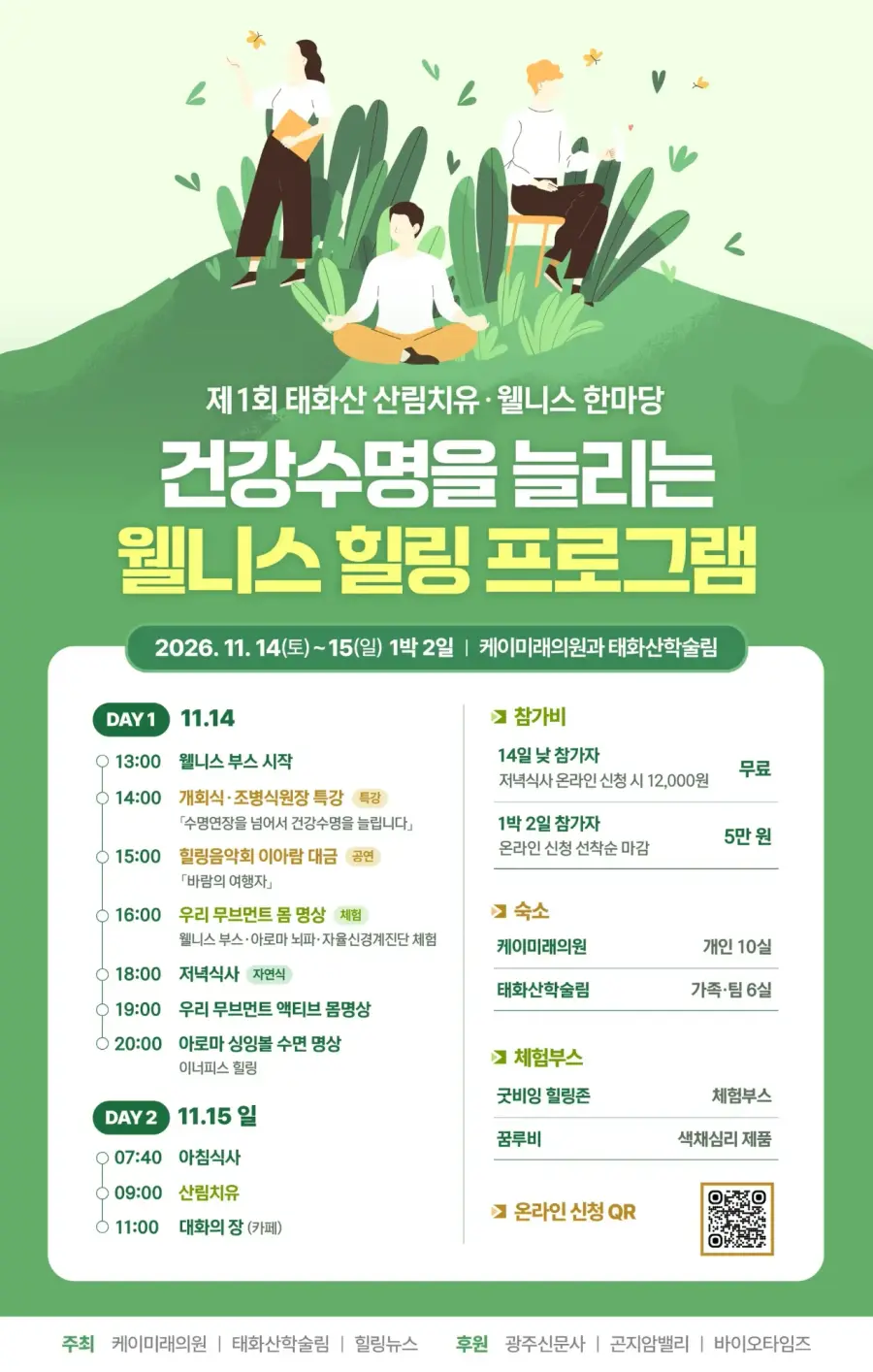
The first Taehwasan Forest Healing and Wellness Festival will take place from Saturday 14 to Sunday 15 November at K-Mirae Clinic, on the slopes of Taehwasan in Gwangju, Gyeonggi province. It is co-hosted by K-Mirae Clinic, Seoul National University’s Taehwasan Academic Forest and Healing News, a media outlet specialising in meditation, with support from Gwangju Newspaper, Gonjiam Valley and BioTimes. Under the theme of wellness and healing programmes to extend healthy life expectancy, the two-day, one-night event will feature health talks, traditional Korean music, body meditation and forest healing.
Despite being a first-time event, it has attracted a strong response. Accommodation, meals and experiential programmes were fully booked within two hours of registration opening. There are still opportunities to attend, however. The health lecture by Dr Cho Byung-sik and healing concert, both taking place alongside the opening ceremony on 14 November, are free to everyone, while visitors can sign up on site for free experiences at the wellness booths. Here is a preview of the day’s programme.
From meditation devices to brainwave assessments: wellness booths open at 1pm
The event opens at 1pm on 14 November with its wellness booths. Visitors can try meditation devices, have a brainwave and neurological programme assessment, and browse stalls selling meditation accessories—a chance to take a brief look at the state of their body and mind. Good Being Healing Zone will also take part, along with Kkum Ruby, which showcases colour psychology products. Booth experiences are free; sign up on site.
A doctor asks what it takes for cells to recover: a health lecture by director Cho Byung-sik
Following the opening ceremony at 2pm, Cho Byung-sik, director of K-Mirae Clinic, will give a health lecture focused on cellular regenerative medicine, entitled ‘Extending healthy life expectancy beyond simply living longer’.
Cho graduated from Pusan National University College of Medicine and has spent more than 20 years providing integrative medical care, chiefly to people with cancer and other chronic conditions. After winding down Natural Clinic, which he ran in Gyeongju for 18 years, he opened K-Mirae Clinic in Gwangju, Gyeonggi province, in 2023, combining natural and modern medicine. He is currently director of K-Mirae Clinic and Dr Cho Natural Healing Centre, and chairman of the K Regenerative Medicine Research Association. He is honorary president of the Korean Society of Natural Medicine and the Korean Society of Clinical Integrative Oncology. His books include 『Cho Byung-sik’s Natural Healing』, 『Stop Taking Medicine and Change Your Body』 and 『The Foolish Doctor Who Saves Cancer Patients』. This year, he published 『Regenerate Cells and Disease Can Be Cured』.
At the heart of the lecture is K Regenerative Medicine, an approach he developed. Drawing on natural healing and lifestyle medicine, it brings together functional medicine, Eastern medicine and epigenetics, with a focus on creating conditions in which cells can function properly again. Cho believes health problems begin when the cellular environment breaks down because of factors such as oxygen deprivation, nutritional imbalance, toxins and inflammation.
Lifestyle is an aspect that may particularly resonate with people who meditate. Cho sees diet, exercise, sleep, breathing and meditation not as supplementary measures but as key to maintaining the body’s balance. In the same vein, he has incorporated mind-body medicine, meditation and danjeon breathing into his clinical programmes, broadening his work into holistic healing that cares for body and mind together. For anyone wondering how to live well for longer, this is a chance to hear a doctor talk about breathing and meditation in the forest.

Daegeum in the forest: where will the traveller on the wind go?
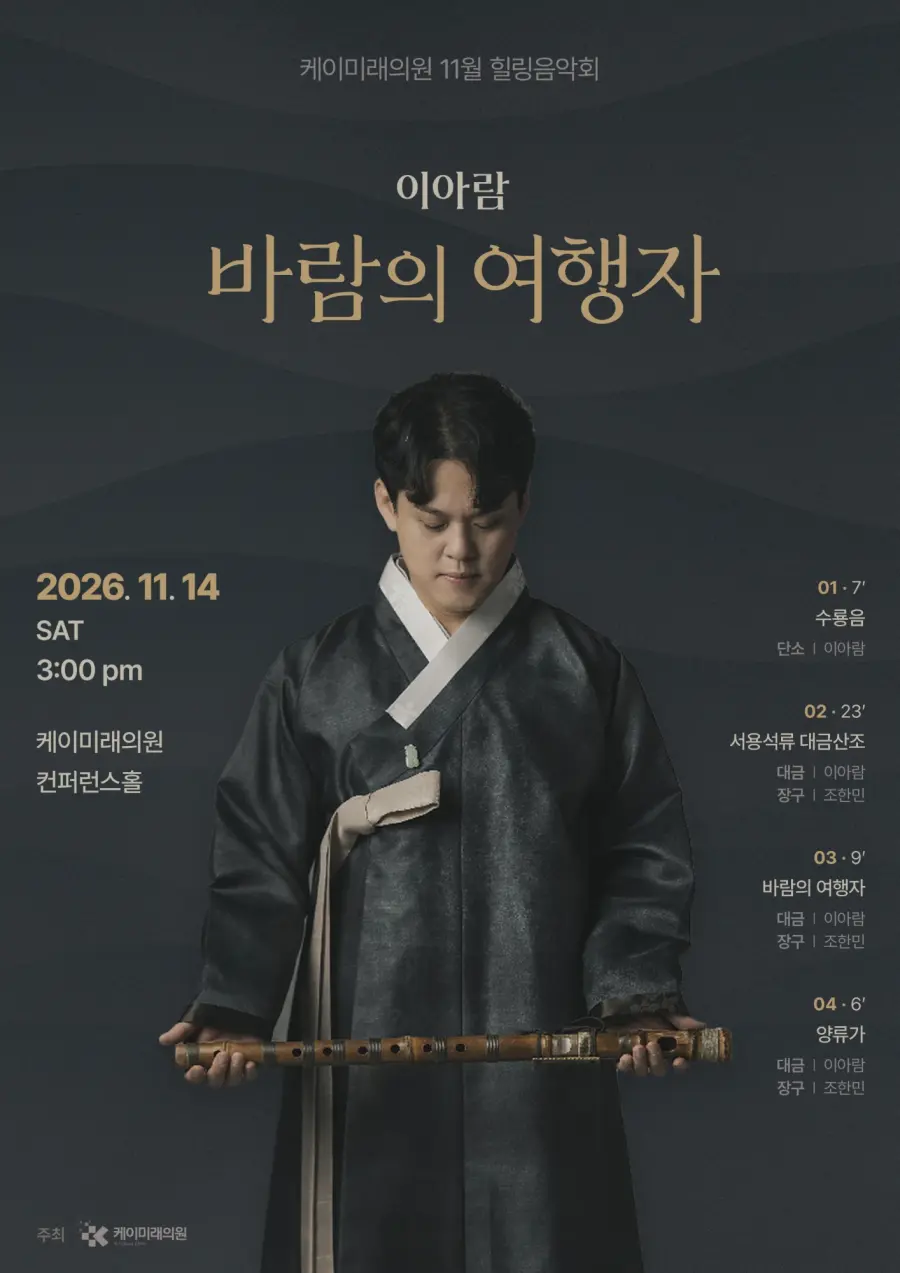
At 3pm, daegeum player Lee A-ram will present her healing concert, 「Traveller on the Wind」. After filling the mind with a health lecture, it is time to listen to the breath of a single bamboo flute in a woodland performance space.
Lee is a performer whose work centres on the traditional daegeum and crosses genre boundaries. According to a 2023 introduction to a performance by the Daejeon Yeonjeong Korean Traditional Music Centre, she has composed music and served as music director for more than 150 works spanning dance, mask dance, theatre, music theatre, installation art and street art. A member of the Korean contemporary music ensemble Baramgot, Black String and the music group Namu, she has performed at major festivals in more than 40 countries and has been described as an irreplaceable, all-round artist.
The performance comprises four pieces. The first, Suryongeum, opens not on the daegeum but on the danso. Its clear, fine sound sets the forest air in order. Next comes the Seo Yong-seok school of daegeum sanjo, the centrepiece of the programme at 23 minutes. Sanjo is solo music accompanied by janggu: it begins with a slow rhythm and gradually builds to faster ones, bringing the performer’s breath and fingertips to the fore. The janggu will be played by Cho Han-min.
The title piece, Traveller on the Wind, broadens the daegeum’s expressive range by drawing on the musical language of India. The final piece, Yangryuga, is a newly composed work inspired by the Gyeonggi folk song of the same name, offering a chance to hear how a familiar folk melody is reborn on the daegeum.
The daegeum makes a sound only when the performer breathes into it. As a long breath passes through the bamboo and becomes sound, following it to its fading end can naturally slow the listener’s own breathing. Simply letting the sound guide you, with no special preparation, can become a meditation in sound. Heard in the forest, deep in autumn colour in November, Traveller on the Wind will resonate differently from a performance in a concert hall.
Fatigue or emotion in your shoulders? Body meditation in the forest
At 4pm, Woori Movement will lead a body meditation session. Through a range of activities, participants will explore key parts of the body one by one, taking time to settle the sensations, emotions and thoughts that have built up there. It is an opportunity to get to know each part of a body we use every day but may never have truly felt.
Woori Movement is a team that has run workshops exploring relationships through the body. Drawing on developmental psychology, it takes inspiration from the Feldenkrais Method, which encourages close attention to sensation, and the principles of aikido, which involves moving in connection with another person. Rather than teaching set, ‘correct’ movements, the programme focuses on noticing what participants feel as they move.
After body meditation, dinner is set to be a vegetarian buffet, Healing Table, prepared with organic vegetables grown at K-Mirae Clinic’s Gyeongju branch.
Morning of day two: first, settle your breathing in a pine forest
The second day, 15 November, begins with breakfast at 7.40am. At 9am, a forest healing programme led by a forest healing instructor will take place in the academic forest’s pine woods, marked as a forest healing area on the event site map. Participants will follow paths between the tall, straight pines, feel the forest floor beneath their feet and slowly breathe in the clear morning air.
Forest healing is a concept defined by law. The Act on Forest Culture and Recreation defines it as an activity that uses the many elements of nature, including its scents and scenery, to strengthen the body’s immunity and promote health. Forest healing instructors are qualified professionals who have completed training at an institution designated by the Korea Forest Service. They develop and lead forest healing programmes in natural recreation forests, healing forests and woodland trails.
Forest healing programmes often begin by awakening the senses rather than with grand gestures. Participants slow their pace, shifting their attention in turn to the sound of leaves moving, the smell of the soil and the feel of the ground beneath their feet. The process of settling the breath and spending time in the forest is, in itself, much like walking and breathing meditation. For those who have loosened up through body meditation the day before, it offers a way to bring the day to a close in the forest.
Taehwasan Academic Forest has long been managed for research, making it difficult for members of the public to access. On 26 December last year, Gwangju City in Gyeonggi province and Seoul National University signed an agreement on using the ecological resources of Taehwasan Academic Forest. They agreed to create a healing forest there and jointly develop forest recreation and education programmes. As the researchers’ forest begins to open as a place of respite for the public, festival participants will have the chance to be among the first to walk through it.
The programme concludes with a conversation at the café at 11am. Participants will gather to talk about meditation and wellness, creating an opportunity to connect.
What’s happening where? A look around the woodland festival site
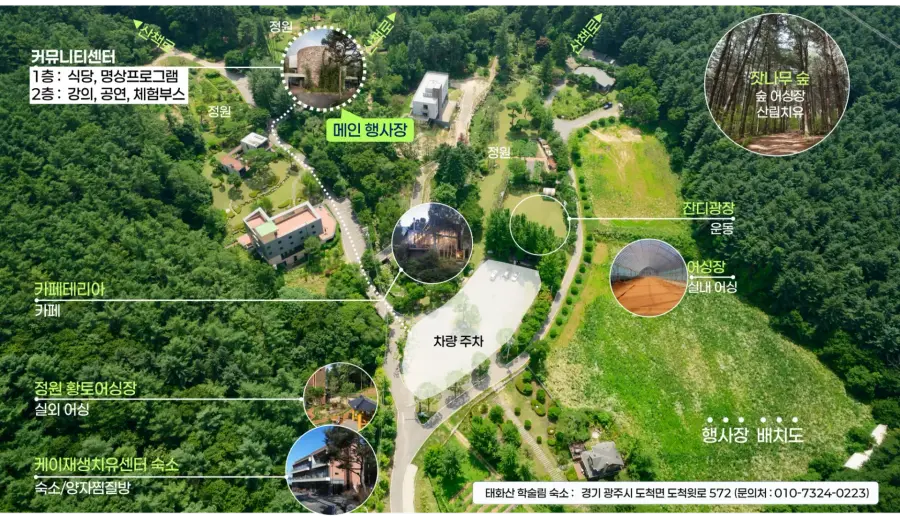
The main venue is the Community Centre. The first floor has a dining room and space for meditation programmes; the second floor houses lectures, performances and experience booths. Gardens and walking paths run around the building. The pine forest has a forest earthing area, while other facilities include garden and indoor earthing areas, a lawn and a cafeteria. Overnight guests will stay in separate Healing House accommodation, not in K-Mirae Clinic’s inpatient building.
To recap how to take part: the wellness booths, open from 1pm on 14 November, offer free experiences with on-site registration. The health lecture by director Cho Byung-sik at 2pm and the daegeum healing concert by Lee A-ram at 3pm are free to everyone. Registration has closed for experiential programmes such as body meditation and forest healing, as well as meals and accommodation. Enquiries: 031-798-6700.
Article enquiries: fare3041@naver.com