
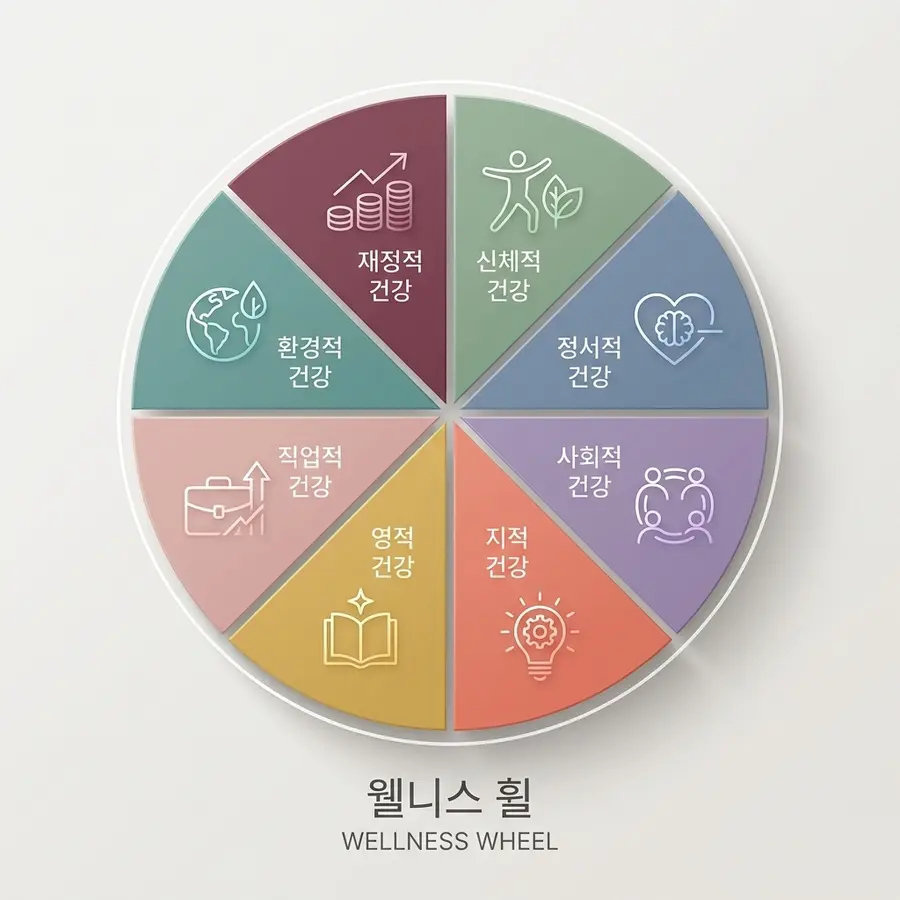
Have you been feeling empty and like your life is hollow, even though your body seems fine? That feeling is not an illusion. Simply not being sick and 'living well' are entirely different stories. Somewhere in between lies wellness.
And the most intuitive tool for checking wellness is the Wellness Wheel.
What is the Wellness Wheel?
The Wellness Wheel is a self-assessment tool that visualizes various areas of human life in a circular (wheel) format. Just like a bicycle wheel, if one spoke is short or broken, the entire wheel wobbles — this philosophy suggests that if one area of life weakens, overall well-being is affected.
This concept was first systematized by Dr. Bill Hettler from the University of Wisconsin in the 1970s. He divided wellness into six dimensions, and later, the Substance Abuse and Mental Health Services Administration (SAMHSA) added environmental and financial wellness, resulting in the currently most widely used Wellness Wheel with eight areas.
Wellness is about actively designing a vibrant and meaningful life, going beyond just the absence of disease (Health).
The 8 Areas of the Wellness Wheel — A Closer Look at Each
1. Physical Wellness
The most fundamental area. Regular exercise, balanced diet, sufficient sleep, and moderation in drinking and smoking are key. When the body is comfortable, there is energy to take care of all other areas. Physical wellness can be considered the 'engine' of the Wellness Wheel.
Self-assessment question: Do you sleep more than 7 hours a day? Do you move your body at least 3 times a week?
2. Emotional Wellness
The ability to recognize one's own emotions, express them healthily, and manage stress independently. The starting point of emotional wellness is the attitude of accepting emotions as they are, without suppressing or ignoring them. Living a life where you can cry when you want to and say you are happy when you are — is not as easy as it sounds.
Self-assessment question: Can you express your emotions honestly? Do you have your own way of recovering in stressful situations?
3. Intellectual Wellness
The fulfillment that comes from constantly learning, thinking, and thinking creatively. Studying for certifications, reading, attending exhibitions, learning new languages, and being interested in current events all fall under this category. The important thing is that it comes from curiosity that arises within, not from being told by others.
Self-assessment question: Have you learned or explored something new in the past month?
4. Social Wellness
A true sense of connection. The ability to experience belonging and support in relationships with family, friends, colleagues, and the community. A life without loneliness, where you can both receive and give help, has a strong impact on both lifespan and mental health.
Self-assessment question: Do you have someone you can contact when you are struggling? Are you maintaining meaningful relationships consistently?
5. Spiritual Wellness
It does not necessarily have to be religious. Feeling that your life has meaning and purpose, acting according to your own values, and maintaining inner peace — this is spiritual wellness. Meditation, contemplation in nature, journaling, and volunteering can all be ways to fill this area.
Self-assessment question: Is the direction and meaning of my life clear? Do I have my own beliefs and values?
6. Environmental Wellness
Understanding the relationship between the environment around me and myself, and the ability to coexist harmoniously with nature. An organized living space, eco-friendly consumption, contact with nature, and small practices for the planet all fall under this area. If you have experienced that when your space is organized, your mind is also organized, you have already sensed environmental wellness.
Self-assessment question: Is my living space psychologically safe and comfortable? Are there practices for environmental protection in my daily life?
7. Occupational Wellness
Finding meaning and fulfillment through work. It is not just labor for the sake of earning money, but when you are doing work that expresses your values and capabilities, occupational wellness is fulfilled. In an era where burnout is prevalent, deficiencies in this area accumulate silently and most commonly.
Self-assessment question: Does the work I am doing align with my values? Do I feel a sense of achievement at work?
8. Financial Wellness
The ability to manage the present and future in a balanced way, free from economic anxiety. The goal is not to become rich, but to create a stable state where life is not shaken by money. Recognizing spending habits, saving, and wisely spending where necessary are key.
Self-assessment question: Do I have financial flexibility that is not shaken by sudden expenses? Do I have savings or plans for the future?
My Wellness Wheel Checklist — Let's Check It Right Now
Read the items below and honestly check those that apply. You will start to see the balance in each area.
Physical — I exercise regularly / I do not overdrink or smoke / I get enough sleep / I eat a balanced diet
Emotional — I express my emotions healthily / I have ways to relieve stress / I accept myself / I have the strength to recover from negative emotions
Intellectual — I enjoy reading or learning / I enjoy new challenges / I engage in creative activities / I am interested in current events
Social — I have supportive relationships / I contribute to the community / I can ask for and receive help / I resolve conflicts healthily
Spiritual — I have a purpose in life / I act according to my values / I have time for meditation or reflection / I strive to grow even in difficulties
Environmental — My living space is pleasant / I frequently contact nature / I practice eco-friendly habits / I live in a safe and stable environment
Occupational — I find meaning in my work / I am utilizing my capabilities / I have a balance between work and life / I have opportunities for growth
Financial — I keep track of my income and expenses / I have savings or investment plans / I do not have significant financial anxiety / I am preparing for the future
Interpreting the Results
25-32: Overall balanced wellness state. You are at a stage of delicately refining vulnerable areas.
15-24: There are imbalances in some areas. It is time to fill in the missing pieces one by one to make the wheel round.
14 or fewer: There is a high possibility that your life energy is depleted. Start with taking care of yourself today, even in small ways.
You Don't Have to Aim for a Perfect Circle with the Wellness Wheel
When you first check the Wellness Wheel, most people end up with an imbalanced shape that is sunken somewhere. That is normal. No one draws a perfectly round circle. What matters is knowing which area is most needed for you right now, and taking steps to fill it from there.
Meditation fills spiritual wellness, and walking simultaneously enhances physical and environmental wellness. The practice in one area ripples out to other areas. The Wellness Wheel is an endless journey — a compass that shows direction, not a destination.
How about taking a moment today to look at the wheel of your life?