
As autumn deepens, trees do not struggle to hold on to their leaves. They let fall, according to their own weight, the leaves that gathered sunlight throughout the year, and meet winter with lighter branches. The human body cannot carry out this task as easily as a tree. As the end of the year approaches, the shoulders gradually rise, the back stiffens and the weight of everything held on to over the year accumulates, vertebra by vertebra. People often think the mind became tired first, only to look back and realise that the body had been sending signals much earlier.
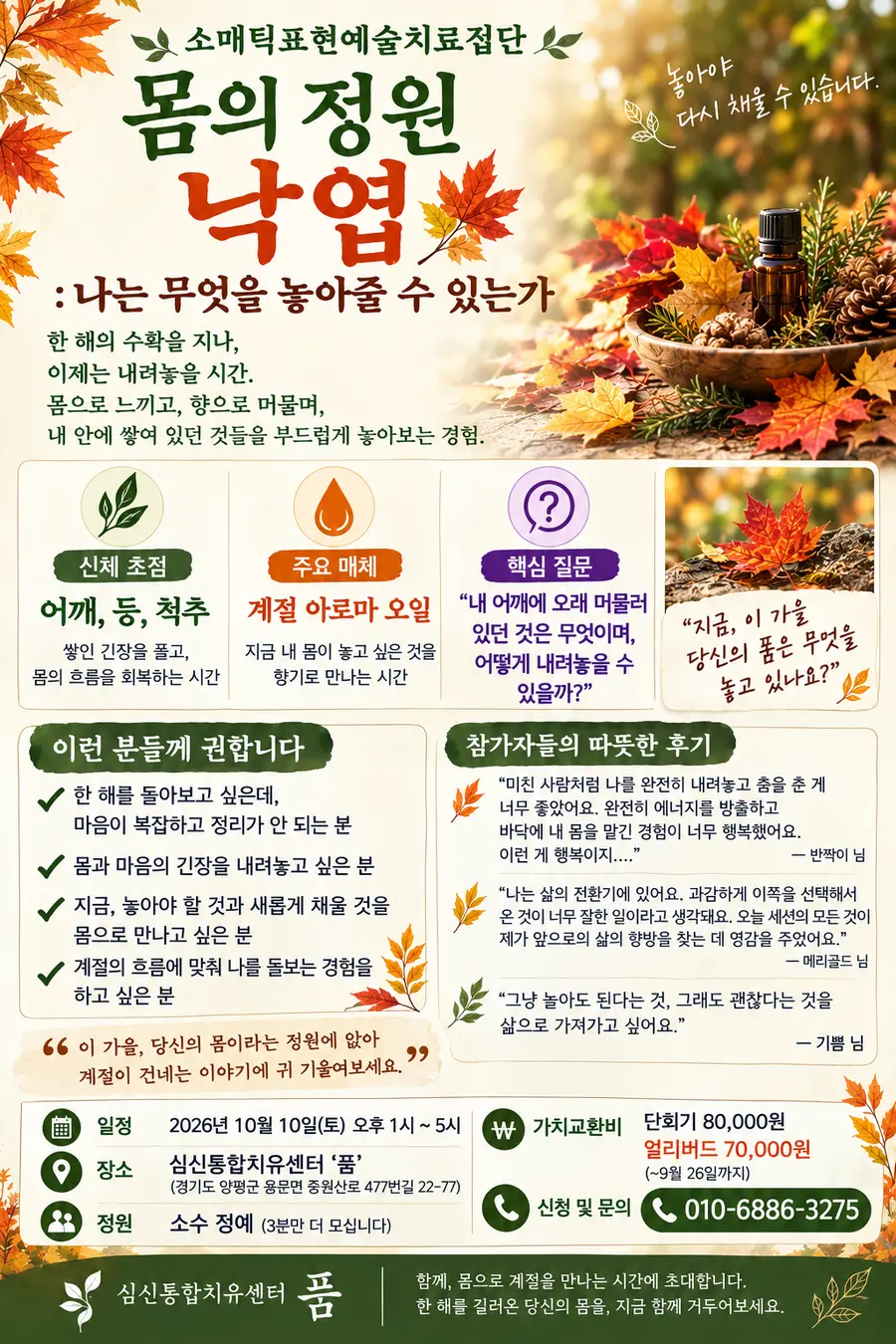
Garden of the Body: The Body of the Seasons, a somatic expressive arts therapy group programme held at Pum Mind-Body Integrative Healing Centre in Yangpyeong, Gyeonggi province, begins at precisely this point. It is a journey across four Saturdays, moving from autumn into winter and encountering the flow of the seasons through the language of the body. The programme completed its first session, Harvest, on 12 September and continues with its second session, Fallen Leaves, on 10 October.
Somatic expressive arts therapy: a time when the body speaks before the mind
Somatic comes from the Greek word soma, meaning body. Unlike conventional exercise or stretching, it focuses not on the body’s outward appearance in the mirror but on the sensations experienced within. Somatic expressive arts therapy involves staying with these inner sensations and bringing out the stories held by the body through media and creative practices that awaken the five senses.
Garden of the Body is led by Won Jeong-eon, a somatic psychotherapist and expressive arts therapist. Each of the four sessions focuses on different parts of the body and media, together with a single question. September’s Harvest remained with the hands and arms and the front of the upper body, using natural materials as its medium. October’s Fallen Leaves encounters the shoulders, back and spine alongside essential oils. November’s Frost and Roots addresses grounding through the pelvis, legs and feet, using singing bowls, while December’s Seeds and Hibernation explores the integration and centre of the whole body through tarot cards. The organisers said their working principle was to establish first the internal and external resources on which the body can safely rely before beginning deep relaxation and release work.
The September Harvest session: stories of the body discovered by participants
The question for the first session was: What have I cultivated? The participant accounts published by the organisers contain a series of small personal discoveries. Dolmeong-i said that, while confronting the movements of the hands and arms, they realised they had struggled in life to push, reach out and pull things towards themselves; releasing long-held energy brought a sense of relief and liberation. Neurit said that, while staying with a thorny chestnut burr, they felt that appearances were not the whole story, and experienced both apology and gratitude towards their body. Banjjagi said they felt deeply happy after completely letting go and dancing, releasing their energy before surrendering their body to the floor. Marigold, who is at a turning point in life, said choosing to be there so decisively had been the right decision, and that everything about the day had inspired them as they searched for a direction for the future.
Of all the reflections, one sentence from Gippeum stayed with me longest: the confession that they wanted to take into life the knowledge that it was all right simply to play, and that it was all right to do so. Noticing how tense the body has become, and giving oneself permission to play for a while. Perhaps what meditation teaches us ultimately comes down to these two things.
The October Fallen Leaves session: learning to let go through a scent that disperses
The year’s weight accumulated in the shoulders, back and spine
The question for the second session is: What can I let go of? Having passed through the season of reaching out and gathering in, participants now ask their bodies what has lingered on their shoulders for too long, and how they might release it. Anyone who has stood in front of a mirror at the end of the day can probably recognise that the shoulders are the first place to stiffen when we try to hold on tightly to something.
Cypress and cedarwood: autumn scents chosen directly by the body
The main medium in October is seasonal aromatherapy. Oils resembling the deep scents of fallen leaves and earth, such as cypress and cedarwood, will be prepared. The organisers explain that, when participants close their eyes and quietly breathe in the scents, the body itself chooses the one that resonates with what it most wants to release at that moment.
There is a reason scent is particularly well suited to this session. However tightly we try to hold it, fragrance flickers between our fingers before dispersing into the air. Watching something fade beyond our grasp becomes, in itself, an exercise in letting go. The message of this session is that there is no need to force anything away; it is enough simply to entrust the breath to the movement of the scent. Participants will receive a healing kit containing seasonal aromatherapy blending oils, inspirational poetry, reflection cards and a pouch, while tea and snacks will also be provided.
An invitation to know that it is all right not to force anything away
The organisers recommend this session to people who want to look back on the year but feel too emotionally tangled to make sense of it, those who want to release tension in body and mind, and anyone who wants to encounter physically what needs to be let go and what can be newly welcomed. The group will be limited to no more than eight people, creating an intimate setting in which participants can respect one another’s pace. After October, the journey continues with Frost and Roots on 14 November and Seeds and Hibernation on 12 December, asking alongside the body what should be protected and what should be planted in the space created by letting go.
A tree’s decision to let go of its leaves is not surrender but preparation for the next season. The message of this session — that we must let go in order to fill ourselves again — tells the same story. If you have walked this far through the year while holding something tightly in a corner of your heart, perhaps this autumn you can allow your shoulders to become a little lighter first. What were your shoulders holding on to today?
We welcome articles from meditation professionals seeking publicity.
Article enquiries: fare3041@naver.com