

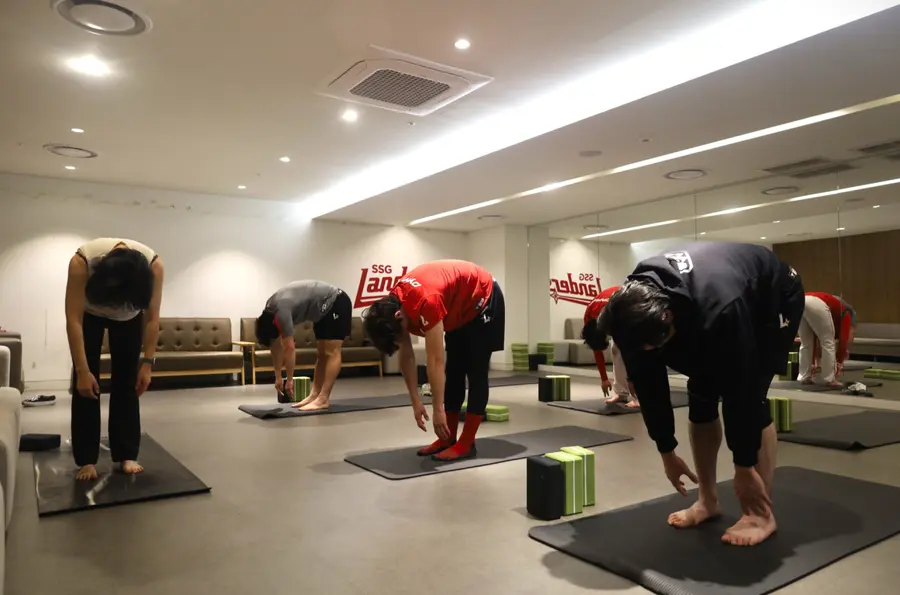
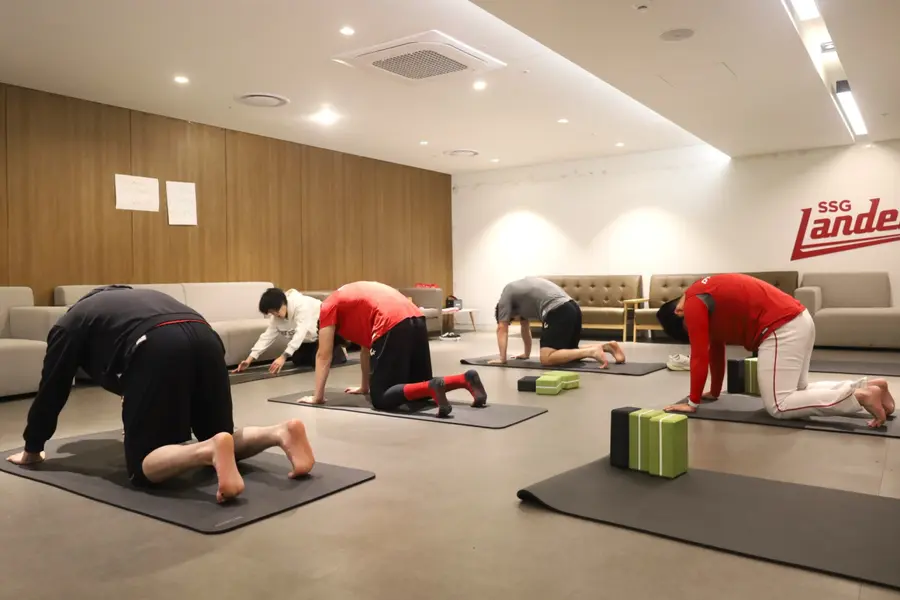
Professional baseball team SSG Landers is running an active recovery programme combining yoga and meditation for its recovery squad at Munhak Stadium (SSG Landers Field) in Incheon during the off-season. The sessions take place twice a week, with players taking part voluntarily. The aim is to ease muscle fatigue and tension built up over the season, reduce mental stress and help players start the next season in good physical condition.
While prospects and players with unfinished business have headed to a camp in Kagoshima, Japan, the recovery squad staying in Munhak includes key players who have put in a taxing year: this season’s captain, Tae-gon Oh; full-time starting shortstop Sung-han Park; and pitcher Byeong-hyeon Cho, who played in the World Baseball Classic and the Asian Games.
Why meditation comes last, after running and weights
The training is structured in three stages. First, running and conditioning build basic fitness; then weight training addresses muscle imbalances. Yoga, breathing and meditation come last. This session focuses on body alignment and joint mobility, as well as letting go of the mental tension accumulated over the season.
Active recovery uses light movement to help the body recover rather than resting completely. It follows a progression: gently stretching muscles that have been working hard, slowing the pace of the breath and, finally, resting both body and mind while listening to sound.
An anatomy-based yoga instructor and a 20-year meditation practitioner: two distinct roles
The club brought in two external instructors. One is a therapeutic yoga instructor specialising in physiotherapy and postural correction, who guides players’ physical balance and movement through anatomy-based poses.
The other is a meditation expert with more than 20 years’ experience. Alongside still yoga, they lead singing-bowl sound baths. A singing-bowl sound bath is a form of sound meditation in which the bowl’s resonances help relax the body and mind. For players who spend matches surrounded by cheering and tension, it provides dedicated time to focus on quiet sounds.
Captain Tae-gon Oh on the secret to feeling lighter
The players’ response has been positive. Oh said the programme was helping him shake off the mental stress and physical fatigue that had built up unnoticed during the season. As players gain experience, flexibility and joint mobility become increasingly important, he said; focusing on body alignment and breathing under expert guidance had left him feeling lighter. He also added that he was determined to put in a good performance next season.
Park said doing yoga alongside his usual training had been helpful because it allowed him to target muscles he did not normally use, down to a finer level. He said he was actively recovering by using his breath to release tight muscles deeply, and would rebuild his basic fitness for next season.
When people who put their bodies to work need meditation
Many people picture meditation as sitting for a long time with their eyes closed in a quiet room. The sight of professional athletes, who have put their bodies through the most over the past year, choosing meditation as the final step in recovery challenges that image. After moving their bodies thoroughly, they slow down through alignment and breathing, then finish by listening closely to sound.
Anyone who enjoys exercise can bring the same sequence into everyday life. After a run or strength workout, lie on a mat and spend a few minutes counting each inhale and exhale in a breathing meditation, or use the final relaxation at a yoga class as time to meditate. For those whose busy minds make sitting still difficult, a singing-bowl sound bath at a nearby yoga studio or meditation centre can offer an introduction through sound. For people who put their bodies to work, meditation is not a pause in exercise but a way to prepare for the next movement.
Article enquiries: fare3041@naver.com