

Sitting upright on a cushion and counting your breaths does not come easily to everyone. After a whole day spent chasing information on screens, the moment you close your eyes can often be when your thoughts grow noisier. So the ways into meditation are widening. Two popular options are sound baths, where you let the sound of singing bowls wash over you, and mindful colouring, where you fill in patterns with a pen or on a tablet. In October, reports and research covering these two practices emerged from universities in the UK and the US. Both offer accessible ways into meditation, but the strength of the evidence behind them differs considerably.
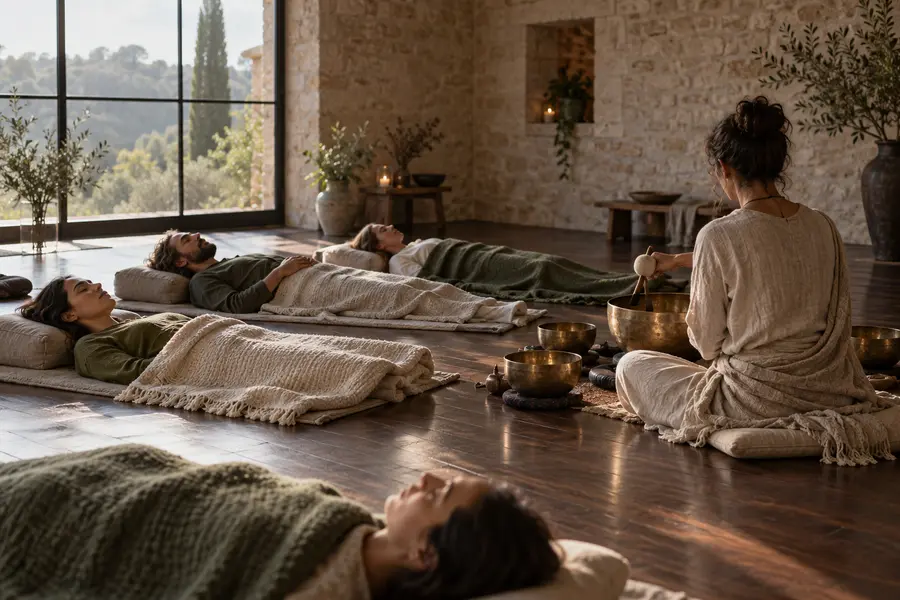
Thirty minutes lying down, but the science is still at an early stage
On 21 October, Northeastern University’s news team published a journalist’s account of trying a sound bath at its London campus. The session was part of an event for Mental Health Awareness Week. Around eight people lay on the floor for about 30 minutes, listening to the resonant tones of metal and crystal singing bowls and an ocean drum, whose beads roll to create the sound of waves. Students and staff who took part said they felt more relaxed and clear-headed.
In the same article, Professor Elizabeth Bucar of the Department of Philosophy and Religion at Northeastern University was cautious. The author of Beyond Wellness, a book about wellness culture, said sound baths were growing in popularity as a spiritual wellness practice, but the science of how sound affects the body was still at an early stage. The article also outlined theories that sound could alter brainwave states and help people relax, or stimulate the vagus nerve. These remain hypotheses.
The London-based sound-healing facilitator who led the session also said people’s responses varied. Some people, she said, felt nauseous or developed headaches. The journalist who tried it likewise said it was hard to expect lasting change from one session and felt it might take regular practice.
297 students tried colouring on their phones; paper made no difference
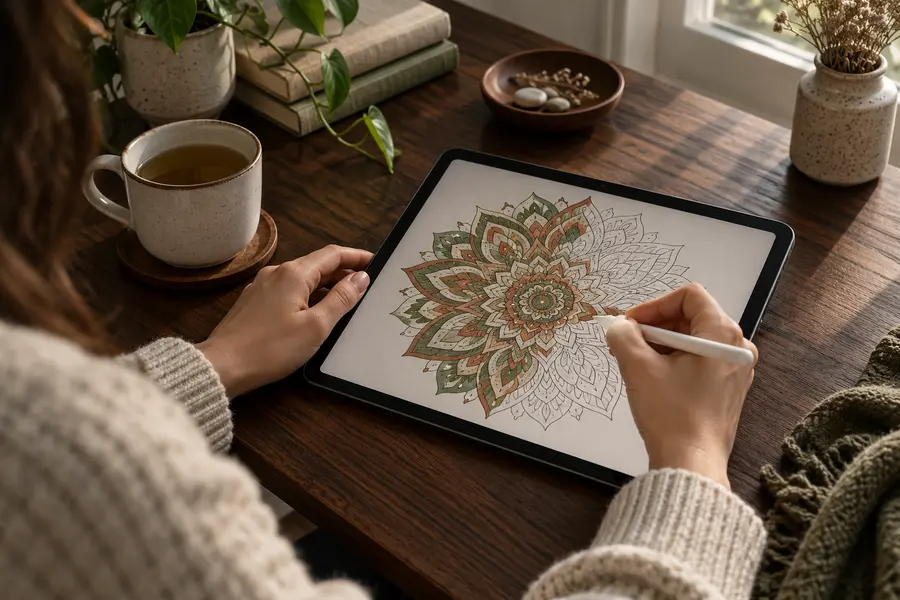
A more concrete set of figures emerged from research into meditation through hands-on activities. A team led by Associate Professor Emma Palmer-Cooper of the University of Southampton’s School of Psychology asked 297 university students aged 18–26 to do mindful colouring at least six times over two weeks. Of these, 134 used coloured pencils and paper, while 163 coloured using an app on a mobile phone or tablet. The results were published online in the Journal of Mental Health on 18 September, and the university issued a press release on 2 October.
Both groups reported reductions in stress, anxiety and symptoms of depression, alongside improvements in quality of life and mindfulness scores. Students who were worse off at the start showed greater improvement. There was no significant difference between paper and screen. The research team noted that focusing only on the harms of screen use could mean overlooking the potential for using devices to practise mindfulness. They also said that mindful colouring was a low-cost option, although it might not suit everyone.
The evidence carries different weight: how to read the numbers
Set side by side, the two reports reveal a clear difference. The sound-bath article recounted a single experience and included a scholar’s commentary; it did not present research measuring the practice’s effects. The colouring study went a step further, tracking nearly 300 people over two weeks and measuring changes through questionnaires.
The colouring study has clear limitations, too. The paper says participants were not randomly assigned; instead, the paper and digital groups were formed according to when they were recruited, making it a quasi-experimental design. There was no comparison group that did not colour, so the study alone cannot determine whether the improvements were due to colouring or simply to changes over time. The results also rely on students’ self-reported questionnaire responses. The most robust finding in the study is that both paper and screen were associated with similar improvements.
How to choose the right way in for you
That does not make gentle forms of meditation any less worthwhile. For people who find seated meditation daunting, sound, hands and colour can offer useful ways to start practising how to focus on the present moment. Those who are sensitive to sound and find it comfortable to lie down could try a sound bath; those who need to keep their hands busy to quiet their thoughts might start with colouring. Spending around ten minutes colouring on a phone during the commute can also be a way to practise managing your mind — welcome news for anyone tired of being told to switch off their screen.
However, it is worth taking another look at programmes that promise dramatic results. If you feel dizzy, develop a headache or feel uncomfortable during a sound bath, do not push yourself; take a break. There can be many ways into meditation. Trying a few and continuing, at your own pace, with what helps your body and mind feel at ease is a way to begin a lasting practice.
Editorial enquiries: fare3041@naver.com