
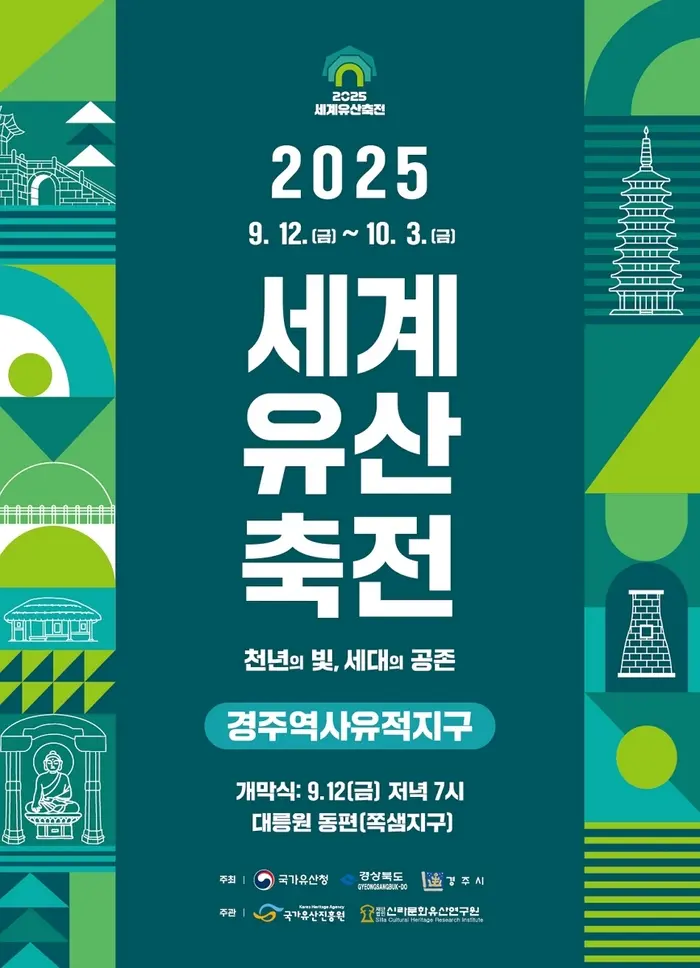
A Grand Epic Under the Theme of ‘The Light of a Thousand Years, Coexistence of Generations’
The First Festival Held Solely in Gyeongju, A Special Cultural Experience Where the Past Meets the Present
The ancient city of Gyeongju is once again drawing the world's attention. The ‘2025 World Heritage Festival Gyeongju Historic Site’ kicked off on September 12 and will continue for 22 days until October 3, showcasing a splendid stage throughout Gyeongju. This festival, co-hosted by the Cultural Heritage Administration, Gyeongsangbuk-do, and Gyeongju City, and co-organized by the Korea Heritage Foundation and the Silla Cultural Heritage Research Institute, holds special significance in many ways.
This is the first time Gyeongju has been selected as the sole host city for the World Heritage Festival, which is now in its sixth year since its pilot implementation in 2020. Gyeongju is home to four UNESCO World Heritage sites: Bulguksa and Seokguram (1995), Gyeongju Historic Site (2000), Yangdong Village, a historical village in Korea (2010), and Oksan Seowon, one of Korea's Confucian academies (2019), making it the city with the most World Heritage sites in the country.
This festival will reinterpret the splendid cultural heritage of Unified Silla in a modern way under the theme of ‘The Light of a Thousand Years, Coexistence of Generations.’ Notably, this year marks the 30th anniversary of the designation of Bulguksa and Seokguram as UNESCO World Heritage sites.
The Dream of the Revival of Hwangnyongsa, Recreated with Drones and Musicals
The opening ceremony was grandly held at the eastern side of Daereungwon in Gyeongju. Starting at 5:50 PM, the Daedongje parade began with a performance by the Silla Gojukdae, followed by the Gyeongsangbuk-do Intangible Cultural Heritage performances of ‘Cheongdo Chasan Nongak’ and ‘Yeongdeok Wolwol-i Cheongcheong,’ creating a magnificent spectacle with grand performances and lively tunes.
The highlight of the opening ceremony was the themed performance ‘Hwangnyong, Rise Again.’ From the founding of Hwangnyongsa in 553 AD to the coronation of Queen Seondeok, the construction of the Nine-Story Wooden Pagoda, and the ascension of Hwangnyong, the spirit of a thousand years of Silla was revived through magnificent stage art and dramatic direction. The grand finale featured a light show with 1,000 drones, depicting Hwangnyong and the Nine-Story Wooden Pagoda of Hwangnyongsa in the night sky, providing an unforgettable experience for the audience.
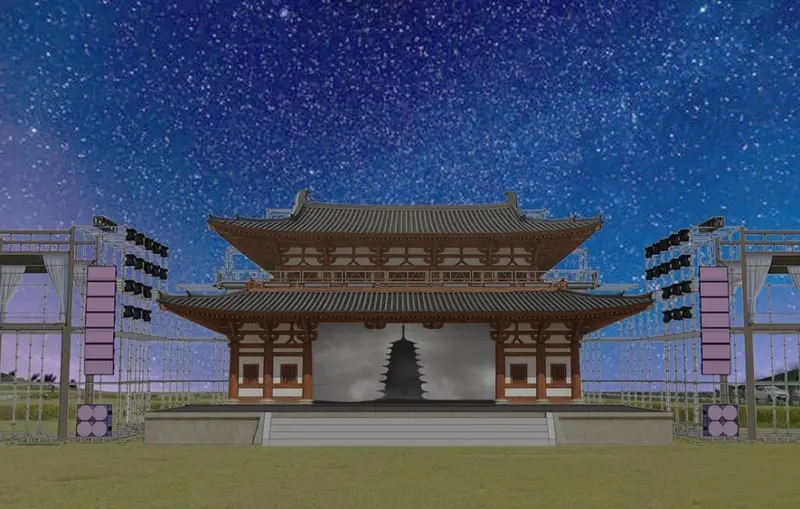
Modern Revival of the Silla Eight Festivals from the Samguk Yusa
On the evenings of the 13th and 14th at 7 PM, the ‘Silla Eight Festivals,’ a national event from the Unified Silla period based on records from 『Samguk Sagi』 and 『Samguk Yusa』, will be recreated through modern performing arts. This is a special opportunity to vividly experience the festival culture of the Silla people a thousand years ago. The biggest attraction of this festival is the experiential programs in special spaces that are usually restricted to the public. ‘Meditation Experience Inside Seokguram: ‘Finding Myself at Seokguram’ is a special program where only selected participants can meditate and pay respects inside Seokguram.
Meditation in this sacred space, which contains the origins of a thousand years of Silla, will be a spiritual experience in itself. In ‘Stories Written in Light IN Bulguksa,’ participants can walk on the Cheongun Bridge and Baegun Bridge, which are usually off-limits. Climbing the 16 steps of Cheongun Bridge and 18 steps of Baegun Bridge, a total of 34 steps, participants will experience a symbolic journey from the secular world to the world of Buddha.
Diverse Programs Across Gyeongju as the Stage
The festival will unfold across Gyeongju's World Heritage sites, including Seokguram, Bulguksa, Gyeongju Namsan, Wolseong, Daereungwon, Hwangnyongsa, Cheomseongdae, Yangdong Village, and Oksan Seowon. ‘Queen Seondeok’s Starry Night’ at Cheomseongdae is a program that reflects on the wisdom of Queen Seondeok while observing constellations at the observatory Cheomseongdae. In ‘Yangdong Village’s Night Stroll at Deokrakdang,’ visitors can enjoy the subtle ambiance of a traditional house from the Joseon Dynasty.
The Bunhwangsa Music Concert is an emotional performance that brings together moonlight, starlight, and people, transforming the serene ruins into a splendid stage. The ‘New Kushname’ performance presents a unique fusion show that combines Silla Hyangga and Cheoyongmu with Persian narratives. ‘Oh, Night of Silla’ is a storytelling tour that follows the birth legend of Kim Al-ji of Silla. Starting from Gyelim, this tour guides participants into the mysterious stories of Silla a thousand years ago.
Global Attention Ahead of the APEC Summit
This festival is being held just over a month before the 2025 Asia-Pacific Economic Cooperation (APEC) Summit, drawing international attention. Gyeongju City plans to expand the cultural diplomacy arena through this event, enhancing its status as a global cultural city. The World Heritage Festival is a representative project of the Cultural Heritage Administration that widely promotes the value of Korea's UNESCO World Heritage sites and shares their significance.
Since its pilot implementation in 2020, the festival has been held in various locations including Korea's Confucian academies, Jeju Volcanic Island and Lava Tubes, Baekje Historic Areas, Suwon Hwaseong, Andong, Yeongju, Gyeongju, and Suncheon, recording approximately 1.95 million visitors. This year, it will be sequentially held starting from Jeju (July 422), Gyeongju (September 12 to October 3), Suncheon (September 12 to October 3), and Gochang (October 222). This festival consists of a total of 22 programs, including the representative program ‘Hwangnyong, Rise Again.’
Through diverse immersive programs such as performances, academic events, experiences, and digital content, the festival will provide audiences with new cultural experiences. The festival expands heritage, which has remained in the realm of preservation, into performances, exhibitions, experiences, and digital content, presenting it as ‘living culture.’ It is creating new cultural content through the meeting of tradition and modern technology.
Sharing the Cultural Depth of a Thousand-Year-Old Capital with the World
Mayor Joo Nak-young stated, “The World Heritage Festival Gyeongju Historic Site is a festival that shares the cultural depth of a thousand-year-old capital with the world,” and added, “I hope that through the first World Heritage Festival held solely in Gyeongju, visitors will directly experience Gyeongju's World Heritage and remember the autumn of Gyeongju in a special way.” Director Ahn Tae-wook and Director Lee Je-hyung explained, “‘Hwangnyong, Rise Again’ is a work that brings the grand narrative of Silla Hwangnyongsa back to life on today’s stage,” and emphasized, “We focused on directing so that the audience can experience both the past and the present by unraveling the historical and symbolic aspects of the heritage in modern artistic language.”
This festival, which modernly reinterprets the glory of a thousand-year-old Silla, will be a precious opportunity to reflect on the true value and meaning of our cultural heritage beyond mere tourism. Special programs such as meditation inside Seokguram and experiences on Cheongun Bridge and Baegun Bridge in Bulguksa require advance reservations, so it is advisable to check in advance.
Gyeongju City has officially opened the festival's official website (https://gjwhf.kr/). It has been optimized for both PC and mobile, and multilingual support features have been added to significantly enhance accessibility for international visitors. The website systematically provides key information such as festival introduction, programs, festival site, and community, and allows searching for programs categorized by viewing, experiential, and tour types by keywords and dates. Detailed schedules and programs can be checked on the official website (https://gjwhf.kr/).