

Today, meditation is not limited to the practice of a specific religion. Modern individuals, exhausted by competition and speed, are turning to meditation to alleviate issues such as stress, anxiety, depression, and chronic fatigue, and meditation is now being recognized as a 'skill of the mind' that everyone should learn. Companies are introducing meditation programs for stress management among employees, and schools are conducting mindfulness classes to improve students' concentration. Hospitals are utilizing meditation as an auxiliary therapy to aid patients' recovery.
However, the techniques of meditation have not taken root everywhere. There are still many in our society who desperately need meditation but have not been exposed to it. Among them, the most marginalized are individuals with developmental disabilities. Individuals with developmental disabilities, who are among the most discriminated against among the disabled, suffer from mental health issues, substance dependence, and poor welfare environments. Especially after reaching adulthood, it is a reality that they struggle to find social roles or meaningful daily lives, living in isolation.
Interestingly, prior research abroad has reported that individuals with developmental disabilities can experience emotional stability and improved self-esteem through meditation, as well as alleviation of stress and anxiety, and improvements in behavioral issues such as sleep quality, eating habits, and aggression. Caregivers of individuals with developmental disabilities have also been shown to reduce parenting stress and emotional burdens and improve their quality of life through meditation. Meditation holds the potential to enrich the lives of not only individuals with developmental disabilities but also their families and the entire community.
Of course, there are several challenges for individuals with developmental disabilities to learn and practice meditation. For those who may have short attention spans and limited verbal understanding, the presence of a meditation guide is essential, and a delicate and specific approach is required, including the use of easy-to-understand language, familiar activities, and the introduction of physical movements. Additionally, for the effects of meditation to be sustained, consistent practice beyond short-term experiences must be supported.
Under this awareness of the issues, Mind Lab Corporation has begun a groundbreaking attempt at the vocational rehabilitation facility for individuals with developmental disabilities, 'Woori Village', in Ganghwa Island, Incheon.
A 40-Week Journey to Open the Door of the Mind
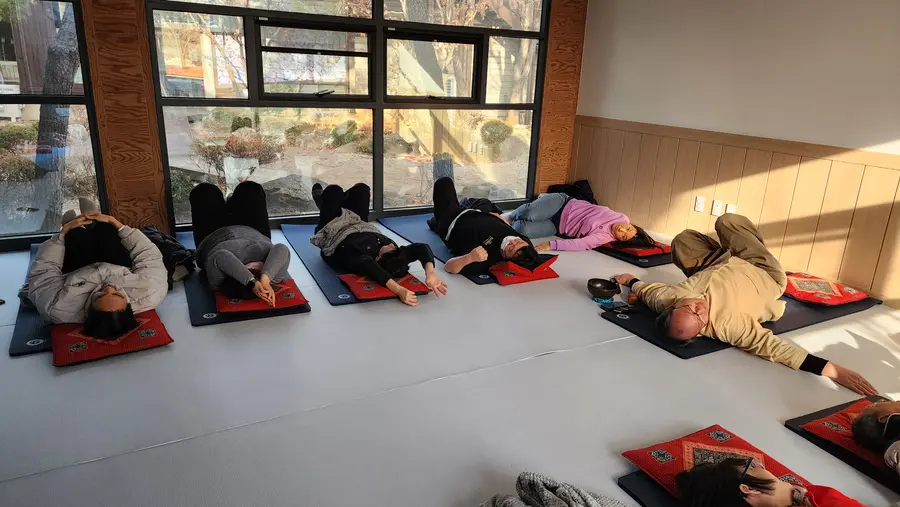
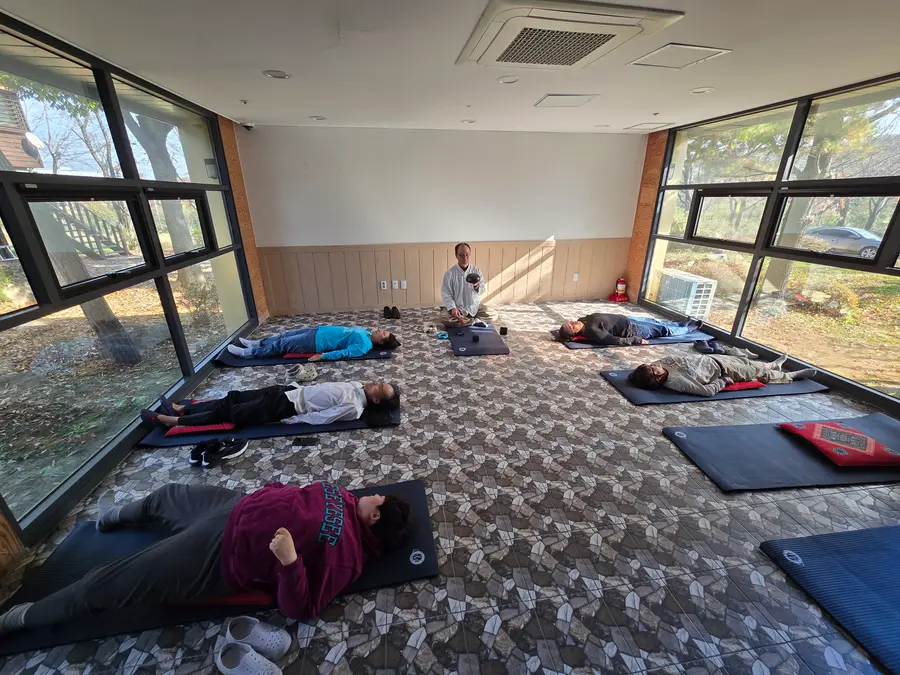
Every Wednesday, a special meditation class is held at Woori Village in Ganghwa Island. As participants lie on their mats and close their eyes, a gentle sound of bells fills the lounge. "I am precious and the best." "May I be happy." Following the gentle guidance of Professor Kim Jae-sung from the Graduate School of Mindfulness Psychology, individuals with developmental disabilities engage in loving-kindness meditation, wishing for their own happiness and the happiness of all beings.
On December 3rd, this meditation training marked its 40th session this year. Among the 9 participants, 6 were individuals with developmental disabilities, and they greeted Professor Kim with bright smiles as he entered the classroom. This was evidence that they had been eagerly awaiting the class. When this program first started, the reactions from those around were skeptical. "Can individuals with developmental disabilities concentrate on meditation?" However, now, after a year, small but meaningful changes are occurring here.
Meditation: A Necessary Rest for Everyone
Meditation is not simply an activity of sitting still. It is an active process of regulating and stabilizing the body, senses, emotions, and attention. Modern individuals easily lose their mental balance amidst the constant influx of information and stimuli. Focusing on breathing and observing one's inner self through meditation becomes a precious time to escape the noise of daily life and meet oneself.
Breath meditation stabilizes heart rate and breathing, restoring balance to the autonomic nervous system. Sound of bells meditation serves as concentration training that gathers a distracted mind, while loving-kindness meditation cultivates positive feelings towards oneself and others. Regular meditation practice is known to reduce anxiety and stress, improve emotional regulation abilities, and enhance overall quality of life.
In particular, loving-kindness meditation involves repeating phrases like "May I be happy" and "May you be happy," wishing for one's own and others' happiness. This is not just a simple mantra, but a process of confirming and nurturing heartfelt wishes that arise from deep within. Through such meditation, we can regain the leisure of life and restore our sense of connection with others.
New Possibilities Opened for Individuals with Developmental Disabilities
For individuals with developmental disabilities, meditation holds even more special significance. Individuals with developmental disabilities, who find it difficult to regulate emotions and are sensitive to stimuli, face various challenges in daily life. Sudden changes in the environment or unexpected situations can heighten anxiety, and at times, they may experience emotional outbursts that are difficult for them to control.
Meditation offers them an experience of "becoming friends with oneself." The process of focusing on breathing and feeling bodily sensations becomes the first step in looking inward and understanding oneself. Additionally, meditation can help reduce anxiety and improve concentration. Even short practices of focusing on one's breath, sounds, and movements can reduce distractions or repetitive behaviors and cultivate the ability to calm oneself.
Most importantly, meditation conveys the message to individuals with developmental disabilities that "it is okay to be just as you are right now." When there is someone quietly breathing alongside them, and accompanying them without words, meditation becomes an experience of healing and relationship building. When individuals with developmental disabilities meditate alongside others, they can feel each other's presence and experience a deeper connection than words can express.
A Quiet Innovation at Woori Village in Ganghwa Island
Founded in 2000 by Bishop Kim Seong-soo of the Anglican Church, 'Woori Village' in Ganghwa Island is a workplace and home for individuals with developmental disabilities. Here, individuals with developmental disabilities have cultivated independence by growing bean sprouts and making pencils from coffee grounds. One day, Bishop Kim thought, "Wouldn't it be helpful to teach meditation to individuals with developmental disabilities?"
After much contemplation, Bishop Kim sought help from Mind Lab Corporation. Director Cho Seong-taek of Mind Lab recalls that he was honestly worried. "Everyone was concerned about whether individuals with developmental disabilities could concentrate on meditation. Still, we started with the mindset of 'let's just try it.'"
In October of last year, the first meditation class began with 9 participants. Professor Kim Jae-sung carefully observed the daily conditions of individuals with developmental disabilities and flexibly adjusted the program. They focused their attention through sound of bells meditation and stabilized their minds through breath meditation. In loving-kindness meditation, they repeated phrases like "May my mother be happy" and "May my friend be happy," nurturing feelings of love.
At first, there was almost no response. However, as time passed, participants began to follow Professor Kim's words and started to express their own voices. When one participant said, "May the scarf lizard be happy," everyone laughed and shared that sentiment together. The pure wish to remember a small creature seen on TV and wish for its happiness warmed the classroom.
At the end of the 10 demonstration classes, 8 out of 9 participants expressed their willingness to rejoin. Consequently, from February of this year, the meditation class became an official program, firmly taking root beyond the 40th session.
A Miracle Made Possible by Togetherness
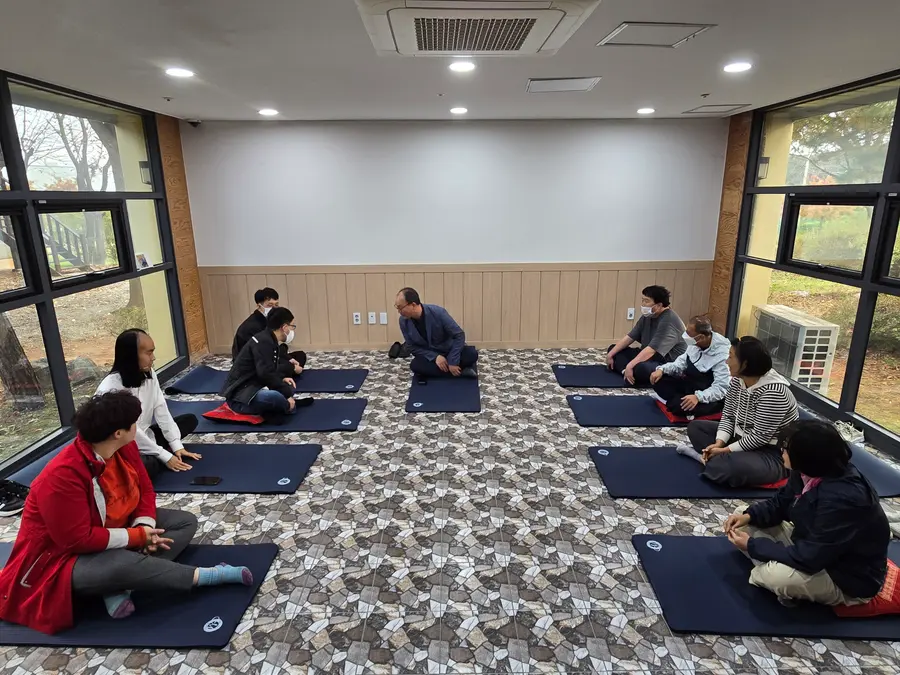
The core of the Woori Village meditation program is 'meditation together.' For individuals with developmental disabilities, meditating quietly alone can be challenging. However, when there is someone next to them providing stable relationships, presence, and support, meditation becomes a completely different experience.
Professor Kim participates as a 'companion' rather than a 'leader' in meditation. Instead of teaching or guiding, he sits quietly, breathes together, and shares the same movements. He breathes in sync with the participants' breathing and body movements, providing psychological stability with gentle smiles and eye contact.
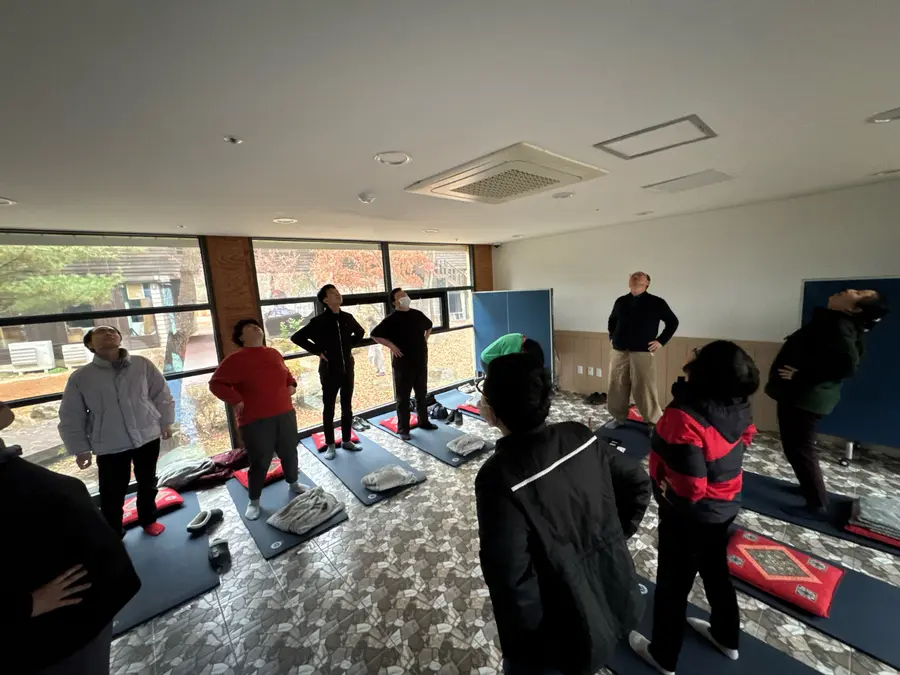
During the "tree meditation" time, participants lift one leg and stretch their arms to the side to maintain balance. They burst into laughter at each other's wobbling, but everyone waits and encourages those who lose their balance until they regain their center. This is the true meaning of a 'class created together.'
In "mountain meditation," they stand straight and repeat, "I am a mountain," and "My mind is calm and peaceful like a mountain," recognizing themselves as a solid mountain. Although it was a short time, peaceful smiles bloomed on the participants' faces.
The last part of the class is "eating meditation." They slowly bite into apples and snacks, fully focusing on the taste, texture, and the process of chewing and swallowing. The lounge, which had been filled with laughter just moments ago, fell into silence. One participant said after the class, "I really enjoyed the time wishing for my mother to be happy."
The Highest Barrier of Prejudice
Mind Lab Corporation has systematically organized the meditation classes at Woori Village into a 'Meditation Guide for Individuals with Developmental Disabilities' and is distributing it for free in welfare settings. However, the wall of prejudice remains high. The doubt of "Can individuals with developmental disabilities concentrate on meditation?" does not easily dissipate.
Director Cho Seong-taek firmly states, "It has been confirmed in the field that meditation has increased the self-esteem and anger regulation abilities of individuals with developmental disabilities. This will enhance the happiness of not only the individuals but also their families and facility staff."
Professor Kim Jae-sung cited the participants' growing interest in meditation as the greatest achievement. "At first, there was almost no response. But as time passed, they began to follow my words and express their own voices. In the future, I would like to do 'walking meditation' with the participants."
Professor Jo Kyung-jin of Korea Cyber University identifies training meditation leaders as an urgent task. "We need to secure enough leaders to quickly respond to the demands of facilities. Especially if facility staff and parents directly experience meditation and feel its effects, they can actively encourage participation from individuals with developmental disabilities."
Towards a World Where It's Okay to Be a Little Slow
Lee Jeong-eun, the secretary of Woori Village, shared an unforgettable moment. "One individual with developmental disabilities who participated in the meditation class expressed great satisfaction in wishing for their mother to be happy. I felt that the meditation education for individuals with developmental disabilities, which many considered 'impossible,' could become a program that Woori Village, Mind Lab, and individuals with developmental disabilities are all waiting for."
Mind Lab's meditation education aims to enhance concentration, compassion, and wisdom. Interestingly, this meditation education, which has a Buddhist color, is taking place at Woori Village, a facility based on the Anglican Church, showcasing a beautiful example of interfaith collaboration. Director Cho Seong-taek emphasized, "While dialogue between religions has been verbal, the meditation education at Woori Village is a concrete outcome of interfaith dialogue."
Precious Fruits of Experience in the Field
Based on over a year of experience and research results, Mind Lab has published the 『Meditation Guide for Individuals with Developmental Disabilities』. This is the result of systematizing all processes of the program conducted weekly for 50-60 minutes by Professor Kim Jae-sung as a meditation guide, along with qualitative research conducted by Dr. Jeong Byeong-eun and Dr. Jo Kyung-jin through participatory observation and face-to-face interviews.
This guide is compiled in a manual format based on qualitative data regarding the necessity and effectiveness of meditation for individuals with developmental disabilities, including precautions during education, attitudes of guides, and specific methods that can be utilized in the field. Above all, this book was born with the hope that meditation can enrich the lives of not only individuals with developmental disabilities but also their families and the entire community.
Mind Lab is distributing this guide for free in the welfare field for individuals with developmental disabilities. This is with the hope that it will provide practical help to practitioners, meditation leaders, and researchers working in the field of welfare for individuals with developmental disabilities. For inquiries, please contact via email (admin@mindlab.or.kr). This will serve as a starting point for the ongoing meditation program for individuals with developmental disabilities, with plans for continuous improvements in the future.
Beautiful Changes Created Together
The 40-week journey has clearly shown one thing. Individuals with developmental disabilities are not incapable of meditation; they can do it sufficiently when there is someone to 'do meditation together' in a way that suits their characteristics. And when there is a relaxed attitude of "it's okay to be a little slow," and acceptance of "it's okay to be just as you are right now," things that seemed impossible become a reality.
Wednesday afternoons at Woori Village in Ganghwa Island have now become a special time. The sound of bells rings, breaths flow evenly, and the words "I am precious and the best" quietly resonate. This small miracle, where individuals with developmental disabilities and non-disabled individuals sit together, feel each other's presence, and share peace of mind, shows the true integration and coexistence that our society needs.
Meditation is not about pursuing perfection. It is about looking at and accepting oneself as one is in this moment. The message conveyed by the meditation program for individuals with developmental disabilities is clear. We all live at slightly different paces and in our own ways, but when we are together, the journey becomes more beautiful and meaningful. And in that journey, we are all "precious and the best."
I sincerely hope that more individuals with developmental disabilities can discover the tranquility and peace within themselves through meditation. And I wish that such attempts spread throughout our society, creating a warm community where no one is left behind.
The 『Meditation Guide for Individuals with Developmental Disabilities』 compiled by Mind Lab is available for anyone to download and can be found on the Mind Lab Corporation website. https://mindlab.or.kr