

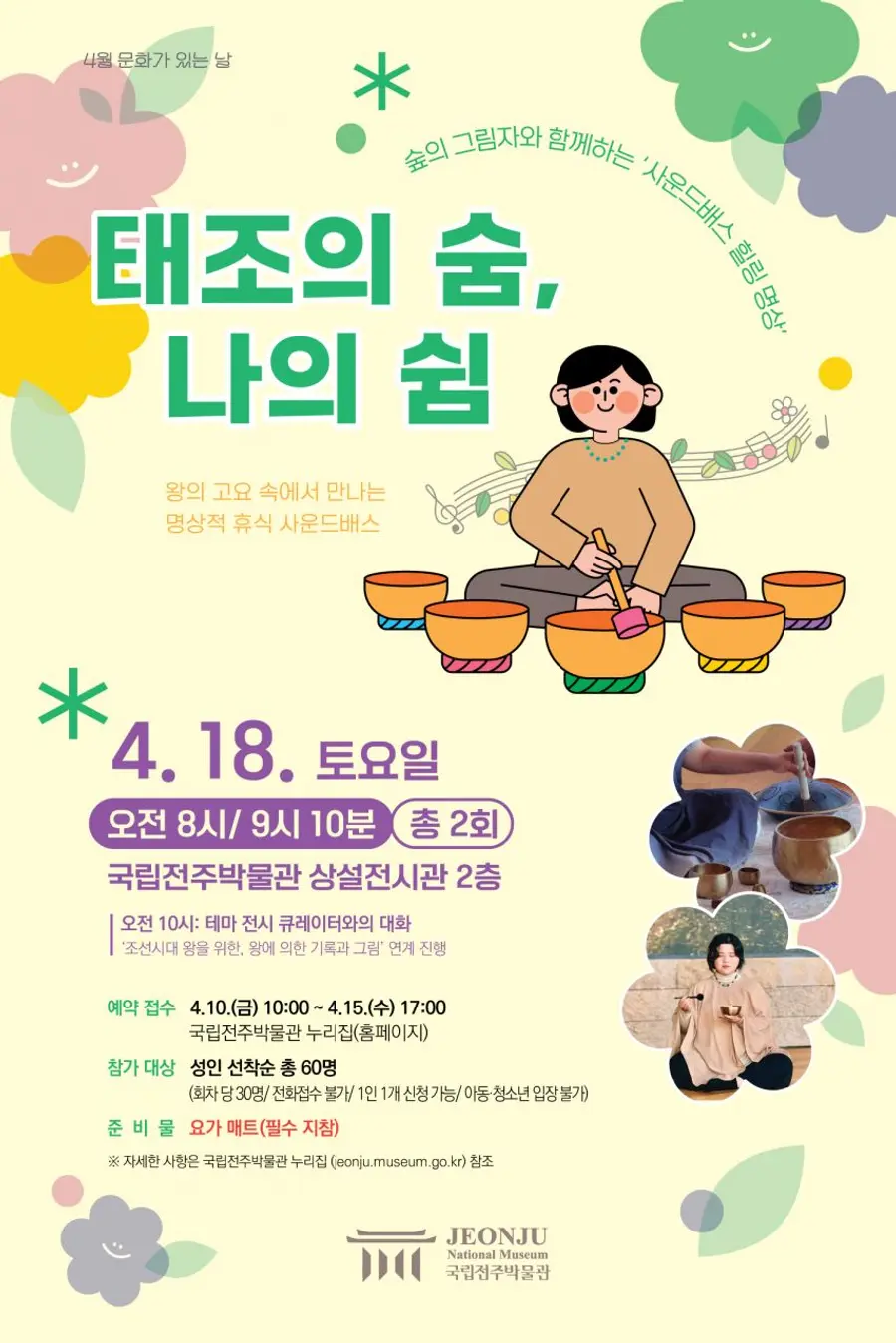
On a quiet early-spring morning, low and deep sounds fill the exhibition halls where the artifacts lie in still slumber. Let the singing bowls’ overtone harmonics slowly permeate your body, carried on the air. For April Culture Day, the National Jeonju Museum has prepared a special healing session.
The National Jeonju Museum (Director Park Kyung-do) will hold “Sound Bath Healing Meditation ‘With the Shadows of the Forest’” on Saturday, April 18, on the second floor of the permanent exhibition hall. With “The Breath of King Taejo, My Rest” as its theme, this program draws on the historical weight and quiet energy contained in the portrait of Joseon’s King Taejo, Yi Seong-gye—namely, the eojin (御眞)—and reinterprets it through a contemporary healing narrative, offering far more than an ordinary meditation experience.
Wash away your whole body with sound and draw out inner calm
A sound bath, quite literally, means “washing your whole body with sound.” It’s an advanced sound-meditation method in which you relax as if you were fully immersed in the vibrations and overtones created by instruments such as singing bowls, a gong, and crystal bowls. Because the session is guided lying down, even meditation beginners can join comfortably. Deep overtones support brainwave activity toward the alpha and theta ranges, helping ease physical tension and guide you into inner calm.
In particular, the vibrations of Himalayan singing bowls are known not only for auditory stimulation, but also for a subtle micro-massage effect down to the level of body cells. The feeling of sound passing through your skin to your bones and muscles—this experience itself is why people who try a sound bath often want to come back.
A meeting of King Taejo’s eojin and sound meditation—where history meets healing
What makes this event special is the harmony between the venue and the program. In one corner of the exhibition hall, the themed exhibition “Opening the Vault of Records” is currently underway, and within the atmosphere of that space, the sound bath unfolds. Standing before the eojin portraits that preserve 600 years of the Joseon dynasty, the sight of modern people lying down within the waves of sound becomes an experience in art itself.
After the meditation experience, there will be time for a conversation with a curator. When you view the artifacts with a body and mind that have settled, you may notice a new perspective—one that feels different from your usual way of seeing. This is a moment when the museum reinvents itself not only as a place to visit, but as a space for healing and reflection.
Step away from everyday noise into the museum’s silence
Amid the notifications and noise pouring in every day, people gradually search for a place where “you can’t hear a single sound.” In that sense, a museum is the most ideal meditation space within a city. Let the quiet rhythm of your breathing settle as you come among artifacts that carry centuries-old breath—that is why this event resonates even more deeply at the National Jeonju Museum.
In April, on a spring morning, enjoy the experience of lying down with a yoga mat laid out on the second floor of the museum. When you close your eyes, the sound of singing bowls flows above you, and within those vibrations, your body becomes heavier little by little—then lighter again. A moment to set aside the weight of history, just for a while. The spring sound bath at the National Jeonju Museum is waiting with the door left open.
Reservations begin at 10:00 AM on April 10 via the National Jeonju Museum’s official website (jeonju.museum.go.kr), on a first-come, first-served basis.