


Meditation is getting attention — in corporate training sessions, in school classrooms, and online. What was once considered the exclusive domain of practitioners is now becoming everyday language.
The reason meditation has risen so prominently in modern society is not simply a passing trend. It is closer to a survival strategy for protecting the brain and nervous system amid an environmental crisis of unprecedented attentional depletion in human history. Amid smartphone notifications, fast-moving videos, and an endless stream of information, people’s eyes and bodies and their attention are turned outward 24 hours a day. Because the human brain is designed to detect external threats and solve problems for survival, the medial prefrontal cortex (MPFC) responsible for goals and execution runs nonstop, pushing people into a chronic fatigue state.
‘Good being’ is the key to building mental strength
《Inner communication》, 《resilience》, 《grit》 — in a lecture by Professor Joo-hwan Kim, the author of these works, he calls the role meditation plays in stabilizing the amygdala and activating the prefrontal cortex ‘good being,’ and he emphasized that this is the key to building mental strength. Meditation is the most scientific form of mental-strength training: by turning the “remote control” of attention away from the outside and back to “right here, in my body and senses,” it physically rearranges the brain’s neural circuits.
This inner power takes on even more distinctive value in the age of artificial intelligence. Beyond the officially faced Doing mode, it is the power of Being mode — accepting yourself without judgment and staying fully present within relationships — that is the unique human “mind muscle” that becomes solid only through meditative training.
We often live with the mindset that we should do things better. This is the Doing mode. By contrast, Being mode is the state in which you pause for a moment and notice your body and mind in the here and now. Meditation invites us into Being mode.
The belief that you are valuable only if you do better drives us to keep doing something without rest. In the Doing mode where you run toward performance and goals, it is hard to meet your fully present self.
Meditation is an exercise in briefly letting go of efforts to fill something up or prove something. When you simply watch — as they are — the sensations of breath entering and leaving, the subtle tremble of the body, and the wavering of the mind, you finally experience Being mode, where you stay as “existence itself.”
In this moment, focusing on your breathing and giving your body and mind a safe haven can begin to fill you with a sturdy, presence-centered strength.

A baby is Being mode itself, perfectly
In fact, babies are already the perfect Being mode itself — existing throughout their whole bodies without judgment.
The issue is that the period when Being mode — the foundation of a human life — and inwardly tuned sensory perception are disrupted is arriving faster and faster, now beginning in infancy. Infancy is when babies experience the world with their entire bodies and when the brain grows most actively. But today’s children face two challenges: overstimulation from smartphones and reduced movement before they get enough experience sensing and moving with their whole bodies. From the moment they are born, their Being mode(Being Mode) is threatened.
Children exposed to ‘sensory-motor loss’
Physiological psychologist Thomas Hanna called it ‘sensory-motor loss.’ When children have fewer experiences moving their bodies enough and sensing them, they also get fewer experiences of sensing their body’s signals with precision. A baby’s movement and sensations in infancy are not just a matter of physical development; they connect directly to the very experience of regulating emotions through the body. Babies are placed in a paradoxical environment where the brain is overloaded while sensory experiences through the body decline.
This phenomenon is directly tied to severe caregiver burnout in the parenting environment and the physical depletion of parents. That is because parents also run their attention outward 24 hours a day, gradually distancing themselves from their own body sensations. A child’s nervous system is tuned while reflecting the caregiver’s state like a mirror. If the parent’s brain remains in an excited state due to chronic stress, it becomes difficult for the baby to form a stable nervous system as well.
Good Being Inner School proposes hands-on care centered on the body for ‘Good Being ON’
Good Being Inner School starts from this point. Quietly turning attention that used to face outward back inward, and reaching the state of noticing the self that is already good enough — they call this ‘Good Being ON.’ The ‘good being’ here does not mean merely feeling good. It means noticing the self that is already good enough and living in that state. Based on this perspective, Good Being Inner School aims for a multi-generational community of mental-strength practitioners in which parents, teachers, and counselors are connected together, and it proposes body-centered care practices that begin in infancy.
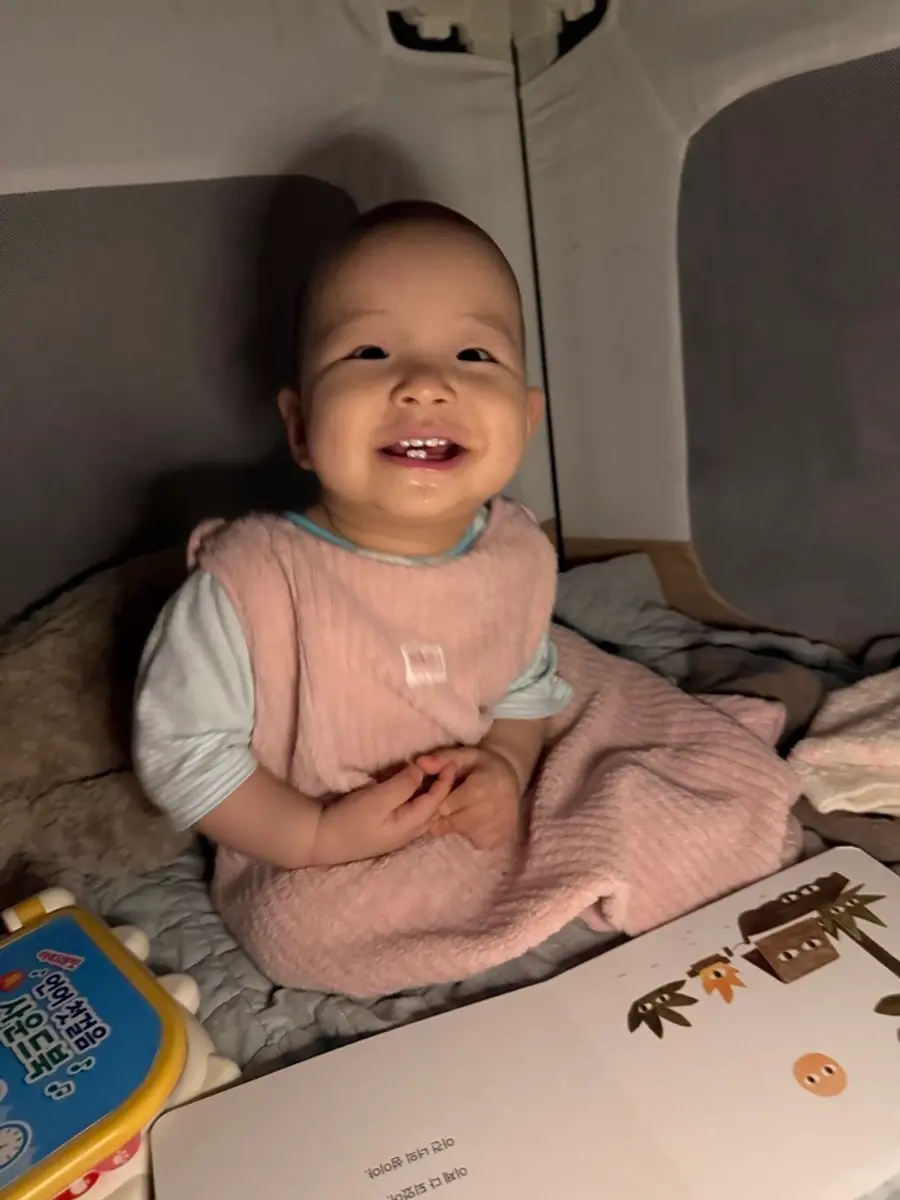
When smiles disappear — the relational signal delivered by Good Being Baby [Smile Meditation]
Human nervous systems adjust themselves through interaction with the environment from the moment of birth. In particular, during infancy, the brain reacts sensitively to the external environment. In the early period after birth, babies detect and regulate a caregiver’s emotional cues through voice and touch. Later, as they grow, they sense and coordinate those emotional signals through facial expressions.
A 1978 ‘Still Face Experiment’ by Dr. Edward Tronick makes this starkly clear. The moment a caregiver suddenly stops making facial expressions and goes blank, a baby becomes anxious within just a few seconds, heightens body tension, and tries to restore the relationship. This classic scene shows that a child’s vulnerability is not the point — rather, babies are already beings that notice and connect to nonverbal relationship signals before language.
Recent studies show that a caregiver’s emotional regulation ability is deeply related to an infant’s recovery in the autonomic nervous system. Caregivers who regularly tune their own emotions and body states help children return to a stable state more quickly even after the child experiences stress.
A caregiver’s smile is not a temporary technique for calming a child. It is a safety signal that matches the rhythm of the nervous system together. [Smile Meditation] is the process in which the caregiver first notices their own tension and fatigue, then stays in a way that their inner stability is naturally conveyed through facial expressions. When parents remain in their own bodies and shape a comfortable smile, the child naturally connects to that stable state.
Time you meet with eye contact — Good Being Baby [Eye Contact Meditation]
Long before language begins, children learn relationships through eye contact. Even newborns that are 2 to 5 days old tend to look longer directly at a person’s eyes than at the angle of the head they turn to. Eye contact is the earliest form of nonverbal connection for infants.
Neuroscience research shows that when caregivers and infants make eye contact, neural synchrony occurs in both brains. This is not just an exchange of gazes — it is a biological event in which two nervous systems connect silently. At this moment, oxytocin is released, creating a cycle of connection that leads to even more eye contact.
[Eye Contact Meditation] is a time when you place the child on your lap or sit facing each other and look fully — with no other purpose. It’s okay if you don’t speak to the child or try to teach something. In that quietness, parents naturally feel their own breathing slow down too. Eye contact is not only for the child; it is also a nonverbal door that brings parents back to the present.
Warmth delivered through the body — Good Being Baby [Petting Meditation]
For an infant, touch is the earliest language that senses whether the world is safe or not. That is because for a child in the period when you can’t explain things in words, safety is formed not through instruction but through body sensations that are experienced repeatedly. The more a parent fully stays in “right here,” the more positively it affects an infant’s ability to regulate the autonomic nervous system. In particular, repeated and stable contact experiences form an important foundation for the child to build the power to calm themselves.
The core of [Petting Meditation] lies in touch that doesn’t rush, and in a distinctive rhythm created by repeated and predictable contact. This is not a grand training. Simply humming a lullaby the baby is familiar with in daily life and gently stroking the back — as well as everyday care like applying lotion carefully to the baby’s face after a bath and gently touching the cheeks and forehead — are all excellent contact meditations. In the touch parents deliver while fully staying, the child gains the power to return to the safety of their own body. Touch is the most powerful nonverbal language of care that needs no explanation, and the child’s body already understands that language fully.
Believing the world is safe — the start of attachment — Good Being Baby [Holding Meditation]
According to research, early skin-to-skin contact in the first days after birth can positively affect emotional stability and physiological regulation for both mothers and infants. Experiences of holding with skin-to-skin contact were associated with oxytocin release and reduced stress responses, and they also had an important impact on the infant’s emotional regulation.
[Holding Meditation] is a practice in which you hold the baby to your chest and stay still while feeling the baby’s weight and warmth with your own body. The sensation of the baby’s breath touching the caregiver’s chest, and the feel of the baby’s small hands gripping the caregiver’s clothes. While you focus on those sensations, the caregiver’s body relaxes as well, and the two people’s rhythms quietly fall into one. Holding is a way of communicating as “being,” not just as action.
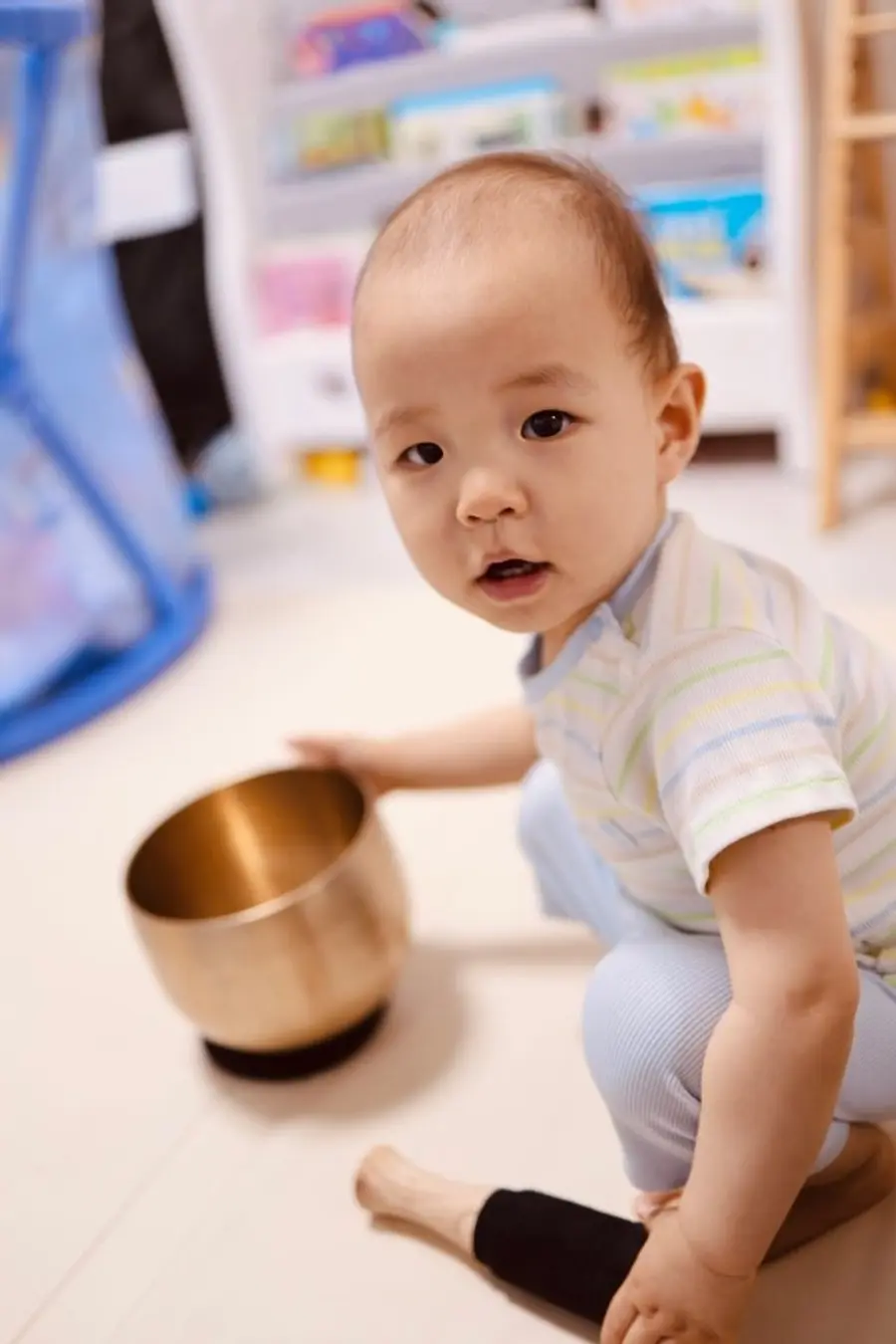
Good Being Baby [Breathing Together Meditation] and [Humming Meditation]
An infant’s heart rate is much faster than an adult’s, and the baby is highly sensitive to external stimuli. Infants tune their nervous systems together through a caregiver’s stable biological rhythm. Especially when sleepiness comes before bedtime, infants’ brains are more likely to land in an excited “hyperarousal state” due to fatigue and overstimulation. If you try to soothe the baby with words at that moment, it becomes another auditory stimulus — the baby gets even more agitated and breaks into uncontrollable crying.
[Breathing Together Meditation] is the simplest and most powerful way to turn off this urgent alarm. Mom or dad lies down comfortably and holds the baby while lying together. Place the baby’s belly against the mother or father’s belly. When you inhale, the belly rises, and the baby rises too; when you exhale, the belly lowers, and the baby lowers as well. In the force of inhaling and exhaling, the baby’s body already feels the rhythm.
Seung-hyeon’s mother, a counselor at Good Being Inner School and a parent, says:
“When Seung-hyeon is sleepy before bedtime, she cries and wails. At first, when I said things like ‘Let’s breathe—inhale for 4 seconds, and exhale slowly,’ she actually screamed and cried louder. So I stopped talking and entered meditation first. Whether Seung-hyeon was too young to know or not, I kept breathing and letting my breathing sounds be heard through the gaps in her crying. Then, at some point, she suddenly got quiet~~~~. When I feel comfortable, it seems to be delivered positively to Seung-hyeon no matter what.”
Seung-hyeon’s mother’s experience is a day-to-day scene showing how closely the parent’s and baby’s bodies connect and respond to each other. When the caregiver stops explaining and returns to their own breathing first, the infant’s nervous system begins to follow a calm flow, using the caregiver’s stable brainwaves and breathing sounds as an nonverbal support.
Add [Humming Meditation] here, and the tuning goes even deeper. “A low hum sung to match the breath — ‘mm’ — promotes the release of nitric oxide in the parent’s nasal passages, expands blood vessels, and activates the parasympathetic nervous system. The subtle physical vibration created by humming is delivered to the infant’s nervous system as a signal of calm. In this quiet back-and-forth of nonverbal give-and-take, stability is not something delivered one way; it is something created together as both people’s rhythms align.”
The conclusion is the parent’s body state — the most powerful foundation of care
Ultimately, the most important core of meditation in infancy boils down to the parent’s current body state and the quality of their “being.” If the caregiver is trapped in fatigue and stress and holds tension in their body, no matter how warmly they talk or gently stroke, the baby’s sensitive nervous system detects the caregiver’s subtle tension signals.
According to research, stress can be transmitted to people nearby through nonverbal cues such as facial expressions, voice tone, breathing, and body tension. Even without special words or actions, the parent’s body state itself affects the child. By contrast, if the parent first chooses to gather their breath and remain in inner stability, the baby’s nervous system naturally regains calm by following the parent’s rhythm.
That is why the first thing you need before starting baby meditation is this one line.
“I’m struggling.”
Without judgment, without trying to fix things, and just noticing. Researchers of self-compassion explain that this kind of attitude has a positive effect on emotional regulation and nervous system stability. Being kind to yourself is the fastest way to stabilize your nervous system.
The Good Being Baby meditations proposed by Good Being Inner School — Smile Meditation, Eye Contact Meditation, Petting Meditation, Holding Meditation, Breathing Together Meditation, and Humming Meditation — are natural practices that help restore connectedness in everyday life. And this practice is not only for the child; it is also care for the parents themselves, who are worn down by lack of sleep and fatigue.
That is why Good Being Baby meditation begins with Smile Meditation. Before you look at the child’s face, you return first to your own body. Before you deliver touch, you feel first the warmth in your own hands. Before you share breathing, you notice first where your breath is. The choice to stop for a moment and gather your breath becomes the most stable environment for the child right away.
Infants take in external stimuli with their entire bodies. They are complete beings who are already sensing, connecting, and absorbing rhythm. The sensations that allowed the child to feel the world was safe, and the experiences in which their body felt comfortable when someone was with them, remain as nonverbal memories before language — becoming the firm roots of the mind that supports the child for life.
Caring for myself is caring for the world. A parent’s meditative state synchronizes a baby’s heart rhythm in real time.
[By] Good Being Inner School, Mind Garden Master