

For people who fill each day without feeling like anything is missing, yet still have a persistent sense of emptiness in one corner of the heart.
The moment they grasp something, another longing rises. Comparison, regret, and anxiety rarely fade away. A book has appeared that faces head-on the identity of that familiar hunger.
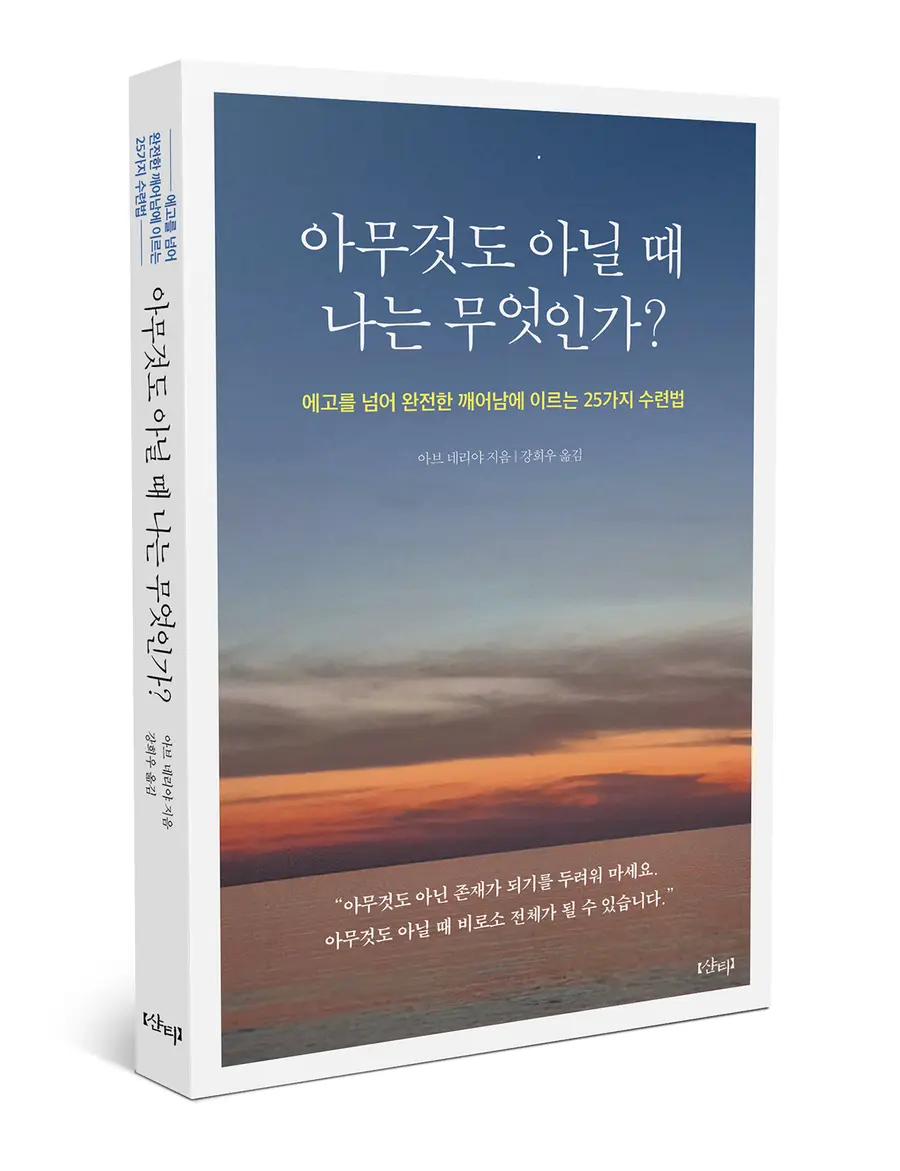
The new book released by Shanti Publishing on June 10, “What Am I When There’s Nothing at All?”
Written by Av Neryah and translated by Kang Hee-woo, the book takes “25 training practices that lead to complete awakening beyond ego” as its subtitle and presents a practical guide to the essence of consciousness yoga.
A single sentence on the cover compresses the tone of the entire book. “Don’t be afraid to become a being of nothing at all. Only when there’s nothing at all can you become whole.”
Why are we always thirsty for something?
The book begins with questions that everyone has held in their hearts.
Why do we constantly compare and judge, and want to control others? Why don’t regret, worry, and anxiety ever come to an end? The author traces the root to “ego.” The belief that the false self is masquerading as our real self—and the sense of separation that comes from the conviction, “I am this body,”—is said to be the starting point of all suffering.
Every being born into the world has no choice but to experience “me” and “others.” The author calls this sense of separation a fundamental trauma: a deep belief that you have been cut off from the whole, and a feeling of lack that you are not complete on your own. The endless pursuit of money and status, success and specialness grows directly out of that sense of deficiency. As long as the sense of self remains alive, the insight lands heavily: no matter how long you meditate and build spiritual achievements, it still stays within the realm of ego.
The mirage does not die—it’s only that you realize it was a幻 (illusion)
The book takes one more step toward the disappearance of ego. The ego, which seems powerful, fears death more than anything, because it believes it has individuality. We, too, who identify ourselves with ego, carry that fear to the fullest. That is because we assume that when the body disappears, “I” disappears as well. The author quietly asks: how could a mirage die? A mirage can only come to realize that it was an illusion.
When you look at every fantasy of ego with an empty consciousness, a paradox runs through the entire book: only by becoming a state of nothing at all can you become whole.
What remains where “I” has been fully set down
What remains where ego disappears is not the death of “I.” After all manner of attachments—thoughts and memories, emotions and personality, jobs and property—fall away, what still exists is something, the unfolding of the real self, the awakening of the true self. The author writes that, “Even without thoughts, even without emotions, even without a body, I still exist.” What remains is pure awareness, and it is the true “I” itself.
When you stay in a state of fully awakened presence, even if painful thoughts arise, you no longer identify with them. Without suppressing or fighting, you remain simply as a “witness,” becoming a single point of consciousness that watches from a distance. The author says that as training deepens, even that witness disappears and you move into a nondual consciousness where only awareness remains.
Not on a meditation cushion, but right in the middle of life
A virtue of this book is that it does not stay in theory. The author offers 25 nondual practice guidelines that lead you to dwell in pure consciousness, and he repeatedly emphasizes that training is not something that happens only on a meditation cushion. Practicing how to detach when anger comes up, practicing how to set everything down until there’s nothing left to set down—these practices seep into every moment of daily life.
The signs of progress also make themselves clear kindly. If life has become more peaceful and joyful than before, if mental noise has decreased and you’ve gained more time to stay in the present without having to try so hard, then that is a signal that your training is ripening.
A three-step map, from liberation from the false self
The book is made up of three parts and 22 chapters. Part 1, “False Self,” lays bare the nature of ego, its tactics, and its spiritual traps. From chapter titles such as “Ego, My Longtime Friend” and “Spirituality Can Become Ego’s Playground,” curiosity is immediately piqued. Part 2, “True Self,” leads readers past “Even when there is nothing, I still exist,” into the stage of directly training nonduality. Part 3, “Liberation,” follows “Surrender,” “Nothing at All,” and “The Heart of Consciousness,” opening the final door toward the completion of awakening.
A book discovered first by readers around the world
Reactions from overseas readers well reflect the book’s character. On Amazon, praise continued, saying it “teaches how to recognize ego’s clever deception—the biggest obstacle in a spiritual journey—and how to get free from it.” One reader who has walked a spiritual path for more than 30 years described it as “a jewel-like book encountered along the way.” Many say the philosophical explanations get right to the core with conciseness, while the training methods can be put into practice immediately without complicated effort. Recommendations also stand out, noting that it becomes a signpost for seekers who feel stuck or lose their way.
Author Av Neryah and translator Kang Hee-woo
Author Av Neryah has devoted his life to embodying ultimate liberation and has worked to lead sincere seekers to awakening. Without being bound to any specific tradition, and through deeply experiencing a range of spiritual traditions and training methods, he guides the path to enlightenment with a powerful and direct nondual system. The book’s first English edition was published under the pen name Santata Gamana, and he published several books dealing with nondual practice, including “Samadhi: The Forgotten Eden,” “Turiya: The God State,” and “Kundalini Exposed.”
Translator Kang Hee-woo majored in English-language and English literature and worked as an English teacher. She is also a practitioner who began meditation in her early 30s and has studied yoga and Zen for more than 30 years. While searching for and reading English original texts for her yoga practice, she encountered Av Neryah’s books, and she took on the translation role because she wanted to introduce his awakening and training methods to Korean readers. She also translated Deepak Chopra’s “Perfect Health” into Korean. Spiritual-related books make translation truly important, and since a practitioner has translated the book, you can trust it and read it with confidence.
For people who, on the path of practice, cannot easily shake off the self-sense called “I,” and for those who want to truly distinguish between the real and the unreal, this book will become a kind yet steady companion on the road.
The price is 17,000 won, and it can be purchased at 49 specialty bookstores nationwide.