

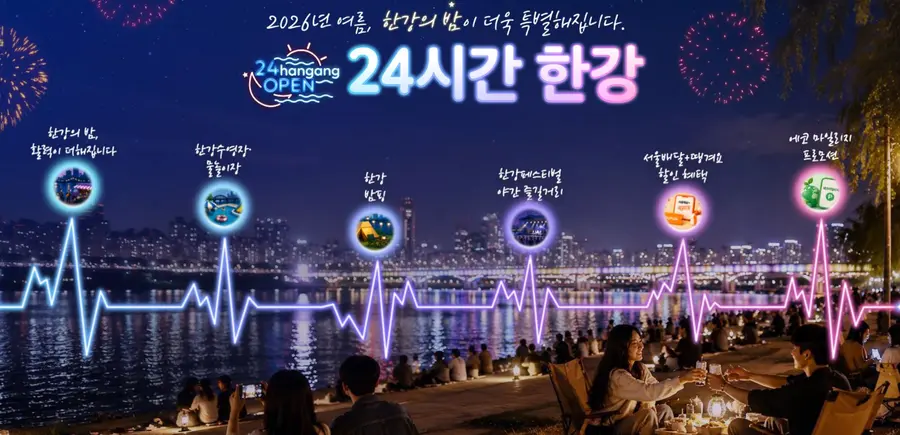
Time after work is no longer simply the end of the day; it is becoming another beginning. As Seoul City rolls out its “Seoul-style night economy”, expanding the city’s schedule from 6pm to 6am the following morning, it has set out plans to grow meditation programmes at city-centre temples and night-time hiking into cultural content for the hours after dark.
On the 20th, Seoul Mayor Oh Se-hoon announced “Seoul, a 24-hour vitality economy city” at City Hall and laid out a comprehensive night-economy plan that links culture and sport, tourism and retail districts, transport and safety, and cleanliness and hygiene into a single framework.
Not a night that boosts consumption, but one you can enjoy better
Seoul City said the policy is not about extending trading hours or encouraging late-night spending. The mayor said: “When people hear ‘night economy’, they easily think of policies that keep shops open late and increase consumption. The night economy Seoul is trying to build is different from the very starting point.”
He added: “People’s increased activity and time spent—walking, working out, watching performances, and enjoying leisure in the neighbourhood where they live—then leads to the local alley restaurants and shops, and to regional culture and tourism.” The city presented four strategic pillars: nights in which citizens’ lives become more plentiful; nights that let visitors stay longer with Seoul’s own attractions; orderly nights where movement and safety are secured; and sustainable nights created together.
Mountains and temples become night-time content
A key focus of the meditation sector is a plan to combine Seoul’s mountains and city-centre temples with night-time content. Seoul City said it will activate K-mountain climbing that lets people enjoy the city’s night skyline, and meditation programmes encountered at temples, turning them into healing content that allows people to experience Seoul’s nature and traditional culture only at night.
Sports and festivals are also tied in to night-time content in the same way. The plan is to link the footsteps of residents and tourists who enjoy games and festivals to nearby markets and backstreet commercial areas.
[Image: People sitting on seat cushions and meditating inside a Dharma hall — Official press image for the Korea Buddhist Culture Business Group’s Temple Stay, or search on Unsplash for “meditation temple Korea”, and check whether it can be used]
“The role of temples is important for activating wellness”
A Seoul City official said: “In activating wellness, which seeks balance of body and mind, the role of temples is important. We plan to continue conducting programmes such as temple meditation experienced at night with the temples themselves.” However, the presentation did not disclose details such as which temples will participate, how programmes will be structured, or when operations will begin.
In Seoul’s city centre, temples have already established themselves as places for practice and a calm setting with good accessibility. Temple stays run by the Korea Buddhist Culture Business Group, as well as meditation and Seon (Zen) practice programmes at city-centre temples, are also known to foreign visitors. Add operation during night hours and the recovery options available to office workers after a full day of work will broaden, without the need for major preparation.
Recovery time seeps into Namsan forest and neighbourhood parks
Namsan will be developed as a city-centre healing destination where people can enjoy both the forest and the night scenery, through emotional camp-nicking at Beokbeom Square, night-time autumn foliage trails, and a firefly garden. The city plans to link Myeongdong’s buzz and Namsan’s rest into a single night-time tourism event.
In parks by district, the city will expand programmes such as yoga and stretching to help people shake off the fatigue of the day and recover both body and mind. Seoul Forest and Maehyeon Citizens’ Forest will provide a garden theatre and night-time programmes. Eight cultural facilities, including municipal museums and art galleries, will gradually expand night-time opening from September to up to five nights a week until 9pm, while 269 school and park sports facilities will open up to midnight, depending on conditions.
“Movement and safety on night roads were designed together”
From October, in addition to the existing late-night bus service (N-bus), a late-night “Firefly Bus” will run connecting major night-time hotspots such as Hongdae and Gwanghwamun, DDP and Myeongdong, and Gangnam, as well as subway stations. According to a report by Asia Today, it will operate from 11pm until 5.30am the following morning.
For night-time hubs where many people gather, the city will designate them as priority-managed areas and use AI-based crowd-detection CCTV to check congestion in real time, while building an emergency medical response system by linking health centres, fire services and hospitals. In areas with many foreign tourists, it will deploy 49 officers from the Seoul Metropolitan Police Agency’s wide-area prevention patrol unit, and introduce 100 Seoul security guardians from next year. In areas with large flows of people at night, 150 sanitation mobile units will be dispatched.
Targeting introduction of the ordinance in January next year… the remaining task is balance
Seoul City is preparing a “basic ordinance for activating the night economy”, aiming to bring it into force in January next year. In September, it will launch the Seoul Night Economy Committee to seek expert advice on the basic plan and on shared-benefit special zones and regulatory improvements. Dispersed night-time content will be brought together in a “Seoul Night Map” to provide night-time attractions, programmes and travel information in one place.
The city set targets including creating an additional 5tn won in annual night-time spending five years from now, 30 million foreign visitors, and that the share of night-time sales by small business owners will be more than 50%.
For temple meditation to take root in Seoul’s night, challenges also remain. Conditions such as the gap between serenity as a practice space and tourism demand, the reconciliation between night-time noise and acceptance by nearby residents, and the operational capacity available for each temple will have to be coordinated. Even so, it is a clear shift that the city has begun to talk about the recovery of the city at night using policy language. Whether Seoul’s night can become a time for rest beyond the hours for consumption—and whether part of the answer will be placed inside the quiet of city-centre temples—has now come into view.
For article enquiries: fare3041@naver.com