

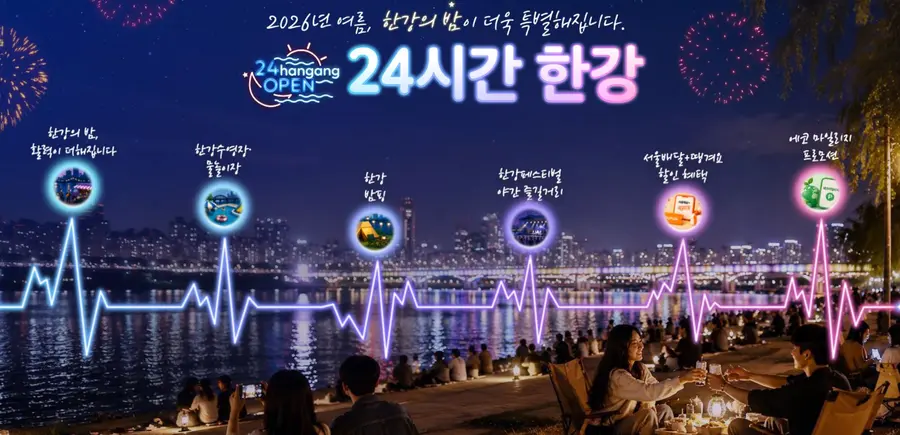
The hours after work are no longer the end of the day—they are becoming the start of something new. As Seoul City pushes forward with its “Seoul-style nighttime economy,” expanding the city’s active hours from 6 p.m. to 6 a.m. the next morning, it has laid out a plan to grow downtown temple meditation programs and nighttime hiking into cultural content for the night.
On the 20th, Seoul Mayor Oh Se-hoon unveiled “Seoul, a 24/7 City of Vitality” at Seoul City Hall and released a comprehensive nighttime economy plan that links culture and sports, tourism and commercial areas, transportation and safety, and cleanliness and hygiene into one.
Not a night that simply boosts consumption, but one people enjoy more
Seoul City drew a line, saying the initiative is not a policy to extend business hours or to encourage late-night spending. “When you hear ‘nighttime economy,’ it’s easy to think of policies that keep businesses open late and increase consumption,” Oh said. “The nighttime economy Seoul wants to build is different from the starting point.”
He added, “The activities and stays of the people who, after work, walk, work out, watch performances, and enjoy some leisure in the neighborhoods where they live will then connect to the alleyway restaurants and shops, as well as local culture and tourism.” The city presented four strategy pillars: nights that make citizens’ lives more abundant, nights that keep people staying longer with Seoul’s own charms, orderly nights where movement and safety are secured, and sustainable nights built together.
Mountains and temples become nighttime content
The point drawing the most attention from the meditation sector is a plan to combine Seoul’s mountains and downtown temples with nighttime content. Seoul City said it will activate K-hiking that lets people enjoy downtown night views, and meditation programs found at temples, turning them into healing content that allows people to experience Seoul’s nature and traditional culture only at night.
Sports and festivals will also be bundled with nighttime content in the same way. The plan is to connect the steps of citizens and tourists who enjoy games and festivals to nearby markets and neighborhood commercial strips.
[Image: People sitting on cushions and meditating in a lecture hall — Official press image from the Korea Buddhist Culture Business Group / Temple Stay, or search Unsplash “meditation temple Korea” and confirm availability]
“The role of temples is important for boosting wellness”
A Seoul City official said, “In efforts to boost wellness—seeking a balance between body and mind—the role of temples is important,” adding that “we plan to continuously carry out programs such as temple meditation experiences at night with the temples themselves.” However, detailed items such as which temples will participate, how the program will be composed, and when operations will begin were not disclosed in this announcement.
In downtown Seoul, temples already serve as accessible spaces for spiritual practice. Temple stays operated by the Korea Buddhist Culture Business Group, along with meditation and seated meditation programs at downtown temples, are also known to foreign visitors. With added nighttime operations, people who have finished the workday can gain more options for recovery without needing much preparation.
Recovery time that seeps into Namsan’s forest and neighborhood parks, too
Seoul City plans to develop Namsan into a downtown healing destination where people can enjoy the forest and the night view together, through the Baekbeom Plaza emotional campnics, nighttime autumn foliage trails, and a firefly garden, among other features. The city’s plan is to link the energy of Myeongdong and the rest of Namsan into a single nighttime tourism festival.
At parks by area, the city will expand programs such as yoga and stretching that help people shake off the fatigue of the day and recover both body and mind. In Seoul Forest and the Maehyeon Citizens’ Forest, it will prepare a garden theater and nighttime programs. Eight cultural facilities such as city-run museums and art museums will sequentially expand nighttime openings from September to five nights a week until 9 p.m., and 269 school and park sports facilities will stay open up to as late as midnight, depending on conditions.
“Movement and safety along the night roads were designed together,” too
Starting in October, along with the existing late-night bus service (N-Bus), a new late-night “Firefly Bus” will begin operating, connecting major nighttime attractions such as Hongdae and Gwanghwamun, DDP, Myeongdong, and Gangnam, with subway stations. According to a report by Asia Today, the operating hours run from 11:00 p.m. to 5:30 a.m. the next day.
Late-night hubs with heavy foot traffic will be designated as priority managed areas, with AI-based crowd detection CCTV used to check congestion in real time. The city will also build an emergency medical response system for each hub, linking public health centers with fire services and hospitals. In regions with many foreign tourists, 49 staff members from the Seoul Metropolitan Police Agency’s wide-area preventive patrol unit will be deployed, and starting next year, 100 Seoul security guards will be introduced. In areas with large amounts of nighttime floating population, 150 mobile cleanliness units will be dispatched.
Targeting enactment of the ordinance in January next year… the remaining task is balance
Seoul City plans to prepare the “Basic Ordinance for Promoting the Nighttime Economy” with a goal of implementing it in January next year. In September, it will launch the Seoul Nighttime Economy Committee and seek consultations on the basic plan and win-win special zones, along with advice on regulatory improvements. Dispersed nighttime content will be bundled into the “Seoul Night Map” to provide nighttime attractions, programs, and movement information in one place.
The city also set targets: an additional 5 trillion won in annual nighttime consumption after five years, 30 million foreign tourists, and a nighttime sales share of at least 50% for small business owners.
There are still assignments that need to be solved if temple meditation is to take root in Seoul’s nighttime life. Conditions must be coordinated, including the gap between the quietness of spaces for spiritual practice and tourist demand, nighttime noise and local residents’ willingness to accept it, and the operational capacity available at each temple. Even so, the fact that the city has begun to talk about the night’s recovery in the language of policy is clearly a change. Whether Seoul’s nights can become time for rest beyond time for consumption is where one piece of the answer has ended up—in the stillness of downtown temples.
For article inquiries: fare3041@naver.com