

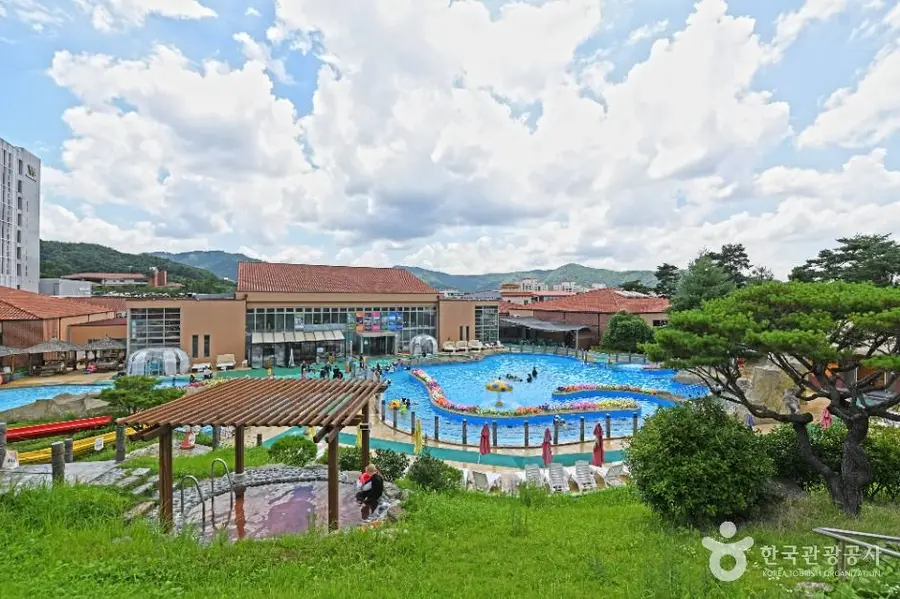
Mornings in Gochang begin with water. Hot-spring water drawn from underground fills the baths, while a thin veil of steam rises from the surface and warms the air. At Well Park City, centred on Seokjeong Hot Spring at 173 Seokjeong 2-ro in Gochang-eup, the day begins in this way.
Gochang is best known for its dolmens and fortress, but wellness travellers have another reason to know the name. Here, a single complex brings together hot springs, leisure, healthcare, culture and housing. Jeonbuk Special Self-Governing Province’s tourism guide describes Well Park City as “the Republic of Korea’s leading wellness complex, where nature, health and relaxation come together”.
A city born from hot springs
Well Park City grew from Seokjeong Hot Spring. Accommodation, recuperation and leisure facilities were added one after another around the water, creating the complex as it stands today. It includes Seokjeong Hot Spring Hue Spa, with its hot-spring and spa facilities; a wellness hotel; the healthy loess holiday homes at Healing County; health and medical facilities; and walking trails and green spaces. A 470,000-pyeong retirement village and a family-oriented 18-hole golf course are also part of the development.
This layered design allows visitors to choose how they stay. Someone who spends a day using only the baths and someone who stays for several days to follow a programme can occupy the same space at very different paces.
Water rich in germanium
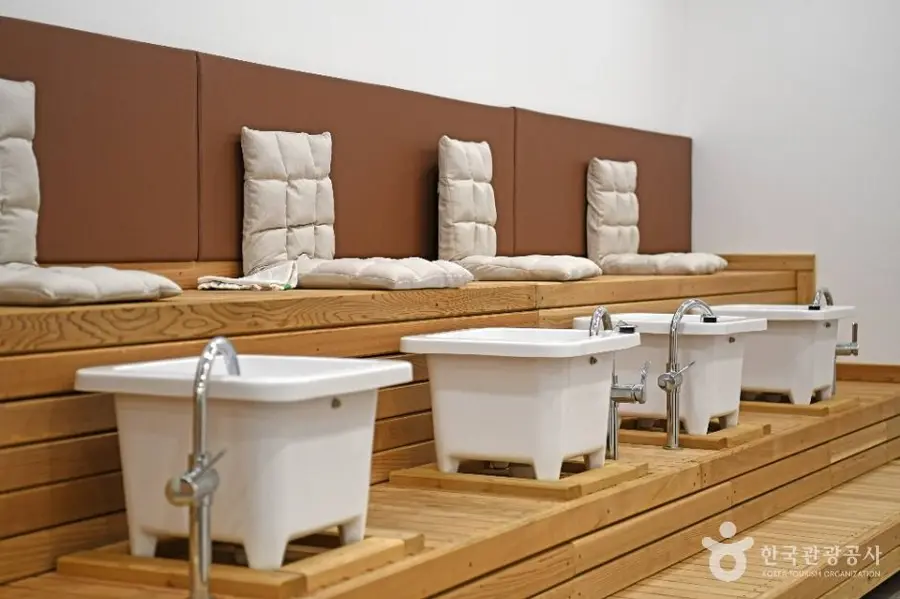
The water here is germanium hot-spring water from Seokjeong-ri. Gochang County’s tourism guide says the water “has a strong reputation as a healing hot spring because it is rich in germanium”, while Hue Spa says it uses 100% Seokjeong-ri germanium hot-spring water.
Travel publications make a wide range of claims about the effects associated with the water’s mineral content. This article reports only on the water’s composition and the facilities available. Hot-spring bathing may not suit everyone, depending on their health, so people with chronic conditions should consult their doctor before using the facilities.
From baths to spa: following the water
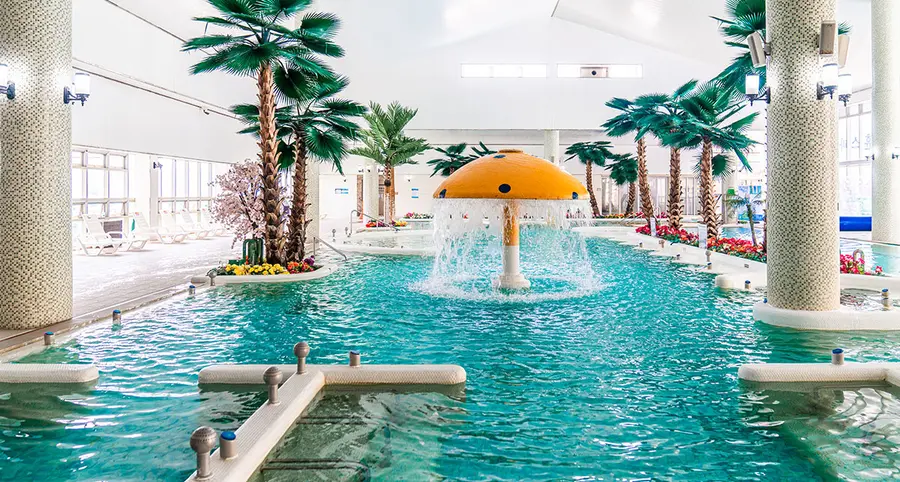
The indoor facilities include separate hot-spring baths for men and women, an open-air bath, a body pool, a children’s pool, and dry and wet saunas. Outside, visitors will find a lazy river, an event pool, a waterfall bath and an outdoor experiential spa, along with sun loungers, cabanas and a slide for young children.
According to the travel publication Teltrip, the indoor spa has bubble baths, floating facilities, neck showers and a hinoki dry sauna. During the peak summer season, the outdoor spa, slides and open-air bath operate alongside it.
The scale of the complex is also reflected in its amenities. Gochang County says it has locker facilities for about 2,000 people. There is also a food court, cafeteria, nursing room and dedicated rest areas.
Time beyond the water: yoga and meditation
Well Park City’s point of difference from a conventional hot-spring resort lies outside the water. According to Jeonbuk Special Self-Governing Province’s tourism guide, the complex runs yoga, meditation and aqua-therapy programmes alongside healing programmes centred on its hot springs and spa facilities. Tailored health-management programmes for middle-aged and retired visitors, food and drink offerings linked to local produce, cultural events and health seminars are also presented as key parts of the complex’s operation.
The idea is that a day can unfold entirely within one place: warming the body in the baths, settling the breath on a mat and listening to a talk in the evening. The hot spring becomes not the destination for rest, but the starting point.
Aqua therapy uses the buoyancy and resistance of water to reduce the load placed on the body, making it an approach recommended for people seeking movement that is gentle on the joints. Offering yoga and meditation alongside hot-spring facilities can be seen as an attempt to connect water, breathing and movement in a single flow.
Schedules, capacity and booking arrangements vary by programme and season, however. Visitors should check with the booking office before travelling.
Two distinct accommodation options: Wellness Hotel and Healing County
Accommodation comes in two distinct forms. The Wellness Hotel is the closest to the hot springs within the complex, while the Healthy Loess Holiday Homes at Healing County are stand-alone properties themed around loess. According to Gochang County’s guide, guests at Healing County receive a 20–25% discount on hot-spring admission.
Travellers planning to stay for several days and follow a programme would be well advised to look first at packages combining accommodation with hot-spring access. Travel platforms regularly sell packages that include breakfast and hot-spring admission.
Exploring Gochang: Seonunsa Temple and the Pansori Museum
The surrounding area deserves more than a passing glance at Well Park City. Teltrip puts Gochang Fortress about 10 minutes away by car. The Pansori Museum and the dolmens at Dosan-ri are also nearby.
Those planning a meditation-focused trip could add Seonunsa Temple to the itinerary. Located at 250 Seonunsa-ro in Asan-myeon, Gochang County, on the foothills of Dosolsan Mountain, Seonunsa was founded by the great Baekje monk Geomdan Seonsa 1,500 years ago. Its Daeungbojeon Hall is Treasure No. 290. Temple-stay options include the same-day “A Brief Stay, a Walk Above the Clouds”; the activity-based “Dosolam Trekking” and “Healing Temple Stay with a Coffee Barista”; and the restorative “Rest in Nature”. The same-day programme is for groups of 10 or more, while the restorative programme runs year-round. For enquiries, call 063-561-1375; Korean-language assistance is available on 010-5231-1375.
A two-day itinerary combining a soak to release bodily tension at the hot spring with a night spent regulating the breath at the temple is possible within a single county.
A biosphere reserve as its backdrop
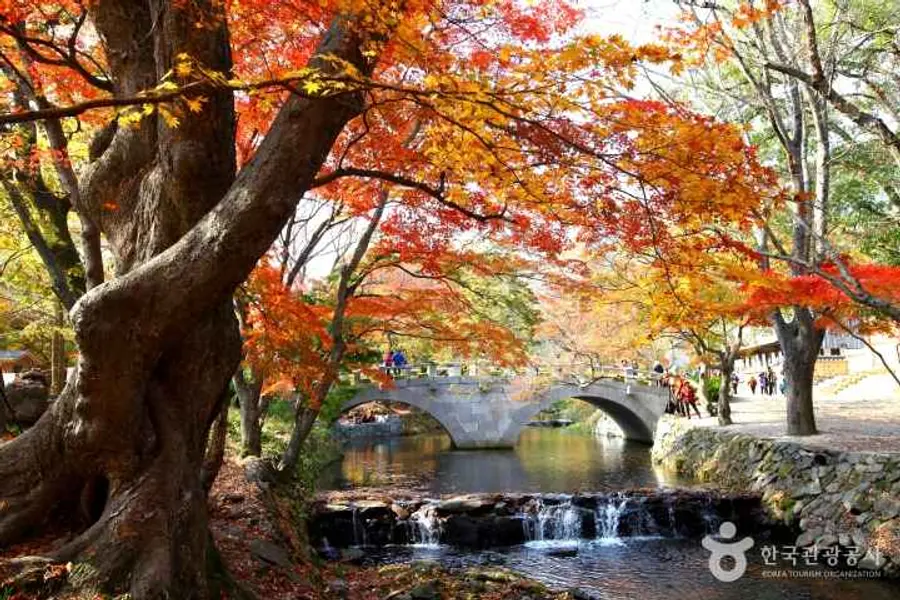
There is another factor that can easily be overlooked when considering Gochang as a wellness destination: the whole of Gochang County has been designated a UNESCO Biosphere Reserve. The designation reflects its landscape, where tidal flats, plains and mountains overlap within a single county.
There are plenty of places to walk when extending an itinerary that began with water into the natural landscape. Gusipo Beach is Gochang’s largest beach, with a pine grove behind its long stretch of sand. Its gentle slope makes it popular with families, while at sunset the islands, including Gamakdo, remain as silhouettes.
Nodong Reservoir is an ecological retreat created to increase urban biodiversity. Designed to connect wetlands, waterways, grassland and woodland, it received an award from the Minister of Environment. Its floating waterside deck, which rises and falls with the water level, is a distinctive feature. As visitors walk slowly across the water, the pace of their breathing seems to ease naturally.
In other words, a three-day itinerary of warming up at the hot spring, walking through wetlands and along the beach, and spending a night at the temple can be completed within one county’s boundaries. For anyone planning a wellness itinerary, that is an unusual combination.
Getting there and visitor information
The address is 173 Seokjeong 2-ro, Gochang-eup, Gochang County, Jeonbuk Special Self-Governing Province. Teltrip estimates the journey at about three hours by car from Seoul and 1 hour 30 minutes from Gwangju. By public transport, visitors can travel from Gochang Bus Terminal by local bus or taxi.
According to figures published by the same outlet, hot-spring admission costs 12,000 won for adults. Spa admission ranges from 28,000 won in the off-season to between 38,000 won and 43,000 won in the peak season. Discounts are available for spa entry after 4pm, according to the guide. Prices vary by season and seller, so visitors should check before booking.
For enquiries, call 063-560-7500. Information about the complex is available at www.wellparkcity.com, while details of the hot springs and accommodation can be found at www.huespapension.com.
There are two particularly suitable times to visit. Late autumn and winter, when the water is most welcome, are the best seasons for a hot-spring trip, while summer, when the outdoor spa and lazy river are open, suits family visits. Those seeking a quieter itinerary should avoid peak season.
Its place as a Korean-style wellness destination
Gochang Well Park City was among 11 new sites selected as Excellent Wellness Tourism Destinations, announced by the Ministry of Culture, Sports and Tourism and the Korea Tourism Organization in April 2025. It was the site chosen in Jeonbuk.
Hot-spring regions are scattered across the country, but few examples link water, accommodation, programmes, healthcare and housing within a single complex. The attempt to move beyond short visits for a soak towards longer wellness stays defines the character of this development.
Its focus on programmes for middle-aged and retired visitors is also notable. As domestic wellness tourism can easily narrow into spas and yoga classes aimed at the tastes of people in their 20s and 30s, Well Park City has a retirement village and medical facilities on site, and is designed for visitors who stay longer. In planning for months rather than days, it sits on the boundary between wellness tourism and recuperative care.
It also has the ingredients to serve as a gateway for introducing Korea’s hot-spring culture to international travellers. Tidal flats, wetlands, dolmens and a 1,500-year-old temple are clustered within the surrounding area, so visitors do not have to build an entire itinerary around the hot spring alone.
The remaining challenge is information. Although the complex’s introduction explicitly mentions yoga and meditation programmes, there is no clear channel for checking schedules, instructors and fees before a visit. For travellers whose main purpose is meditation or yoga, that is the information they need most. Once programme details are organised as clearly as the hot-spring information, the destination’s wellness identity should become much more distinct.
Article enquiries: fare3041@naver.com