

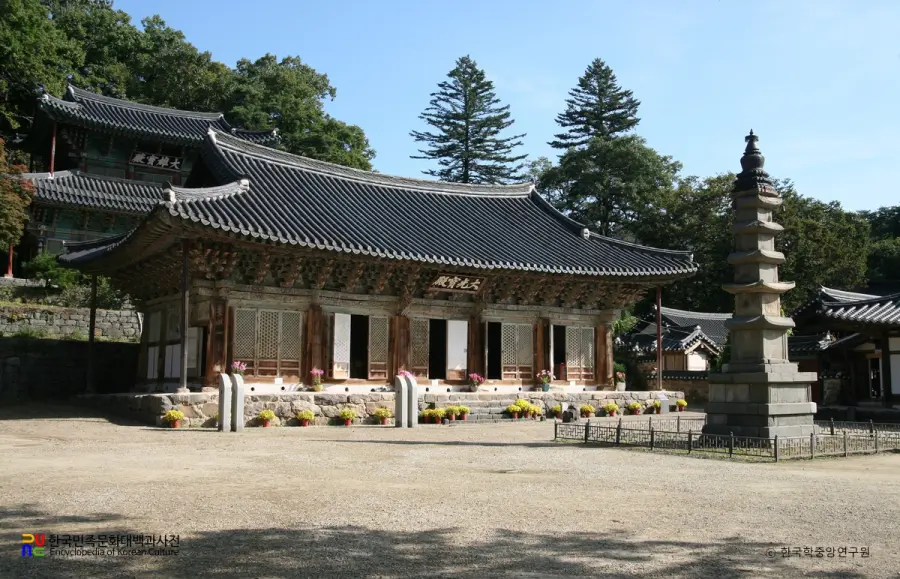
The Time That Faded Dancheong Tells
Magoksa is said to have been founded in 643 during the reign of Baekje King Mu, by Jajang Yulsa, a high monk from Silla. Academic debate over the date and the figures involved continues to this day, but the building itself speaks first to one fact: this temple has endured through long years.
Dae-kwangbo-jeon, the main hall at the centre of the temple, is what ultimately shapes Magoksa’s impression through its faded dancheong. The colours are not newly painted; that is precisely how the age of the temple shrine shows itself. Daeungbo-jeon, Yeongsan-jeon, and Hongseongnu all sit together, while Tae-hwa Seon-won, the training space for practice, is set along the slopes.
Magoksa is one of the seven temples included in “Sansa, Mountain Monastic Places in Korea”, which was inscribed on the UNESCO World Heritage List in 2018. The listing was based on how the mountains and the temple form a single landscape and how the site has carried on traditions of monastic practice. When you look at Magoksa as a meditation travel destination, it is a point you cannot easily overlook. The stillness here was not made for tourism; it has been protected for practice.
The Path Kim Gu Walked: The Baekbeom Meditation Trail
Another element that turns Magoksa into a meditation travel destination is the Baekbeom Meditation Trail that runs behind the temple. The trail was created along a route said to have been walked and reflected on by independence activist Kim Gu, who is said to have hid at Magoksa and practised in quiet devotion, carrying hopes for the nation’s salvation.
The trail is divided into three courses. You can choose according to your walking pace and fitness, which makes it easy to fit into either a one-day plan or a two-day itinerary. Inside the temple there is also a Baekbeom Hall, so if you visit before or after your walk, the trail’s background clings more closely to you.
On a meditation trip, walking matters as much as sitting. For people unfamiliar with seated practice, the time spent slowly walking a forest path becomes a natural entry point. Simply easing your pace and following the sensations that meet your soles is enough to form the basic shape of mindful walking. The Baekbeom Meditation Trail is, true to its name, a path arranged to match those steps.
Magoksa Temple Stay: Living the Temple’s Day as It Is
Magoksa runs temple stays. Temple stays managed by the Korea Buddhist Culture Business Group are generally divided into day-only, experiential, rest-focused, and group options. The experiential type usually follows a one-night, two-day schedule, with participants joining all programmes, while the rest-focused type shares only meals for offerings and prayers, using the rest of the time on their own.
Activities at the temple include temple-guided tours, Seon meditation, tea-and-chat sessions with monks, bowl offerings (bal-u gongyang), prayers, and a 108 prostrations practice, among others. Since the programme structure and participation fees vary by season, it is most accurate to check on Magoksa’s official temple stay page before you visit. For enquiries, call 041-841-6226.
If you are visiting the temple for the first time, the rest-focused type is one worth recommending. Join only the prayers and offerings at the scheduled times, then spend your remaining time walking the Baekbeom Meditation Trail or sitting by the creek. That matches Magoksa’s terrain particularly well.
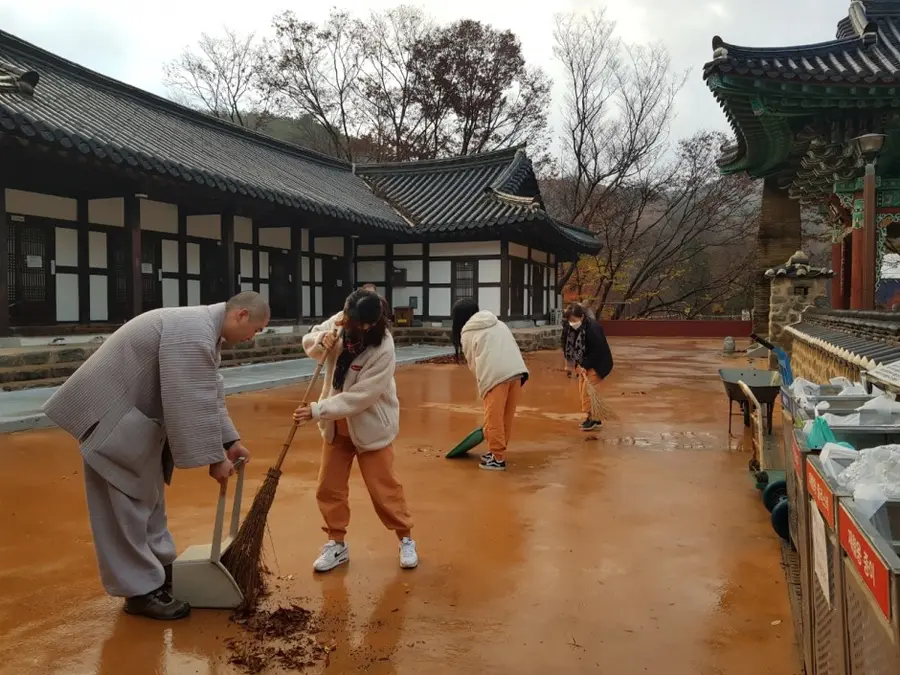
Every Saturday: Magoksa’s Meditation Classes Open
If you do not want to end with a one-day experience, there is another programme to note: the meditation class run by Magoksa’s Buddhist College. Magoksa described the programme as “The courage to pause for a moment even in a busy day—one step changes your life.” It explains meditation as an expansion of the rituals that arise in the midst of stillness, and presents it as a time to acknowledge and hold, as they are, the feelings that remained deep within you while you focus on your breathing.
The meditation class runs every Saturday from 9am to 4pm. You can join on a morning or afternoon basis, so you can take part for only half a day depending on your schedule. In the morning, you begin with stretching and warming up with a foam roller, then move on to 108 prostrations and meditation. After lunch offerings, tea time, a stroll, and walking meditation follow. From 2pm you return to meditation, and from 3pm there is a personal interview session with the lead instructor monk. The day ends with hwageong, the回向, at 4pm.
The order is to loosen your body first, then visit the temple, then sit, walk, and sit again. The point that people new to meditation find most difficult is that their mind does not become calm the moment they sit down, but this schedule relieves that burden by easing it from the front. It is also notable that the personal interview is built into the regular timetable. When you sit alone, there is no way to check whether you are doing it the right way. Having someone to ask every week makes a bigger difference for beginners than you might expect.
The teacher is Jochon-sunim, the head of the Magoksa administrative office. After graduating from the Faculty of Buddhist Studies at Dongguk University, he worked as a lecturer at the Buddhist College of Gilsangsa in Seoul. Tuition is 120,000 won per month, and one session costs nothing. Registration and enquiries should be made via Jochon-sunim (010-5776-4030) or the 담당자 (010-5750-9277).
The people Magoksa recommends its meditation class for are clear. Those who always have a cluttered mind and want to find breathing space, those who want to steady themselves amid stress and anxiety, those who want to live as themselves, and those who want to blend meditation naturally into everyday life.
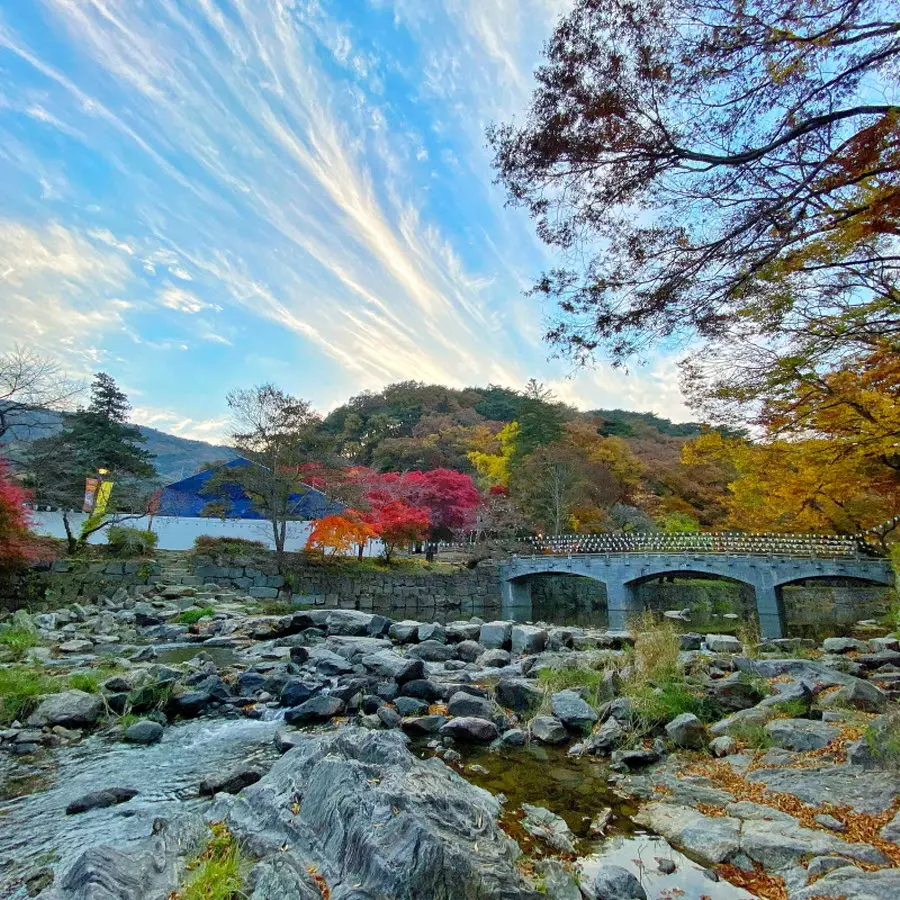
Wednesday Evening: Clear Seon Meditation in the City
Magoksa also runs a “seon myeong-sang” programme. It defines Seon (禪) as training practice that looks at it as it truly is, and explains it as a process of learning to live awake in this very moment without being swept along by thoughts and emotions.
The Saturday seon myeong-sang takes place in Magoksa’s Maehwadang Hall. After warming up with foam roller stretching and 108 prostrations, participants move on to seated meditation and lunch offerings, and then return to seated meditation. If you want to join from within Gongju city, there is also a Wednesday evening version. At the Gongju Buddhist Cultural Hall, every Wednesday from 7.30pm to 9pm, the session is kept short and neat, with stretching and seated meditation. In other words, in just an hour and a half on a weekday evening, you can continue the habit of sitting in the middle of the city, too.
Magoksa as a Meditation Travel Destination
As wellness travel destinations inside the country have multiplied, more spaces have been built promising healing and restoration. Among them, Magoksa’s strength is not that it has created a new type of content; it is that it makes available time that already existed. Tae-hwa Seon-won, protected as a space for training; the view of a mountain temple recognised as a World Heritage site; and a forest path steeped in reflection by historical figures all come together in one place.
Even when introducing Magoksa to foreign visitors, this combination is easy to explain. The structure, in which mountains, temples and paths form a single flow, is a distinctive feature of Korean mountain temples. Within a day, walking and sitting, eating and resting are placed naturally alongside one another. From the standpoint of designing a meditation travel product, this is a place where a day’s itinerary is complete without adding any separate programmes.
Stand for a moment in front of the faded dancheong, walk around the Baekbeom Meditation Trail, join the evening prayers, and then go to bed early. What Magoksa offers is that kind of simple order. And that simplicity is also what is hardest to obtain at the moment. If you feel it is a shame to end with just one trip, you can open this mountain gate again and step in at nine on Saturday morning.
Article enquiries: fare3041@naver.com