

Venerable Jeong Mok’s Dharma talk and Gaya Operetta come together at Gimhae Arts Centre’s Maru Hall at 6pm on 5 October
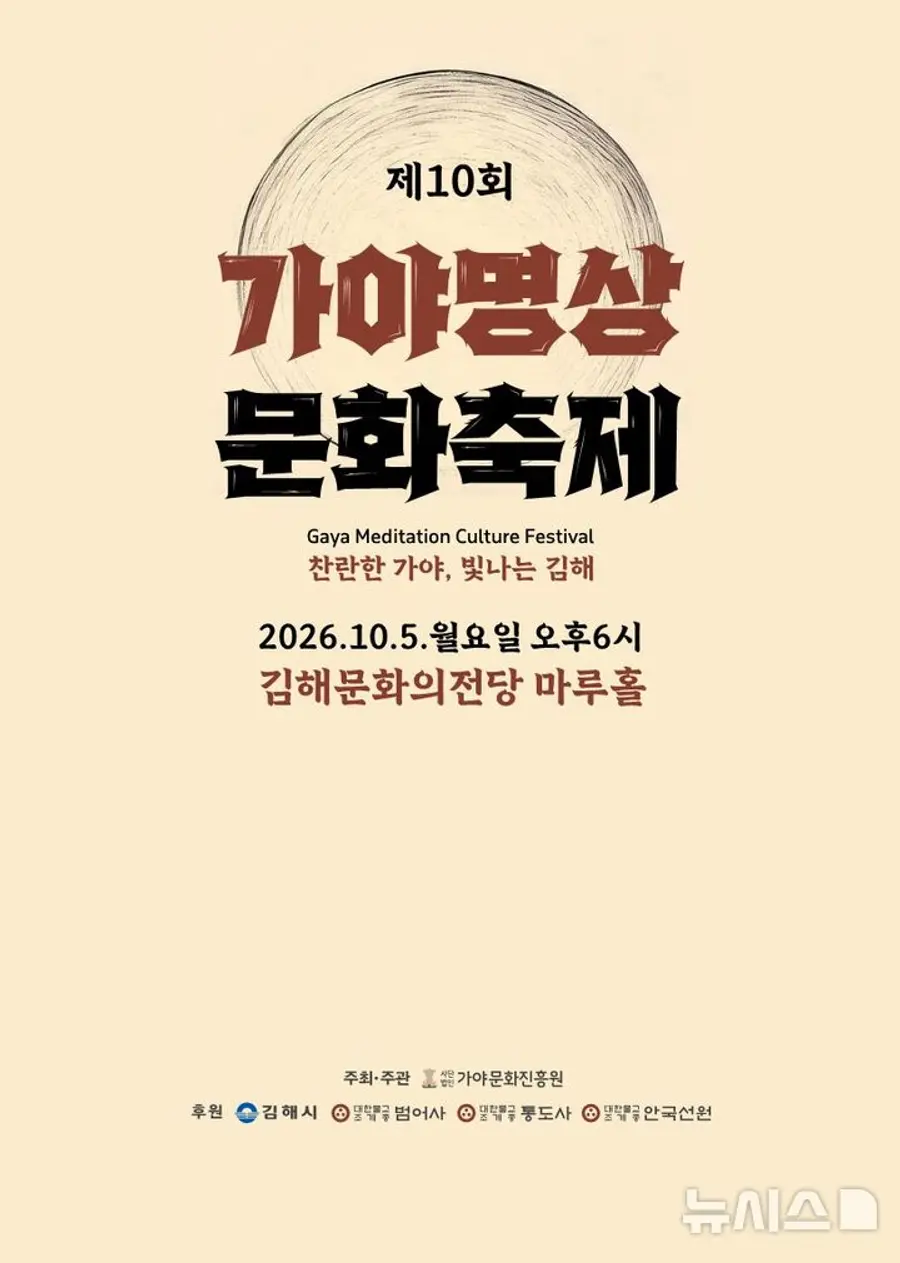
As autumn deepens, the mind too longs to slow down a beat. In a season when the body that has raced through the year is the first to ask for rest, welcome news has come from Gimhae. The Gaya Meditation Culture Festival, which brings meditation and cultural arts together on one stage, is opening its tenth edition this year. For a writer who has spent many years following the meditation scene, the fact that one city has sustained meditation as the name and focus of a festival for nearly a decade feels especially meaningful.
Gaya Meditation Culture Festival, Gimhae’s meditation festival since 2017
Gimhae City said on 29 September that the 10th Gaya Meditation Culture Festival would be held at 6pm on 5 October at Maru Hall, Gimhae Arts Centre. The event is hosted and organised by the Gaya Culture Promotion Institute, a charitable corporation chaired by Venerable Haegong, with support from Gimhae City. Gimhae Ilbo reported that Beomeosa Temple, Tongdosa Temple and Anguk Seonwon are also supporting the festival. This year’s theme is “Brilliant Gaya, Shining Gimhae”.
The festival began in 2017. Gimhae City says it has provided residents with opportunities for rest and cultural enjoyment through programmes combining meditation with the cultural arts. Gimhae Ilbo reported that the organisers designed this year’s event not simply as a religious ceremony or one-off performance, but as a meeting point between Gaya’s history and culture and meditation, a form of contemporary healing. This year’s programme is divided between two acts and includes dance, a Dharma talk, meditation, a gugak theatre production, and choirs made up of children and residents. Overall planning is being led by Venerable Inhae, dean of Tongdosa Temple’s Sangha University.
Act one: birth and quiet movement, from gesture to Dharma talk
Act one opens with a dance performance, 〈Ripples of Stillness〉. The work expresses stillness and breathing through movement. According to Gimhae Ilbo, the performance features Ha Yeon-hwa and Son Mi-ran, choreographed by Choi Eun-hee. It will be a moment when the body offers stillness before words do.
Venerable Jeong Mok, head of Jeonggaksa Temple, then meets the audience for a talk incorporating a Dharma teaching. Its theme is “Everyone was once my mother”. The talk is expected to reflect on life, relationships and sharing. Even reading the title seems to loosen something in the heart. How different might the expression of a day become if we could look upon passing strangers as we would our mothers? After the talk, a meditation programme involving the Gaya International Meditation Centre will allow the audience to settle into a steadier rhythm of breathing.
[Image: View of Gimhae Arts Centre or the Maru Hall auditorium — Gimhae Arts Centre official website, Photo Korea search for “Gimhae Arts Centre”]
Act two: a gugak feast, with Gaya Operetta singing of King Suro and Queen Heo
Act two explores Gaya’s history and mythology through gugak, dance and song, under the theme of Geumgwan Gaya’s era of peace and prosperity. At its centre is the gugak theatre production 〈Gaya Operetta〉, based on the meeting of King Suro and Queen Heo. It tells of the founding myth in which an egg descended from the heavens and a king was born, and of the relationship with a princess who came from the kingdom of Ayuta across the sea. These are stories that Gimhae has carried for nearly 2,000 years.
The operetta features 〈Gaya’s Morning〉 and 〈The Egg Descends〉, as well as 〈Janggunch’a Taryeong〉, based on Janggunch’a, Gimhae’s signature traditional tea. The children’s choir from Gubong Primary School will sing 〈The Dream of Gaya, Land of Jewels〉 and 〈Brilliant Gaya, Song of the Eternal Sun〉. The Hoyeon Gaya Buddhist Dance Troupe will be joined by the dances and the traditional Korean songs of singers Jeong Seung-jun and Kim Seon-hee, while a dance drama inspired by the ancient relationship between Gaya and India’s Ayuta kingdom will also take the stage. The finale will be the Gaya Maha United Choir’s performance of 〈Echoes of Gaya〉. From the clear voices of children to the adults’ chorus, the scene evokes several generations of one city filling an autumn night with the same song.
The people who have nurtured the festival: the Gaya Culture Promotion Institute and Gaya International Meditation Centre
The Gaya Culture Promotion Institute, which leads the festival, was established in 2014. It has continued projects promoting the value of Gaya culture, including running the Gaya International Meditation Centre and holding academic conferences on Gaya culture. According to Beopbo Shinmun, the Gaya International Meditation Centre opened at Baramil Seonwon in Gimhae in September 2022. Looking back at previous editions reveals the path the festival has taken. The sixth festival, held in 2022, featured Venerable Beopsang’s meditation lecture, a tea ceremony demonstration, salpuri and taepyeongmu, under the theme of meditation accompanied by dance and seon tea. At last year’s ninth festival, Venerable Maga led a compassion meditation with practitioners from the Gaya International Meditation Centre, alongside yoga, gugak and sand art. The festival has broadened its character each year by bringing together different meditation teachers and artistic genres. This year, contemporary dance and gugak theatre have joined the programme.
What we gain when meditation takes the stage
Spend enough time with meditation and you learn that stillness does not come only in a quiet room. A single dance gesture can deepen the breath, while the mind can grow tranquil after the final note of a choir has faded. For people who find meditation unfamiliar, a theatre can be the most comfortable point of entry. If closing your eyes and counting your breaths has felt difficult, you can begin by following the movement and sound on stage and naturally finding a steadier breath.
Ahead of the festival, Venerable Haegong said that Gaya meditation was a journey enabling modern people, who race through life without pause, to discover the happiness within themselves. A Gimhae City official also said the city hoped residents would find room to breathe through meditation and reflect on Gaya’s beauty through traditional arts.
It will be an evening of listening to a story from 2,000 years ago in Gaya’s ancient capital while steadying the breath of the present. On Monday 5 October, the hope is that Maru Hall at Gimhae Arts Centre will fill with people ready to share that stillness.