

Somewhere so quiet it almost feels uncanny—wherever you are in the world. That’s what a temple was like.
You’d hear dawn chants softly, catch the scent of incense, and feel the steady rhythm of the wooden moktak.
At least, that’s how it was until just a few years ago.
But these days, people in their 20s are going to temples. Not just to pay respects with clasped hands—but to browse merch, try meditation experiences, and see for themselves what people call the “cool space.” Sometimes, even “adventure” quests to meet someone you could love are carried out at temples.
Why Buddhism—right now? The birth of “cool Buddhism”
We’re in the era of “religion fading away.”
Unquestioning belief and obedience to a supreme being no longer produce the same governance effects. Instead, a generation that trusts individual perceptions has moved to the center of society. Paradoxically, though, that same generation is turning its attention toward Buddhism.
According to a Shin Dae Seung (New Mahayana) network survey, the religion most trusted by those ages 18–29 is Buddhism (21%), far ahead of Protestantism (11%) and Catholicism (6%). The reason Buddhist culture has found its way into younger people is simple: it doesn’t force anything. There’s no proselytizing, and no pressure to donate. Rather than doctrine, it puts practice first—and the keywords of mind training, eco-friendly living, and value-based consumption naturally overlap with where the MZ generation is headed.
Here, Buddhist-based brands like “Haetal Company” lowered entry barriers with merch and pop-ups, while DJ Newjin’s set blending EDM with Buddhist scriptures sparked explosive reactions. The share of people in their 20s and 30s participating in temple stays also jumped from 32.1% in 2019 to 40.7% in 2023. This is Buddhism being consumed not as a “religion,” but as “culture.”
Do you remember 2025? A precedent with 200,000 attendees
Last year, the “2025 Seoul International Buddhist Expo” at COEX’s C Hall wrapped up with a record 200,000 visitors—the highest ever. Of the 42,765 pre-registrants, 76% came from the 2030 generation. With 368 companies and 481 booths, it showcased a Buddhist culture industry spanning both tradition and modernity. Items that perfectly matched MZ tastes went viral—character merch combining capybaras and lotus flowers, the “Gonyangmi” plush doll, and even the milk tea “Smile Smile.” The International Seon Meditation Summit in the Bongeunsa Temple area drew 130,000 participants, while the Seon Meditation Festival attracted 280,000.
If you remember that kind of momentum, there’s even more reason to look forward to 2026.
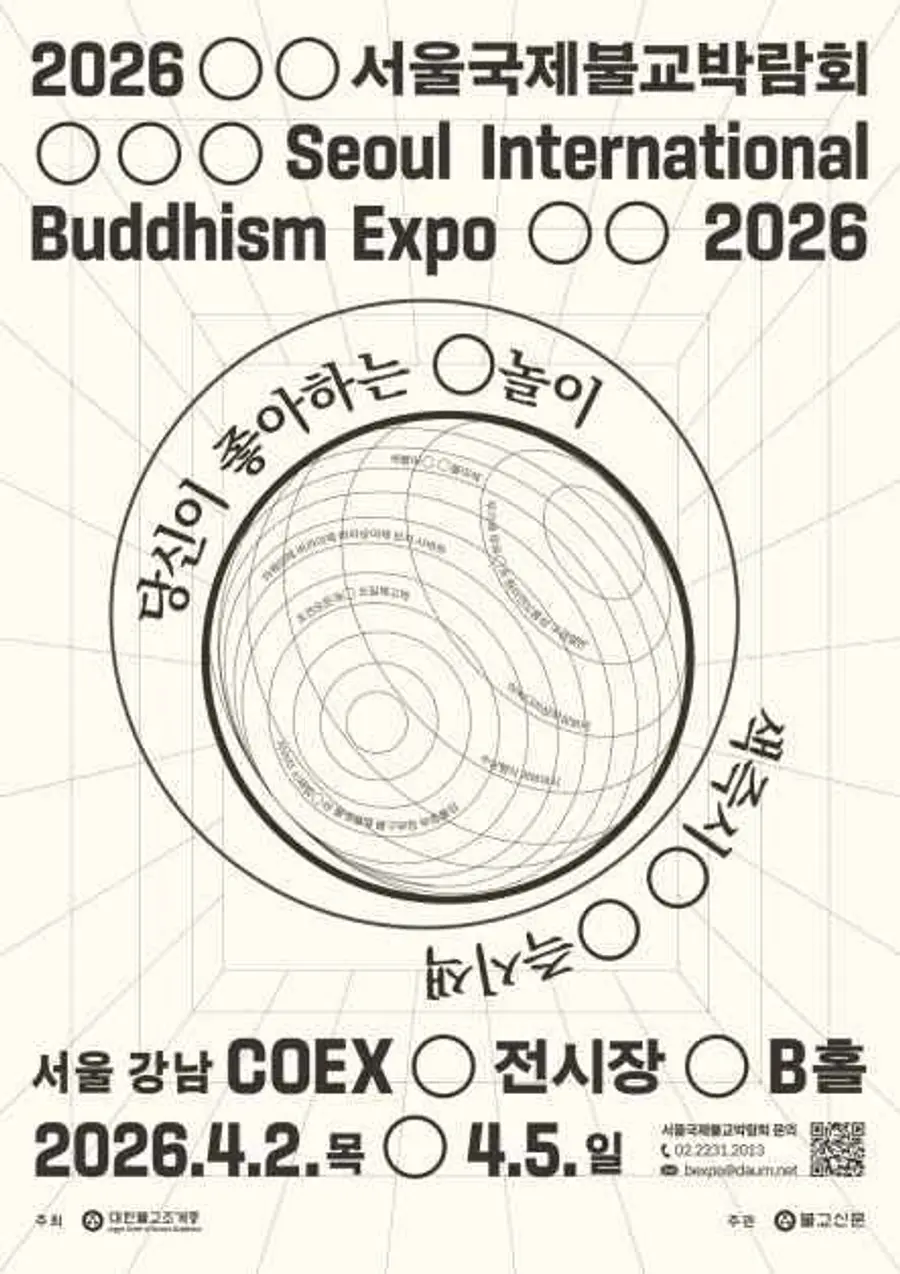
Seoul’s 2026 International Buddhist Expo — “Buddhism becomes play”
The “2026 Seoul International Buddhist Expo,” now in its 14th edition, will be held at COEX in Gangnam, Seoul, from Thursday, April 2, to Sunday, April 5. The slogan is, “Buddhism becomes play, and tradition becomes an industry.” The core theme this year is experiencing the Buddhist idea of emptiness firsthand. Emptiness will be reimagined as “play,” and the Heart Sutra will be reinterpreted through hip-hop and DJ performances. In addition to roughly 430 booths expanded from last year, the event will feature a Buddhist Culture Industry Exhibition, the Buddha Art Fair (BAF), and an international special invitation exhibition from overseas Buddhist countries. A new “Creator Goods Exhibition” has also been added to spotlight emerging creators. Venerable Beopjeong (Hwaeomsa Temple’s publicity director), known as “Flower Monk,” will also hold a book signing to commemorate the release of a new book. Visiting hours are 10:00 a.m. to 6:00 p.m., and free admission is available with pre-registration.
The 2026 International Seon Meditation Summit & Seon Meditation Festival — Probing the inner self in the AI era
At the same time as the expo, across the river in the Bongeunsa Temple area, another large-scale event will take place. Organized by the Jogye Order of Korean Buddhism, the “2026 International Seon Meditation Summit” (Seon Meditation Summit) is scheduled for April 3, and the “Seon Meditation Festival” will run from April 4 to 5 in and around the Bongeunsa Temple and the Bongeunsa Cultural Center.
This year marks the third edition of the International Seon Meditation Summit. Its theme is “Seon meditation in the AI era.” As technology gets faster, the paradox the event directly addresses is that people want their hearts to slow down. One distinctive program is “Mind Prescription,” in which AI analyzes participants’ worries and mental states to suggest personalized meditation methods, tea (tea), and quotes from koan phrases on-site. The program led by Susoo (An Gook Seonwon director) is already sold out early, and most of the 41 sub-programs closed in advance. From last year’s 130,000 participants, this year the target is 200,000 total, including both on-site and online attendees. The Seon Meditation Festival aims to grow from 280,000 last year to 350,000.
From COEX to Bongeunsa Temple — A meditation pilgrimage in the city
A day that starts with Buddhist merch at COEX, then takes a 10-minute walk to Bongeunsa Temple to try Seon meditation. The first weekend of April turns Gangnam into South Korea’s biggest Buddhist and meditation culture belt. It’s a place welcoming everyone—non-believers, meditation beginners, and even those who drop in just because they happened to pass by. The reason Buddhism is “cool” these days comes down to one thing: the door to enter is lower, and inside is wider than you’d expect.
In the spring of 2026, the people in their 20s swept up by cool Buddhism may end up doing cherry blossom viewing at a temple.