

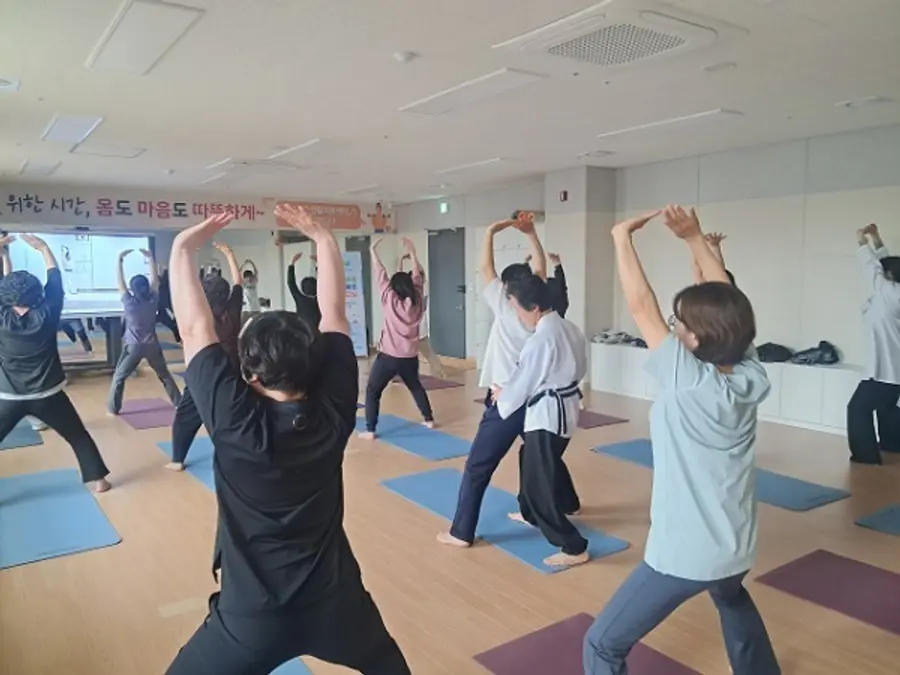
On a spring morning when the noise of the city fades away, people slowly raise both arms from the mountainside in Jecheon, North Chungcheong Province. One breath. One movement. No rushing. That scene lingers in the heart for a long time.
A Prescription Jecheon Draws Up for 'A Nature-Healing City'
Jecheon has long referred to itself as a 'nature-healing city.' With the history of one of the country's top three medicinal herb markets, and with astragalus and angelica said to grow everywhere across this land, traditional Korean medicine healing feels less like a treatment and more like a way of living. This outlook eventually gave rise to the 2026 Jecheon Oriental Medicine Healing Academy.
Operated by the Jecheon Oriental Medicine and Natural Products Industry Promotion Foundation (Chairman Myung-hyeon Choi), this program is a healing education course that began in 2013 and has produced 480 graduates every year. While the primary targets are central government ministries and local government officials nationwide, the philosophy within it is far more universal: 'For those who are worn out, teach them the way to rest first.'
Starting in 2026, the program will shift from simple experiences to an industry-oriented educational curriculum. In the process, the content has deepened further, helping participants build a stronger understanding of the traditional Korean medicine natural products industry.
Healing That the Body Remembers First — Qigong Exercises and Oriental Breathing Meditation
At the heart of this academy are Qigong exercises and Oriental breathing meditation.
Qigong is an Eastern body-training practice with thousands of years of history. Through slow, gentle movements, participants observe the flow of qi, and connect breathing with motion. Thoughts become quiet, and blocked areas within the body start to loosen. It is training that requires no elaborate tools—only your own body and breath.
Here, lifestyle yoga is added as well. This is not advanced yoga designed only for professional practitioners; it is built from movements you can sustain in everyday life. A key feature is that it is designed so even people who lay out a mat for the first time—or those whose bodies have grown stiff from long fatigue—can follow along slowly.
Oriental breathing meditation is a time for finding inner stillness by applying the principles of Dantian breathing. Within the simple act of inhaling and exhaling, participants reconnect with the 'present moment' they may have overlooked for a long time.
The Healing Thread Woven by Jecheon's Nature — From Herb Experiences to Cheongpung Lake
What makes the program special is that it does not stay only inside the classroom. Over a 2-night, 3-day schedule, Jecheon's natural environment and history become the backdrop for healing.
During the herb experience, participants directly touch and learn to prepare Jecheon's representative medicinal ingredients such as astragalus, Schisandra, and balloon flower root. The hands-on practice of making traditional Korean medicine essential oils is an introduction to traditional medicine you learn by doing. After the education ends, participants board the Cheongpung Lake Cable Car to take in the landscapes of North Chungcheong Province, then cross the Okseonbong Scenery Bridge with feet that gently sway. And at Uirimji, a place with 2,000 years of history, they listen closely to a guide's stories.
A special lecture on Oriental medicine constitutional health practices is the first step toward understanding one's own constitution. Foods that suit me, movements that suit me, ways of resting that suit me—everything is woven into a single flow over a day and a half.
What Changes in 2026 — A Deeper Understanding of Industry
Chairman Myung-hyeon Choi said, "We prepared thoroughly so that public officials across the country can find stability for both mind and body through an environment where Jecheon's beautiful scenery and traditional Korean medicine natural products come together. We hope this becomes an opportunity to relieve work stress and gain new energy."
This year's academy changes are not merely adjustments to the curriculum. As Jecheon positions itself as a hub city for the traditional Korean medicine natural products industry, having public officials across the country directly experience and understand the real scene becomes, in itself, a policy message. Healing and industry meet in one space—nature and education come together as well.
Qigong Exercises and Meditation — Why Now?
Modern people's bodies are exhausted quickly. In an environment where we are always connected and always required to handle something, 'time to do nothing' can feel like a luxury. Yet qigong and meditation, they say, actually begin recovery within that 'doing nothing.'
The Jecheon Oriental Medicine Natural Healing Center shares the same philosophy. The center operates a variety of programs year-round, including meditation, nature-healing movement, forest healing, and tea meditation, and is positioned as a space where visitors to Jecheon can restore balance between body and mind. 'Helping people accept reality as it is while growing the power of positivity within' is the center's core direction.
People who learn qigong exercises for the first time often say the same thing: 'I think I learned how to breathe again.' The words are quiet, yet deep.
Perhaps what we need is not some grand change. In Jecheon's Cheongpung Myeongwol breeze, that moment when you slowly raise both arms—just that brief pause to catch your breath—might be enough to become healing. Jecheon is extending that quiet invitation.