

In an era when anxiety, depression and isolation have already become everyday language, both children and teachers—and parents, too—carry their own feelings alone. The proposal to have society share that heavy burden arrives in the language of meditation. The Jogye Order of Korean Buddhism is putting forth as its central theme the ‘fusion of Seonmyeong and public education.’
To be held on July 9 at the Center for Korean Buddhist History and Culture
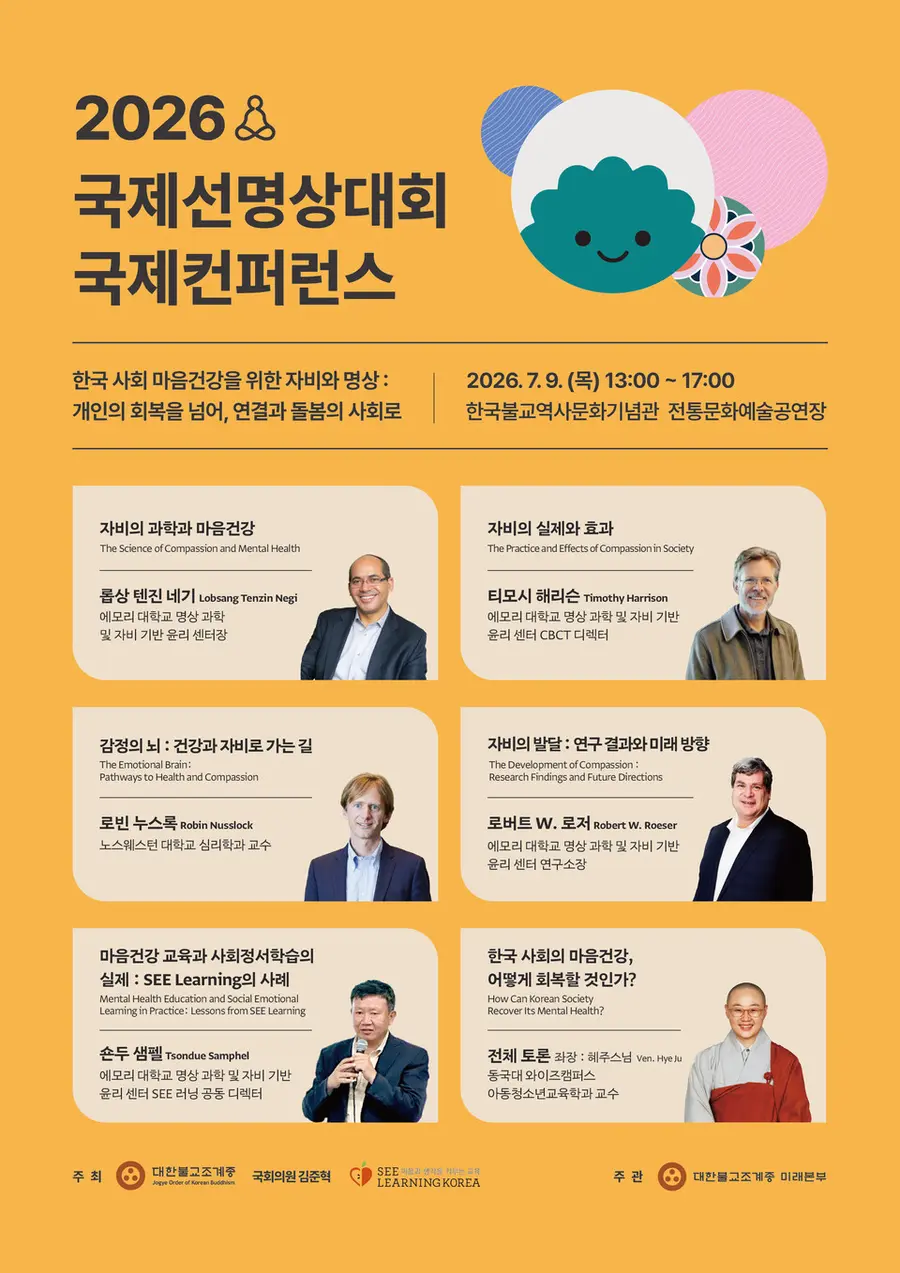
The Jogye Order of Korean Buddhism, led by Grand Master Jin-woo as the head of the General Office, will hold the ‘2026 International Seonmyeong Competition International Conference’ at the Traditional Culture and Arts Performance Hall of the Center for Korean Buddhist History and Culture on July 9 at 1 p.m., jointly with National Assembly member Kim Jun-hyeok and SEE Learning Korea. Organized by the Jogye Order’s Future Headquarters, the conference theme is ‘Compassion and meditation for mental health in Korean society: beyond personal recovery, toward a society of connection and care.’ The conference opens with ‘a time for Seonmyeong,’ when members of the Buddhist community gather their minds together.
Beyond personal recovery, toward a society of connection and care
The target of this conference is clear. It aims to build a public mental-health system that allows children and teenagers who are struggling with anxiety and isolation, along with the teachers and parents who care for them, to look after their minds in daily life. It will develop the social institutionalization of Seonmyeong and the introduction of public education—discussed by the order, politics and the education community since last year—into a concrete implementation roadmap.
Change is already being detected in educational settings. Seoul Superintendent of Education Jeong Geun-sik defined mental health as the foundation for children’s growth and promised a tight safety net. Gyeonggi-do Superintendent of Education Ahn Min-seok also announced a strong determination to introduce preventive emotional education. The direction for social and emotional education pursued by metropolitan-area school offices supports the need to introduce public-education versions of the SEE Learning and Seonmyeong programs.
A relay of presentations from five leading meditation science scholars
The conference’s weight centers on presentations by five scholars who lead meditation science and social and emotional learning (SEL worldwide). The presentations are divided into Part 1 and Part 2.
In Part 1, titled ‘The Science of Compassion and Mental Health in Korean Society,’ Lobsang Tenzin Negi, professor at Emory University and director of the Center for Mindful Ethics and Compassion-Based Ethics, presents ‘The Science of Compassion and Mental Health.’ Negi is the originator of compassion training based on cognition (CBCT), which brought Tibetan meditation traditions into modern science. He is also the designer of SEE Learning, which was created through 20 years of collaboration between the Dalai Lama and Emory University. Next, Timothy Harrison, CBCT director, presents practical methods to manage everyday stress and self-blame under the theme ‘The Reality and Effects of Compassion in Society.’
Part 2, titled ‘Compassion Expanded Through Emotion, Development and Education,’ connects neuroscience and education. Robin Nusslock, professor of psychology at Northwestern University, identifies the neuroscientific principles through which meditation works for emotion regulation. Robert W. Roeser, director of research at Emory University, highlights the potential for children, teenagers and teachers’ social and emotional competencies to grow within schools. Tsondue Samphel, co-director of SEE Learning, shares real-world examples of mental-health programs that can be applied immediately in schools and local communities.
A general discussion that puts six questions on the table
After the presentations, Hye-ju, a professor in the Department of Child and Adolescent Education at Dongguk University’s Wise Campus, serves as chair and leads a general discussion under the theme ‘Mental health in Korean society: how can we recover?’ The event holds a dialogue with the audience around six core questions for moving beyond endless competition toward a society of connection and care. Roeser will also personally conduct a seminar at the Seoul Metropolitan Office of Education the day after the conference, on July 10, for staff responsible for social and emotional education, widening links with public education settings.
Ilgam, secretary general of the Jogye Order’s Future Headquarters, said this will be a chance to confirm that compassion and meditation do not stop at helping individuals find stability in mind and body, but also serve as social capacities that lead to qualitative changes in public education.
A journey shared by 50,000 people comes together around one answer
This conference is an extension of the ‘2026 International Seonmyeong Competition’ that kicked off at Bongeunsa Temple in April this year. About 50,000 people visited over the opening three days, and more than half of those who took part in experiential activities were in their 20s and 30s. The momentum that spread from Seoul to nine regions nationwide—Gongju and Ulsan in addition to Sejong, Busan, Daegu, Yeongam, Yeongdeok and Jangseong—will come together as one answer at the international conference that will close in November. In the Jogye Order’s mental-health journey, which promises ‘Seonmyeong for 5 minutes a day for all citizens,’ the July 9 conference will become a turning point that translates meditation into the language of social care.
Participation Information
In-person attendance can be registered in advance through the pre-registration link (https://forms.gle/zNBqQMSk9ZXYMpvi6). For those who have difficulty visiting the venue, a live stream will be provided in real time on the YouTube channel ‘BTN Buddhist TV,’ and you can also join via the pre-registration link for the online live stream (https://forms.gle/9GpKRZtdxo2YaymX7).