

'
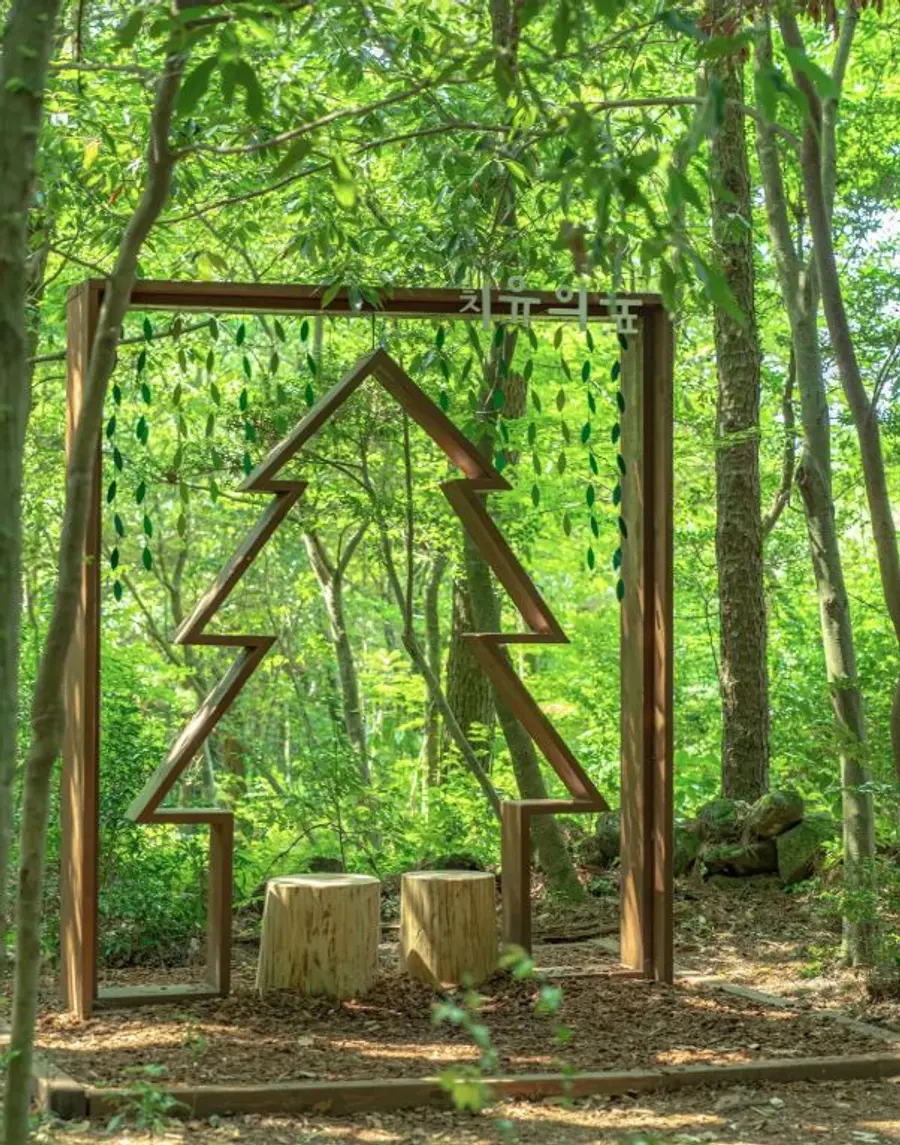
The forest on the south slope of Hallasan holds moisture every morning. When the humidity rising from the sea clings to the lower slopes, a faint mist drifts between incense-cedar and Japanese cedar trees, and the soil under your feet seems to swallow sound. In the Seogwipo healing forest, the first thing that changes is the sound. Where the sound of cars fades, you hear the rustling of leaves and your own breathing.
People usually come to Jeju for the sea. But if you drive from that sea for just about 20 minutes, there is a forest where the day takes on an entirely different rhythm.
On the slopes of the oreum, a forest that opened in 2016
The Seogwipo healing forest is located on the slopes of the oreum in the area around San 1, Hogun-dong, Seogwipo-si. It opened in June 2016. It is not a space created by planting new trees, but an area where long-grown incense-cedar and Japanese cedar forests were kept and an old forest road was refined and reorganized to fit the purpose of healing.
The address is 2271 Sanrok-nam-ro, Seogwipo-si, Jeju Special Self-Governing Province. It is not hard to access because the road heads up toward Hallasan from within central Seogwipo. From Jeju International Airport, visitors travel toward Seogwipo via Pyeonghwaro and Yeongpung-ro and then enter Sanrok-nam-ro.
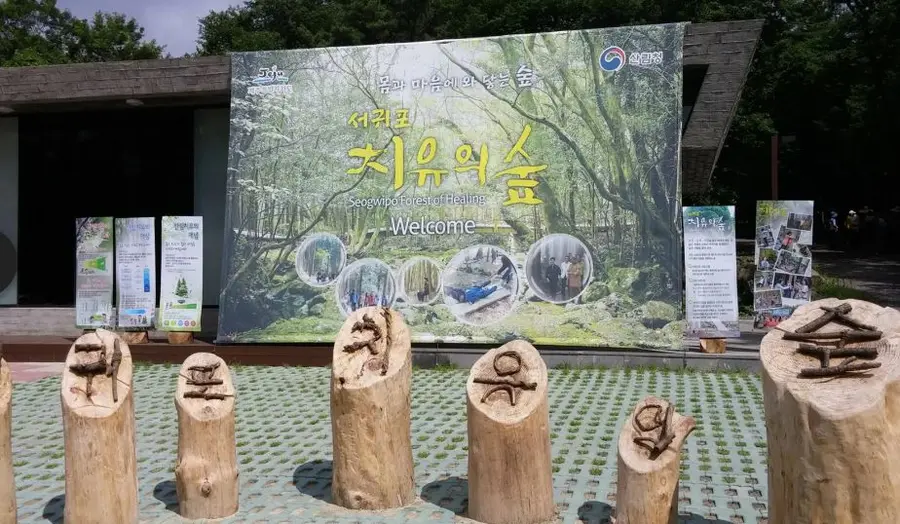
Play, rest, and make your way — Jeju-language names for the trails
What determines the feel of this forest is the names of the paths. The forest trails carry Jeju-dialect names such as “놀멍, 쉬멍, 오고생이.” They mean “while playing,” “while resting,” and “all the way through,” respectively. They are names that set the walking pace in advance.
The trails are divided into short stretches ranging from 0.6 km to 2.1 km. This layout is not designed as hiking routes with a goal of a full traverse; instead, it is structured so you can choose one segment, walk and sit, then return. You can combine the routes according to your fitness level or available time.
If you connect and walk the entire forest trail system, you cover a considerable distance, but the way the healing forest recommends doing it is almost the opposite. It is about walking briefly and staying for a long time.
Even wheelchairs and baby strollers can enter
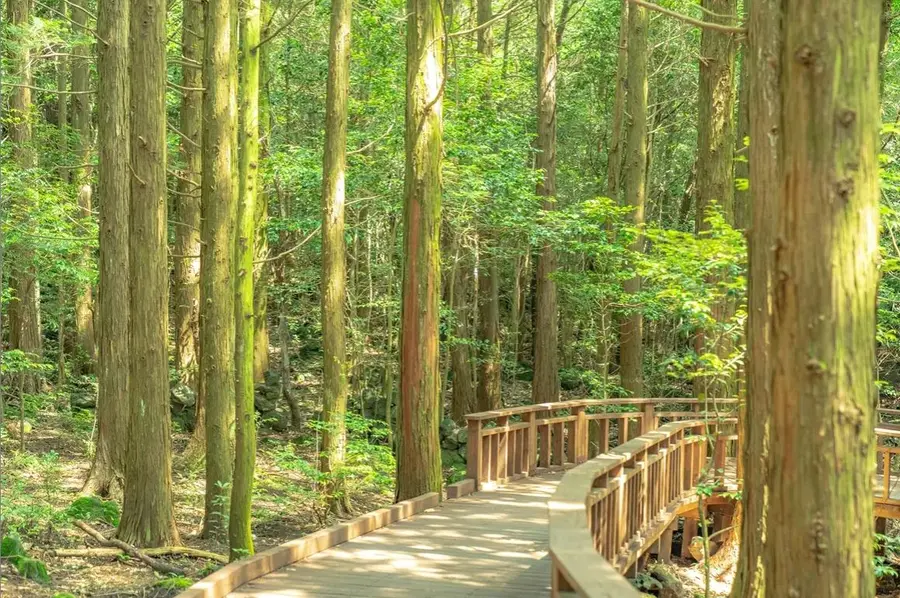
The Seogwipo healing forest was named one of the Ministry of Culture, Sports and Tourism’s “open tourist destinations” in 2020. With barrier-free deck paths and “sharing paths,” visitors using wheelchairs and those accompanied by baby strollers can also go into deeper parts of the forest.
Because meditation and forest healing are not limited to people with a specific level of physical fitness, this design shows the character of the forest well. When introducing domestic wellness tourism spots to foreign visitors, accessibility also becomes an important criterion.
Visitor Center and Healing & Recovery Center, a yoga class in the woods
Inside the forest, there are a Visitor Center, a Healing & Recovery Center, and a yoga class in the woods. On days when the weather is bad or when programs are running, the indoor spaces are used.
Operating programs are divided into several types: interpretive tours with a guide, forest trail programs run on set days of the week, and forest healing programs. Forest healing programs include stretching and meditation, as well as time lying on a hammock and looking up at the sky between the trees.
“Gyueong-sut-sul-bol-meong” runs at 10 a.m. and 2 p.m., and “Jat-dam-gil georeomneung” runs on Tuesday, Friday, and Sunday from 10:30 a.m. to 12:30 p.m. Reservations are required in advance, and there is a set capacity for each session.
[Image: A person lying on a hammock in the forest and looking at the sky between trees — PhotoKorea “forest hammock for forest healing” / Unsplash “forest hammock looking up” search]
Visitor information
Address: 2271 Sanrok-nam-ro, Seogwipo-si, Jeju Special Self-Governing Province (around San 1, Hogun-dong)
Admission hours: Summer season (4 to 10 months) — entry 08:00~16:00; Winter season (11 to 3 months) — entry 09:00~16:00
Closed: Open year-round (admission is restricted if weather conditions worsen)
Guided tour fee: Adults 1,000 won (group 800 won), teens 600 won
Forest healing program: Adults 12,000 won (discounts of 6,000 to 8,400 won applied depending on the target)
Reservation: Make a prior reservation through Seogwipo e-Ticket (eticket.seogwipo.go.kr)
Inquiries: 064-760-3067 / 064-760-3031~5
Fees, operating hours, and program session schedules may be adjusted depending on the season and circumstances, so it is necessary to check before visiting.
When is the best time to go
Incense-cedar and Japanese cedar forests do not vary much by season. Still, taking into account the distinctive humidity on Jeju’s southern slopes, early summer and early autumn are convenient for walking. In summer, the early morning hours are fine, and in winter, the midday period is also workable.
The forest right after it rains is more fragrant. It is also when the incense-cedar scent rises most strongly. If you bring a rain poncho, it is worth targeting the period after the rain.
A place for a meditation trip
Forest healing facilities in South Korea have grown quickly in recent years. Among them, one distinctive feature of the Seogwipo healing forest is that it combines with the destination of Jeju itself. A route naturally forms where travelers who came to see the sea and the oreums set aside a day and stay in the forest.
This combination also becomes a strength when introducing the site to foreign visitors. That is because the program does not require formal barriers such as a temple stay or a yoga retreat; it works simply by walking, sitting, and lying down. It is also worth noting that the facility is designed to be accessible for people with mobility needs.
Meditation does not require a special place, but some places speed up how quickly your mind settles. Anyone who pauses briefly between incense-cedar trees and stands still can feel the difference.
Article inquiries: fare3041@naver.com