

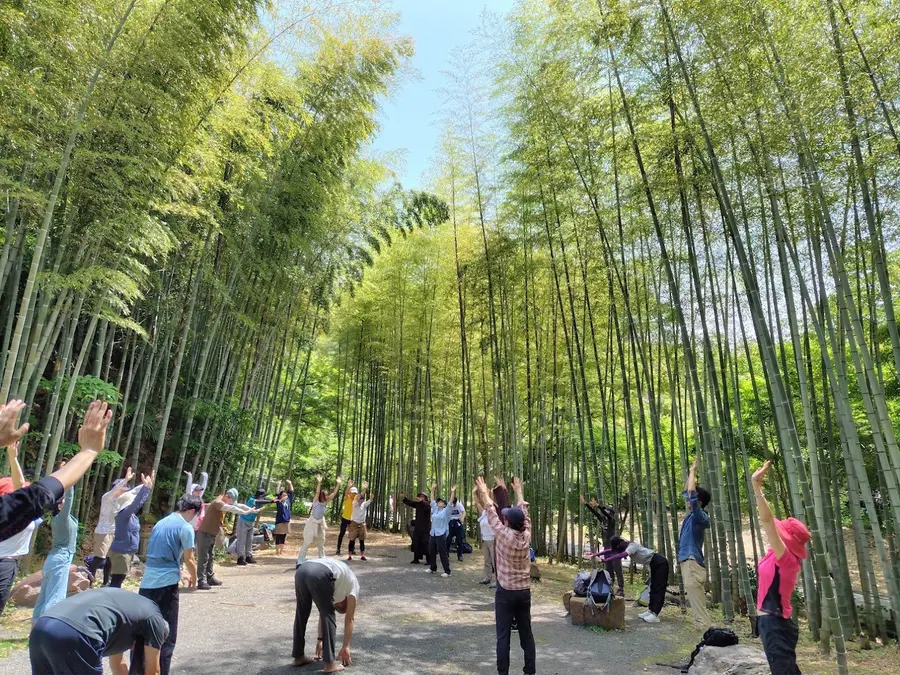
Kamakura, an ancient center of Japanese Zen Buddhism, will turn the entire city into a setting for meditation for one week in November. General Incorporated Association Zen2.0, which has led an international conference on Zen and mindfulness, announced that it will hold Mindful City Kamakura Week throughout Kamakura from November 14 to 21, marking its 10th anniversary. This year’s theme is Wa: The Resonance of All Things.
Since 2017, Zen2.0 has held an annual international conference on Zen and mindfulness at Kenchoji Temple in Kita-Kamakura. According to the organizers’ press release, past speakers have included Nanrei Yokota, abbot of the Engakuji school; former Google mindfulness teacher Chade-Meng Tan; neuroscientist Kenichiro Mogi; and Stanford University School of Medicine psychologist Stephen Murphy-Shigematsu. The organizers aim to make Kamakura a mindful city.
Opening at the Noh Stage, closing at Kenchoji: More than 30 programs in between
The event opens November 14 at the Kamakura Noh Stage. After a dedicatory performance, former Agency for Cultural Affairs Commissioner Seiichi Kondo will deliver a keynote address on the wisdom Japan’s spiritual culture offers for the future. Yuki Shiina, who leads ZEN breathing practices, will guide participants in learning breathwork through movement. A discussion on Wa and leadership will follow, with participants including Jeremy Hunter, professor at the Drucker School of Management at Claremont Graduate University.
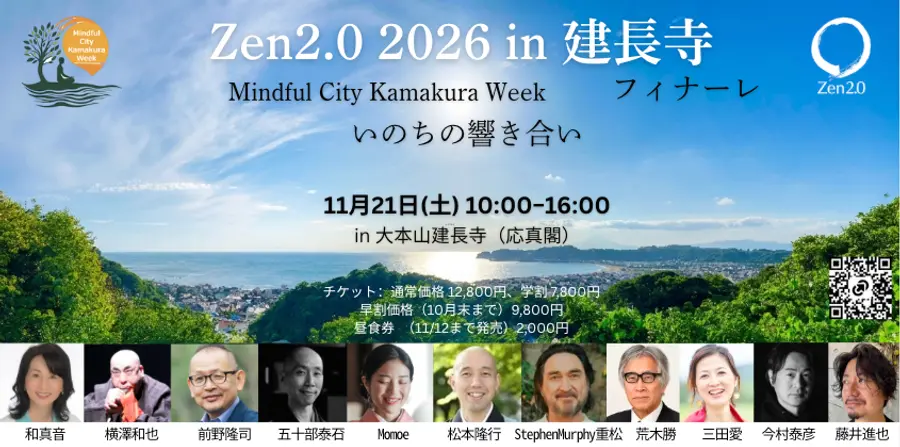
The finale takes place on November 21 at Kenchoji, the head temple in Kita-Kamakura. The day begins with a Buddhist sermon and seated meditation in the main hall, followed by a lecture on the science of happiness by Takashi Maeno, dean of Musashino University’s Faculty of Well-being; a discussion connecting neuroscience, music science and Zen; Zen Eating, in which participants eat slowly and focus on their senses; and sound meditation with singing bowls. The day concludes with a conversation between Stephen Murphy-Shigematsu and all participants.
The week between the two events will be filled with programs organized by residents, groups, shops and businesses. Zen2.0 said more than 30 partner programs will take place at temples, historic homes, and in the city’s sea and forests. Every evening at Jochiji, an installation brings together calligraphy from East and West. At a subtemple of Engakuji, a four-hour program combines tea, conversation and seated meditation. The schedule also includes Horse Education, a chance to connect with horses; a cocktail experience in the forest; Japanese sweets-making inspired by the five elements; sound meditation with crystal bowls and singing bowls; Noguchi Seitai; and body-based practices such as Zen acupressure. There will also be opportunities for discussion, including a peace dialogue ahead of the 80th anniversary of the end of World War II.
A festival that opens several doors for people who find seated meditation difficult
The schedule makes clear that seated meditation is just one of many ways into the festival. Sessions on learning breathwork through movement, immersing oneself in sound, eating, walking and touching are given equal weight. The organizers say participants can choose how to take part and select the ticket that suits them.
In the AI era, when information pours in nonstop, sitting for a long time and observing the mind can be a high bar for people new to meditation. For those who spend most of the day in front of a screen, meditation that begins with movement and listening may be an easier entry point. Kamakura, known as a birthplace of Zen, has included acupressure, stretching, sound meditation and connecting with horses in one festival—a choice that can be read as an effort to make the practice more accessible.
There is also an easy way to try it out. From November 15 to 21, a 30-minute online meditation session will be held on Zoom every morning at 7 a.m. It is free with advance registration. Participants can join Kamakura’s morning meditation from across the sea.
A forum on liberal arts in the AI era makes room for shakuhachi and bodywork
One of the most noteworthy events in the 10th-anniversary program is the special forum “What Does the AI Era Need From the Liberal Arts?” on November 20 at Kirara Kamakura Hall. On October 19, Zen2.0 announced the forum’s detailed program, saying it had deliberately placed music, bodywork and meditation between the lectures and discussions.
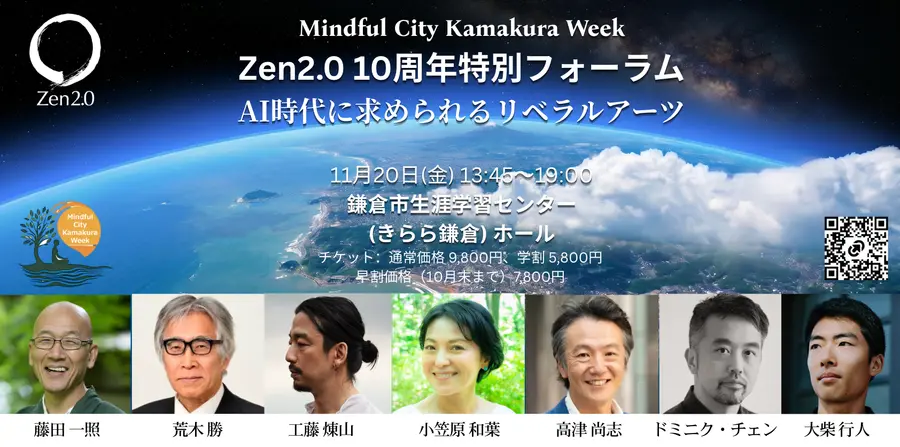
The forum opens with a performance by shakuhachi player Renzan Kudo. Masaru Araki, professor emeritus at Okayama University, will speak about Aristotle’s concept of liberal education, read through the lens of ancient Greek. Waka Ogasawara, a bodyworker and associate researcher at Keio University’s Center for Body Research, will lead a session on reading society and people through bodily sensation. Next, Hisashi Takatsu, former head of IMD’s Northeast Asia operations; Yukihito Oshiba, co-founder of AI company Robust Intelligence; and Dominic Chen, a professor at Waseda University, will discuss what Japan’s spiritual culture can offer the world. Issho Fujita, a Soto Zen priest, will give a lecture on Zen as a liberal art, followed by a discussion with Professor Araki. The organizers say the forum is aimed primarily at business executives and leaders.
AI experts, a Zen priest and a philosopher will share the stage, with the sound of a flute and bodily sensation connecting their contributions. The program suggests that as technology accelerates, the ability to preserve our humanity may be found not so much in intellectual knowledge as in practices experienced through the body. On November 18, Nanrei Yokota will also give a special 10th-anniversary lecture on prayer and the wisdom of life, taking as his starting point the poetry of Buddhist poet Shinmin Sakamura.
A meditation festival organized by temples and the city—and what K-meditation can learn
Kamakura’s experiment raises a clear question for Korea’s meditation community: Can a city’s temples, civic spaces and natural surroundings be brought together on one meditation map, beyond events organized by a single group at a single venue? Zen2.0 activated the entire city by organizing four major lectures itself and leaving the rest to local individuals and groups. The organizers’ September press release projected attendance of 500 to 1,500, opting to highlight the character of the city rather than the scale of the event.
Korea, too, has ancient mountain temples, meditation centers in its cities, forests and beaches. It is already easy to experience temple meditation, walking meditation, sound meditation and tea meditation separately. Bringing them together into a weeklong story across one city could give newcomers in Korea a chance to compare different forms and find one that suits them, while offering international visitors a single place to experience K-meditation. Kamakura’s eight days offer a useful model for considering that possibility.
Event details and reservations are available on the official Mindful City Kamakura Week website. The special 10th-anniversary ticket, which covers all four major events and the morning meditation sessions, costs 19,800 yen for general admission, with a discounted price available through the end of October. Partner programs require separate reservations.
For inquiries: fare3041@naver.com