

Wellness experts from Korea, Japan and China will gather in Wonju, Gangwon State, to discuss how people can restore their bodies and minds in the age of AI. Third Age, led by CEO Lee Boram, announced that it will hold the 2nd Global Senior Wellness Conference on Nov. 6 and 7 at Museum SAN and Oak Valley in Wonju.
The theme is “Recovery and Healing in the Age of AI.” Through seven topics—sleep, nutrition, exercise, mind, space, travel and technology—the conference will examine the recovery needed to live a long, healthy life. Following last year’s inaugural event, which brought together experts from four countries and more than 100 participants, this year’s program more closely weaves walking, rest and meditation into its talks.
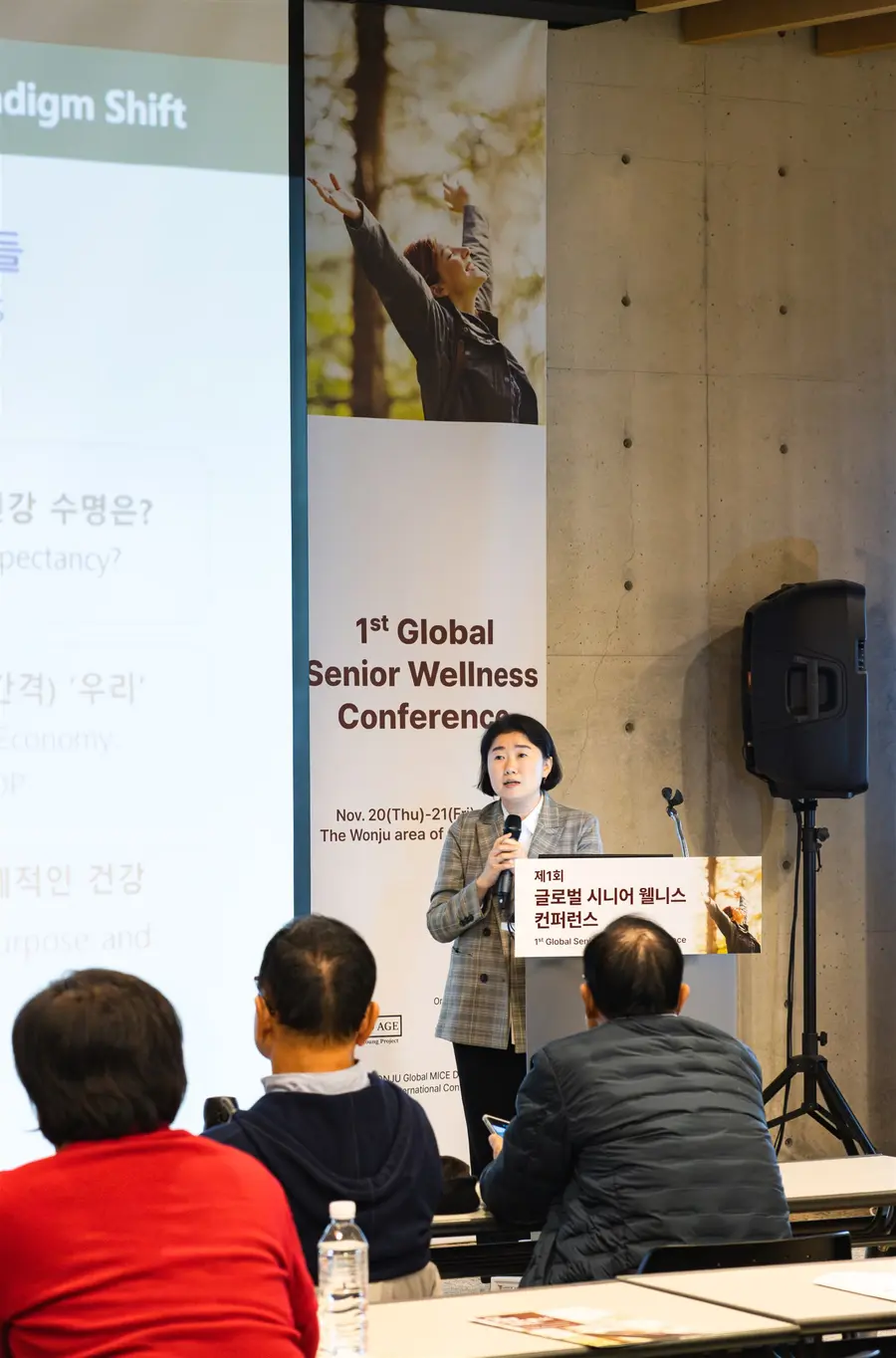
Experts from four countries and more than 100 participants at the inaugural conference in Wonju
The inaugural conference was held across Wonju on Nov. 20 and 21, 2025. Experts from Korea, Japan, China and Singapore took the stage, while attendees from several countries, including Peru, joined the audience. More than 100 people attended, making for a lively event. Lee recalled that it was the largest event she had organized. Park Young-ran, a professor in Kangnam University’s Department of Senior Business, served as moderator.
Wonju supported the event through the Ministry of Culture, Sports and Tourism’s program to help develop preliminary international conference districts. In congratulatory remarks, former Wonju Mayor Won Kang-soo noted that Museum SAN’s Meditation Hall and Oak Valley had been selected as outstanding wellness tourism destinations and expressed hope that the event would help make Wonju an Asian wellness hub.
From Singapore’s trust system to Japanese care robots, questions raised at the first conference
The inaugural talks presented different countries’ approaches to aging societies side by side. In his keynote, Lee Yoon-hwan, president of the Korean Gerontological Society, called for a national strategy that looks beyond disease management to care for people’s lives as a whole. Singapore-based director Esther Tan introduced a nonprofit public trust system in which the government guarantees the principal, addressing financial wellness. Makiko Kawabe, a researcher at Japan’s SOMPO Digital Lab, described a new care model that uses sensors to monitor falls and AI to analyze daily-life data, addressing wellness in the longevity economy.
The discussions also turned to the body and the spaces people inhabit. Jane Jiang of China said people can improve their cardiorespiratory fitness through regular exercise even at 70, recommending activity that raises the heart rate moderately rather than slow walks. Lee Kyung-mi, director of the It’s Okay to Get Old Design Research Institute, said wellness begins with designing dignified living spaces for older adults, from removing thresholds and installing safety rails at home to providing neighborhood benches and public restrooms. Programs at Museum SAN’s Meditation Hall and forest-healing activities at Oak Valley ran between the talks.
Lee defines wellness as the sum of experiences that restore the body, mind and everyday life. Immediately after the first conference, she described it as a long-term project that would continue for years. One year later, its second edition is set to begin.
Six speakers from Korea, China and Japan to explore sleep, restorative meals and the other half of exercise
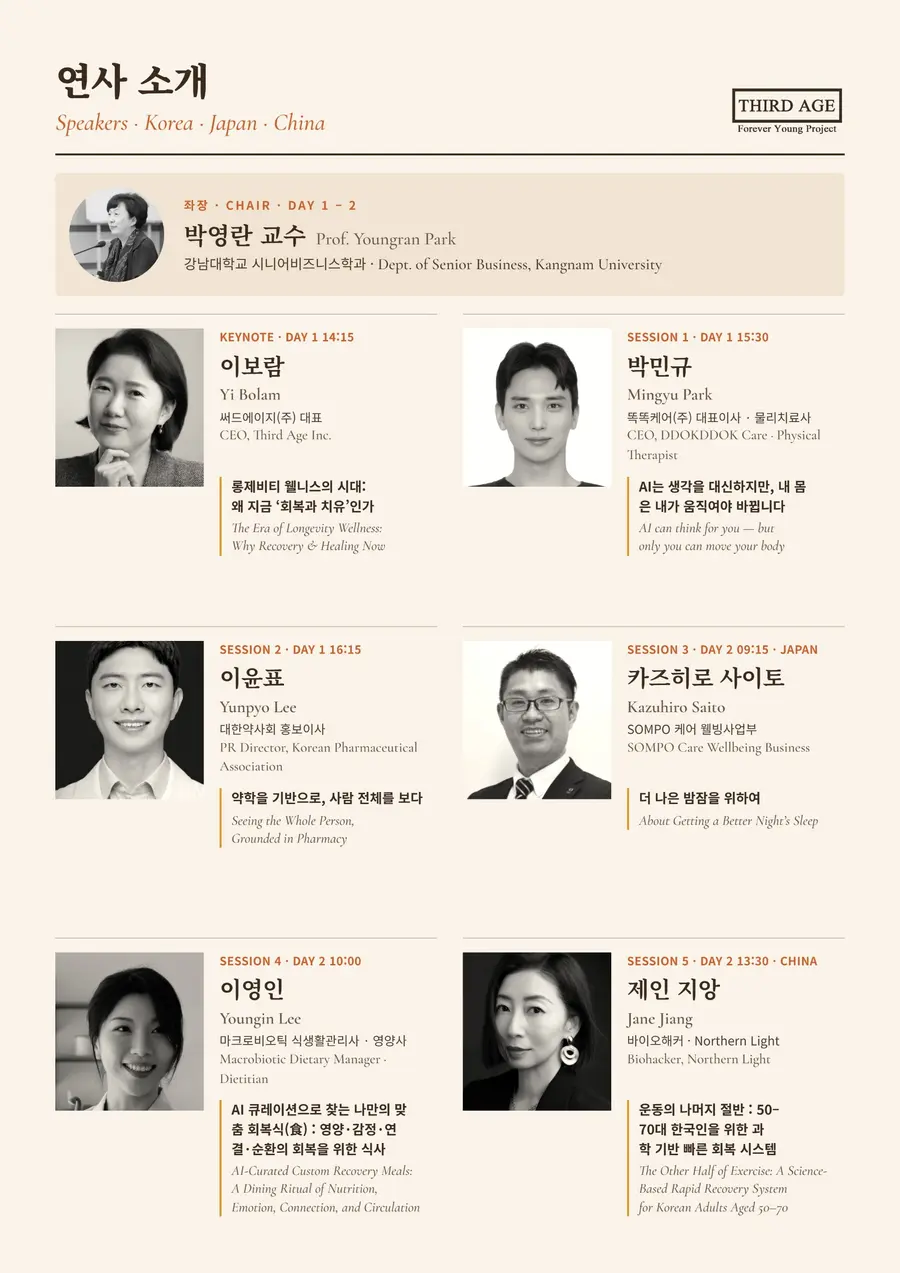
Six speakers from Korea, Japan and China will take the stage this year. Park Young-ran will again moderate, and the event will be conducted in three languages: Korean, English and Japanese.
On the first day, Nov. 6, Lee Boram will open with a keynote on the era of longevity wellness. Park Min-gyu, a physical therapist and CEO of Smart Care, will deliver the message that AI can do our thinking, but our bodies change only when we move them ourselves. Lee Yun-pyo, public relations director of the Korean Pharmaceutical Association, will discuss a pharmacy-based perspective that considers the whole person.
On the morning of the second day, Nov. 7, Youngku Heo, chairman of additional sponsor Neobiotech, will open with welcoming remarks. Kazuhiro Saito of the Wellbeing Business Division at Japan’s SOMPO Care will discuss ways to get a better night’s sleep. Lee Young-in, a macrobiotic dietary counselor and nutritionist, will introduce personalized restorative meals identified through AI curation. Jane Jiang, who spoke about exercise at the inaugural conference, will return as a biohacker to present a science-based recovery system for Koreans in their 50s to 70s under the title “The Other Half of Exercise.” After the final session, Kang Sam-young, superintendent of education for Gangwon State, will deliver closing remarks.
“We have entered an era in which AI analyzes health data and even suggests exercise and lifestyle habits, but as technology advances, what ultimately matters is how people restore their bodies and minds and live long, healthy lives,” Lee said. The event is not limited to a particular age group. It promotes intergenerational wellness, bringing together people in their 30s and 40s concerned about their parents’ health, middle-aged adults preparing for later life and active seniors.
On the morning of the second day, sponsor chairman Heo Youngku will open with welcoming remarks, and after the final session, Gangwon State Superintendent of Education Kang Sam-young will give closing remarks.
40 minutes in Tadao Ando’s Meditation Hall, a 2-kilometer Oak Valley forest walk and a fragrance inspired by Wonju
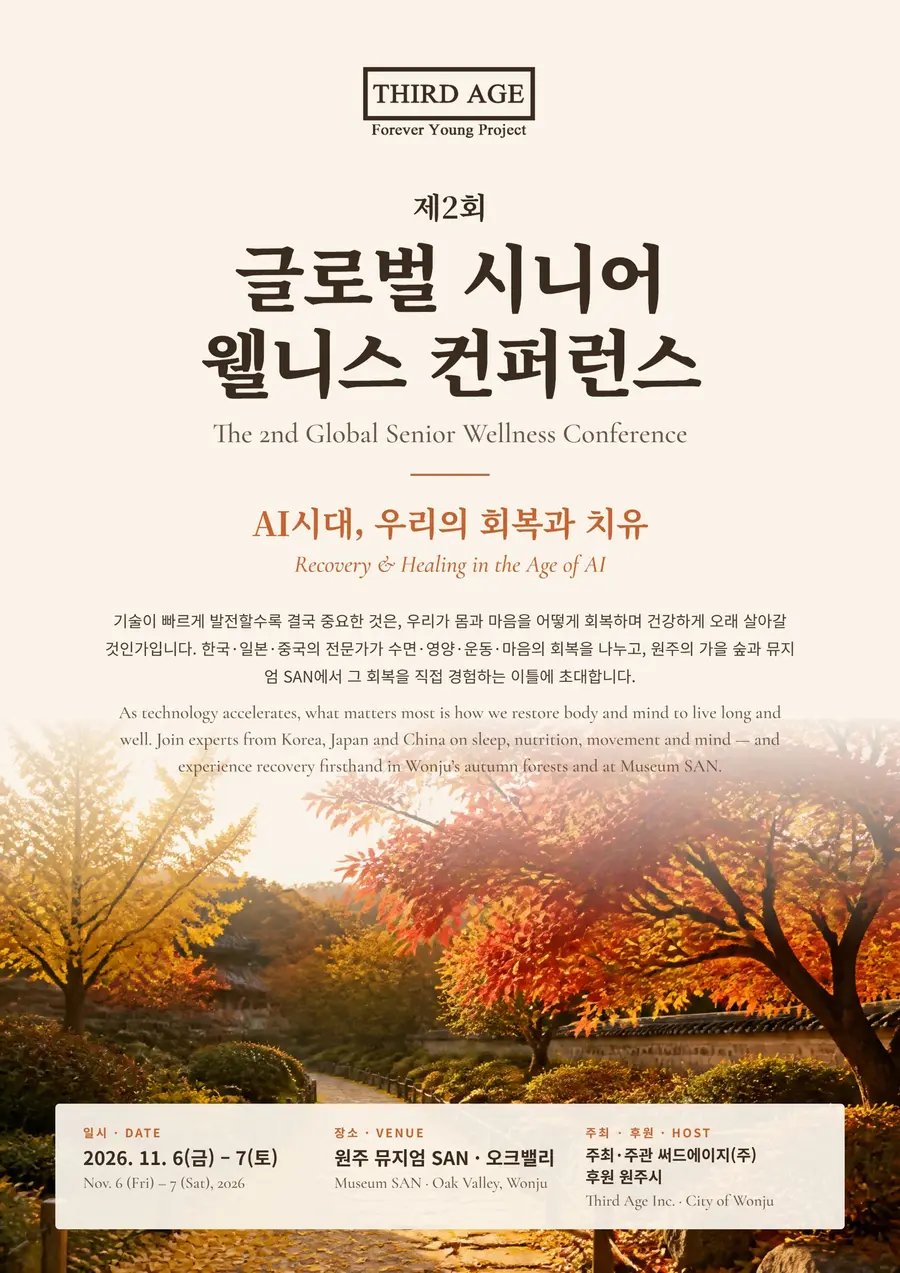
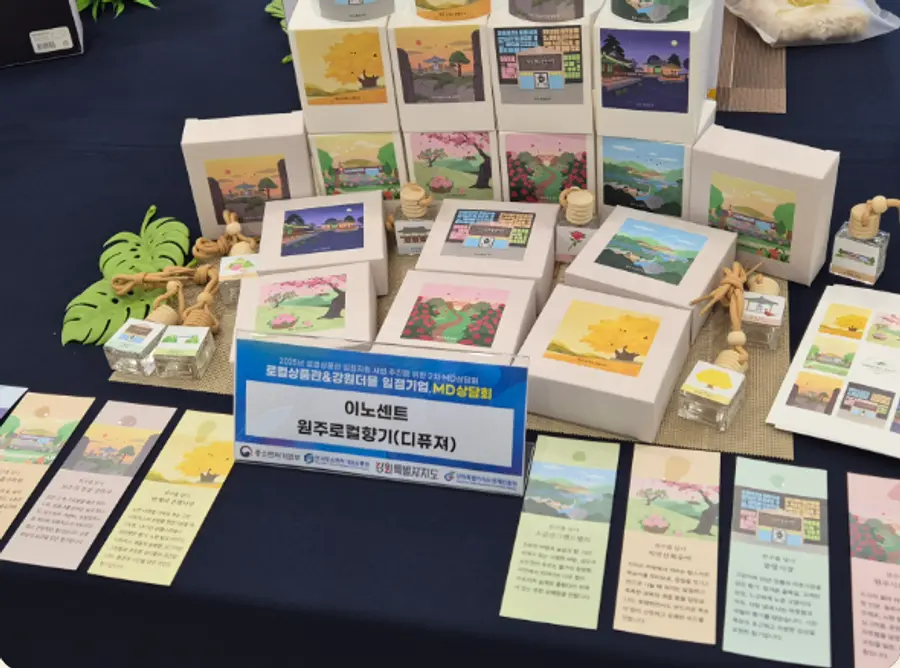
The program includes a lecture and hands-on practice in everyday exercise led by a rehabilitation medicine expert, meditation with a Buddhist monk and a session to create a personal aroma fragrance with a perfumer. Hands-on experiences are central to the program. After the talks on Nov. 7, all participants will make a fragrance inspired by Wonju with Innocent. They will sample scents drawn from Wonju locations, including Chiaksan peaches, the Bangye-ri ginkgo tree and Sogeumsan Grand Valley, then use the memories those scents evoke to create their own fragrance product.
Participants will also choose one of two activities. One is at Museum SAN’s Meditation Hall, where they will spend 40 minutes focusing on their breathing beneath a dome lit by a shaft of light and view the general exhibitions before and after. The Meditation Hall program will run in three sessions, with 20 people assigned to each through on-site registration. The other option is an approximately one-hour, 2-kilometer walk through Oak Valley’s autumn forest with a Pinocchio Forest guide. Participants will examine leaves and trees and make and fire toy pop guns. After the walk, they will share a lunch of healthy boxed meals.

On the morning of the first day, those who register in advance can join either a walk to the Bangye-ri ginkgo tree or a guided tour of Jungang-dong Traditional Market. Participants will receive gifts including a miniature Nepalese singing bowl, Wonju hardy kiwi juice and products from CheongKwanJang. Free shuttle buses will run from Naebang Station in Seoul and Wonju Station.
Why should South Korea, a super-aged society, discuss senior wellness across borders?
South Korea became a super-aged society in December 2024, when people 65 and older exceeded 20% of the population. Longevity wellness is not an issue for South Korea alone. Japan, further along this path, brought care technology to Wonju; Singapore brought institutional approaches; and China brought the science of exercise. Longevity-related wellness is new to everyone. By comparing one another’s trials and errors at an international conference, South Korea can more quickly find solutions for policy, industry and everyday life. In turn, recovery experiences built around Wonju’s forests and Meditation Hall, along with local scents and food, offer international experts a window into Korean-style wellness.
Viewed through meditation, the event’s direction becomes clearer. In an AI age awash in information, simply sitting still and looking inward can be difficult. As people walk forest trails, choose scents and catch their breath in a light-filled space, they naturally turn their attention to their bodies and minds. A path that begins with physical experiences and leads to meditation lowers the barrier for middle-aged and older adults unfamiliar with the practice. Whether they prefer walking or quiet spaces, participants can spend two days finding a form of recovery that suits them.
Starting with this conference, Third Age plans to establish a Gangwon-style wellness living lab based in Wonju, connecting AI, wellness, tourism and healthy longevity, and to expand cooperation with companies, organizations and experts at home and abroad. Lee said she hopes Wonju will become more than a city where people consume wellness tourism: a city where they experience firsthand how to live long, healthy lives and develop new models. If the first conference raised questions facing Asia’s aging societies, this year’s event looks set to let participants test answers through their own bodies.
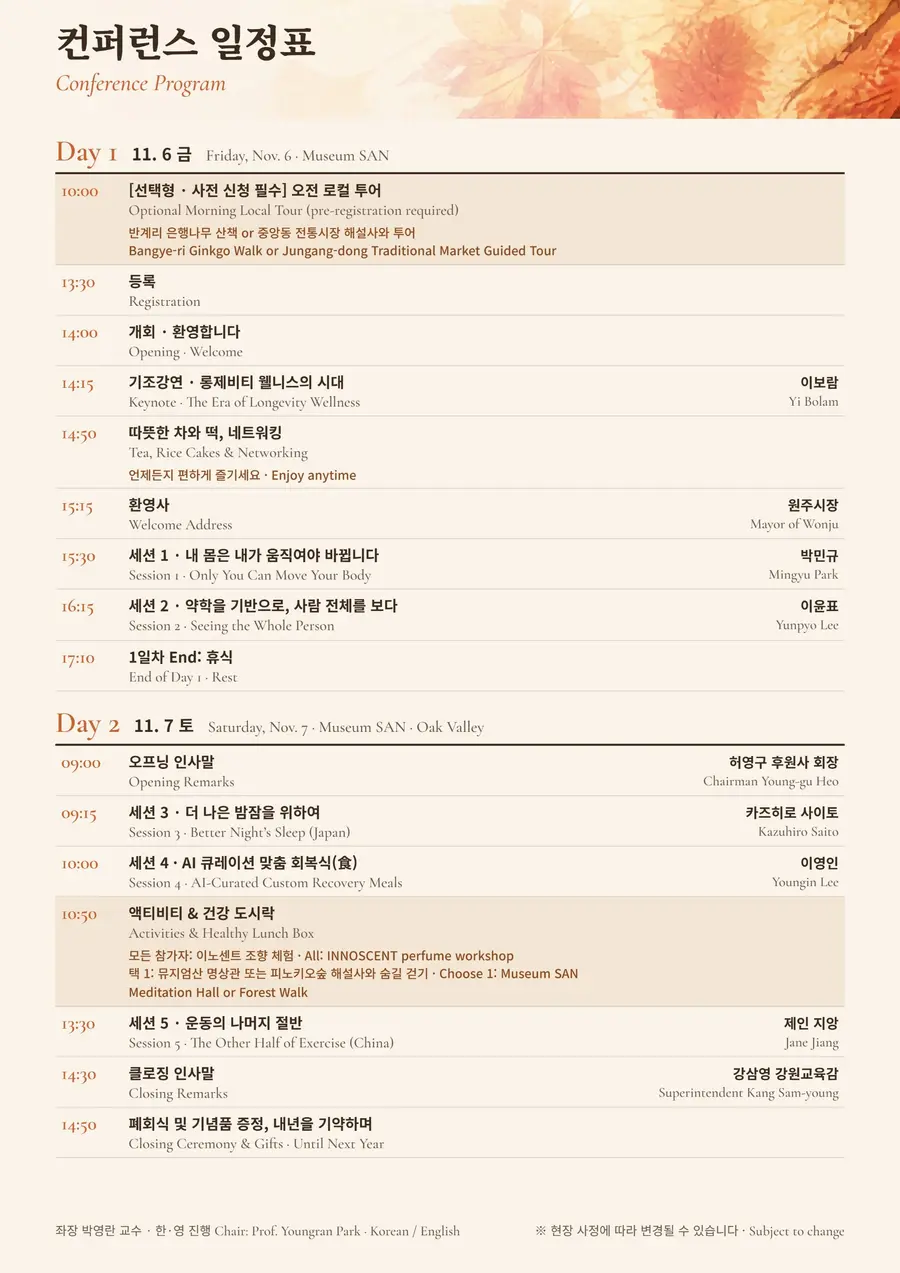
Event details
Event: 2nd Global Senior Wellness Conference, Recovery
Theme: Recovery and Healing in the Age of AI
Date and time: Registration begins at 1:30 p.m. Friday, Nov. 6, 2026; closing at 2:50 p.m. Saturday, Nov. 7
Venue: Welcome Seminar Room at Museum SAN and the Oak Valley area, Wonju, Gangwon State
Host and organizer: Third Age Inc.
Supported by: Wonju City (Preliminary International Conference District Development Support Project)
Sponsors and partners: Neobiotech, Wonju St. Mary’s Hospital, Pinocchio Forest, Fix Media, Caring
Registration fee: 100,000 won for one day, 150,000 won for two days, or 200,000 won including accommodations
Registration: https://event-us.kr/proconnect/event/132855
Inquiries: Third Age, 033-742-3832
Participants are responsible for their own lunch and dinner; parking at the venue is free.
The schedule may change depending on conditions at the venue.
Article inquiries: fare3041@naver.com