

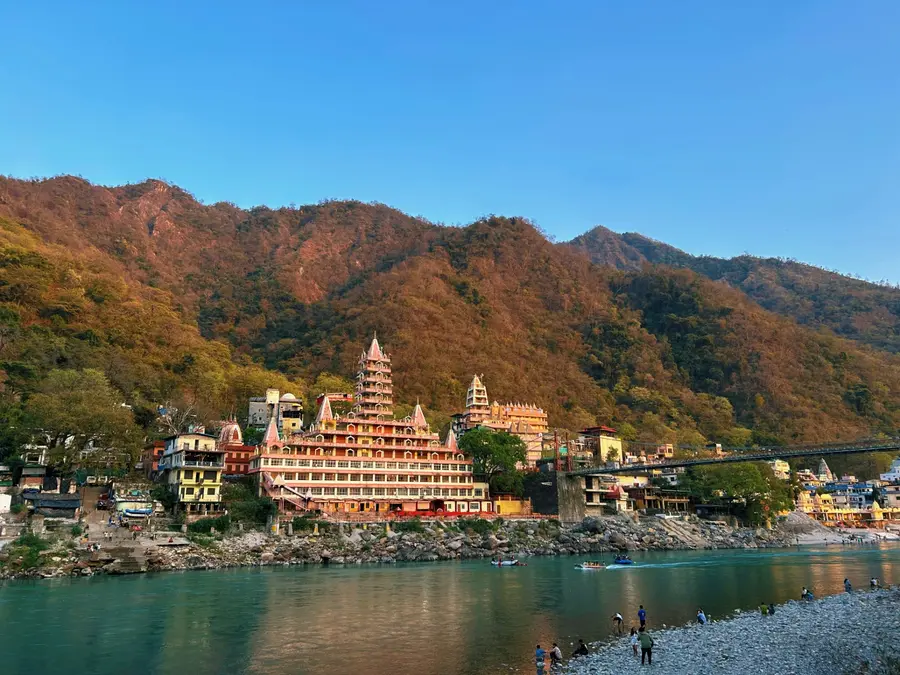
Rishikesh sits at the point where the Ganges, which flows down from the Himalayan foothills in northern Uttarakhand, opens out onto the plains. It is where people come from all over the world to learn yoga and meditation, so it is known as the ‘capital of yoga’. Ashrams line the river, and when the sun goes down a fire-lighting ceremony takes place along the riverbank.
The city carries the face of a tourist destination and that of a place for practice at the same time. Some travellers stay for a few days to take yoga classes, while others move into an ashram for months and keep a disciplined day.
Parmarth Niketan, an ashram standing by the Ganges since 1942
One of the most well-known ashrams in Rishikesh is Parmarth Niketan. It is located in the Swargashram area near the Lakshman Jhula bridge, right by the Ganges. Established in 1942, it is often cited as the largest ashram in the city.
A day here begins with the wake-up bell at 5am. From 5.30am there are morning prayers and meditation, followed by a yoga asana session at 6.30am. The morning passes with evening prayers and breakfast at 8.30am. At 1pm there is a vegetarian lunch, and there are again times for yoga and meditation at 3pm and 4pm. As evening falls, an arati ceremony is held along the riverbank. The day ends with meditation at 7pm and a dinner offering at 8pm.
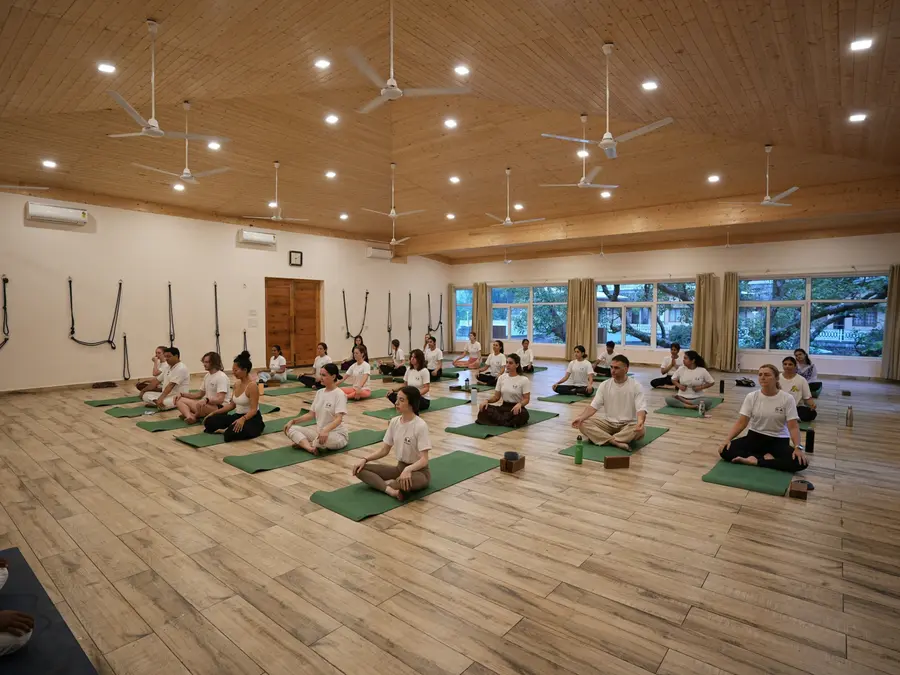
Many people say that living by a set timetable is itself the experience you take away from here. Even if you do not set for yourself what to do and when, the days help quiet the ‘noise’ in the mind.
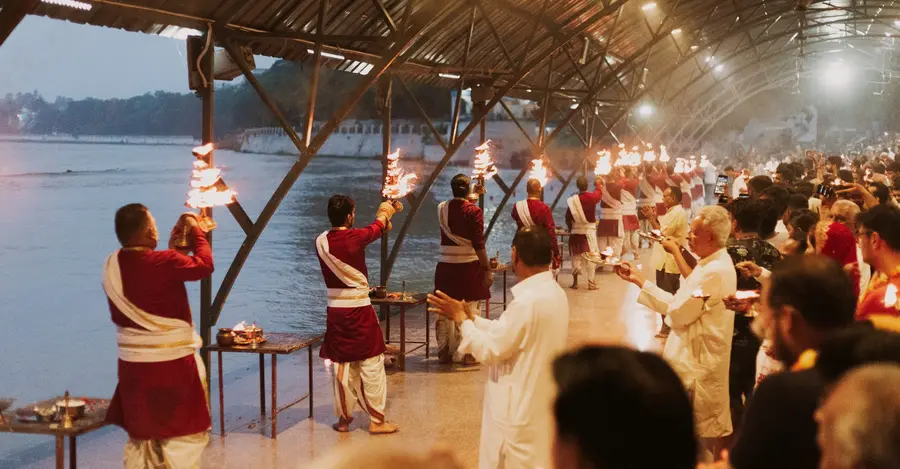
Ganga arati at dusk
The scene that people visiting Rishikesh remember most is the Ganga arati. The evening rite is conducted with lights lit towards the river and with chanting of Vedic hymns, and it is held every day on the riverside steps of Parmarth Niketan. The timing differs by season. From October to March it runs between 5pm and 6pm, and from April to September between 6pm and 7pm.
To get a good spot, it is best to arrive about 45 minutes early. It is a religious ceremony, but viewing is open, and sitting quietly to watch turns into a time that feels close to meditation.
International Yoga Festival every March by the Ganges
Parmarth Niketan is also where the International Yoga Festival is held every March. According to India’s government festival portal, the 36th edition took place from 8 to 14 March 2024, with more than 150 classes on offer, ranging from hatha yoga to Ayurveda. Yoga instructors, spiritual speakers and musicians from many countries take part.
The upcoming 2027 festival will be held at the same location from 9 to 15 March. Applications are accepted via the official International Yoga Festival website. During this period, the whole city is busy, so if your goal is not to take part in the festival, avoiding the schedule can be an advantage for a quieter stay.
How you learn yoga and meditation
Yoga learned in Rishikesh is far from an exercise routine designed to build the body. Asana classes are usually held in the early morning, with breathing techniques and seated meditation grouped together. Classes at an ashram are less about dividing participants by level and more about repeating the same order at the same time. Newcomers may find it hard to keep up at first, but after a few days the body remembers the sequence.
Meditation periods do not include long guidance. After being shown sitting positions and breathing, there is silence. Not being told what you should feel can feel strange at first, but leaving it for people to observe themselves is close to the tradition here.
Meals are also treated as part of practice. Simple vegetarian-focused food is served at set times, and eating quietly is the basic rule. Some travellers say that even a few days when you do not have to choose what to eat create an unexpected sense of space.
The city where the Beatles stayed
Rishikesh is also known as a place where members of the Beatles visited in 1968 to learn meditation. The ashram where they stayed still remains, and during the International Yoga Festival it is included in the visit route for participants. The city produced the kind of scene that helped bring Indian meditation to wider audiences in the West.
Then, as half a century passed, Rishikesh came to hold the character of both a pilgrimage site and a place to learn yoga, as well as a travel destination. Along the river, Ayurveda clinics and cafes have increased, and further upstream you can also meet people who enjoy rafting. It is a view where practice and tourism overlap within the same city.
Where to stay and how much it costs
Accommodation at Parmarth Niketan runs on a donation basis. Based on figures compiled by a travel information outlet for 2026, dormitories cost 500 to 600 rupees and double rooms 800 to 1,000 rupees (air-conditioned rooms), while four-person rooms are around 1,600 to 2,000 rupees. The price includes participation in yoga, satsang and arati. Exact amounts and room composition can change, so it is most accurate to check the official booking page (parmarth.org/reservations). Bookings are safest to make at least a week in advance, and in peak season a month ahead.
There are rules you must follow while staying. Clothing that covers the shoulders and knees, the closure of the main gate at 10pm, and quietness within the accommodation area. Drinking alcohol and eating meat are not allowed inside the ashram.
Getting there and the best time to visit
The nearest airport is Jolly Grant Airport in Dehradun, about 31km from Rishikesh. By taxi it takes around 40 minutes, and fares are typically quoted at around 1,000 to 1,200 rupees. By train, Yog Nagari Rishikesh station is 16km away. From the city centre to Lakshman Jhula or Janki Setu, you can travel by shared auto-rickshaw for 20 to 30 rupees.
The best time to visit is from October to March. As the heat eases and the skies clear, it is a season when you can sit by the river for long periods. Summers are hot, and during the monsoon season that runs from June to September, the Ganges water level rises, which can affect the schedule.
What to know before you go
Rishikesh has many ashrams and yoga centres, with varying standards. Among places that claim to offer international yoga teacher training, there are also unverified facilities mixed in, so the longer you plan to stay, the more important it is to do advance research. Since each ashram has different rules and ways of living, it helps to decide first what intensity you want.
There are no direct flights from South Korea straight to Rishikesh. The usual approach is to fly via Delhi, then move on domestic flights or overland. You should check the latest information on specific flight schedules and visa requirements before departure.
Rishikesh as a meditation travel destination
If Bali’s Ubud grew around wellness resorts and yoga studios, Rishikesh has welcomed travellers from across the world while keeping intact the long-established form of ashram life and practice communities. Waking up at set times, sitting together, eating together, and gathering by the river at dusk leaves more than just a programme for people who come to learn meditation.
It is a different character from retreats that focus on convenience. Whether you can put up with rooms without air conditioning, early wake-ups and simple vegetarian meals largely determines satisfaction. For travellers ready to accept those conditions, Rishikesh becomes not a short break but a chance to reset the rhythm of everyday life.