

The pace of the city keeps accelerating, while the recovery of the mind moves more slowly. In an era where meditation is no longer an unfamiliar term, mindfulness has steadily broadened its application—from reducing stress and recovering from depression to supporting school education and corporate training. As its use has grown, so has the set of questions within the academic community. How should mindfulness meet other forms of healing? And what changes that meeting brings to clinical settings and everyday life.
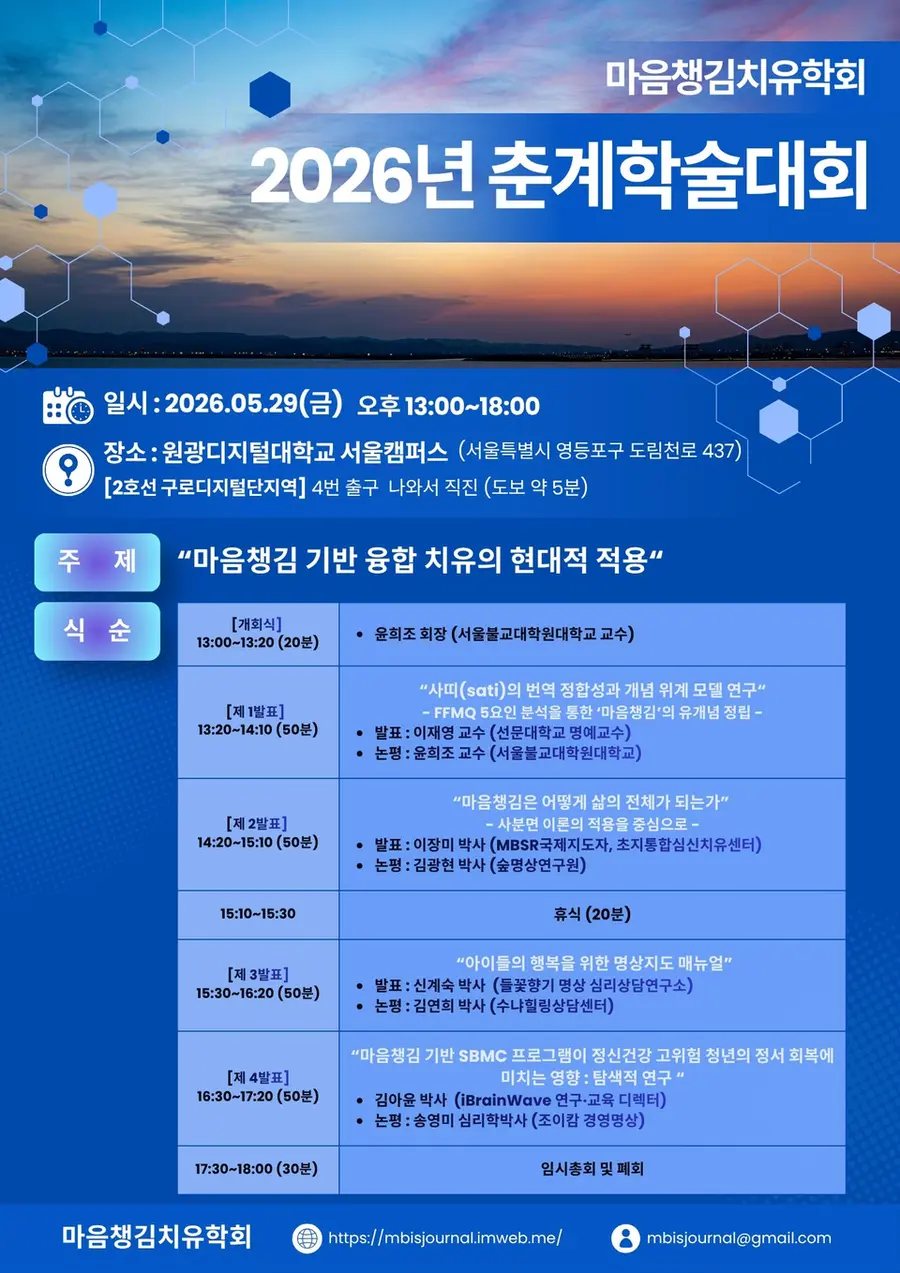
An academic forum that addresses these questions head-on is being organized. The Mindfulness Healing Society (Chair: Yoon Hee-jo Cho) will hold its 2026 Spring Academic Conference at 1:00 PM on May 29 at Wonkwang Digital University in Seoul, under the theme “Modern Applications of Integrative Healing Based on Mindfulness.”
Mindfulness in Everyday Life, and the Next Question: “Integration”
Mindfulness begins with a long tradition of practice rooted in Pali sati. After Dr. Jon Kabat-Zinn of the University of Massachusetts Medical School developed the MBSR (Mindfulness-Based Stress Reduction) program in 1979, it took hold in Western clinical psychology and medical settings as a tool for secular intervention. In Korea as well, MBSR, MBCT (Mindfulness-Based Cognitive Therapy), loving-kindness meditation, and mindfulness based on information about trauma have been actively disseminated, steadily expanding the scope of application.
Behind this conference’s choice of “integration” as its focal point lies the changing needs of the field. The understanding that a single mindfulness technique alone is difficult to address layered emotional and physical symptoms has accumulated both inside and outside clinical practice. At the same time, the trend of cases where medicine and psychotherapy, education, physical activity, and art therapy combine with mindfulness continues to grow.
The Points Highlighted by “Modern Applications of Integrative Healing Based on Mindfulness”
The society plans to examine, from both theoretical and practical perspectives, what areas mindfulness meets, what effects it demonstrates, and what limitations it has. Theoretically, it will be possible to revisit the mechanisms of mindfulness at the intersection of neuroscience, cognitive psychology, and Buddhist psychology. Practically, the focus will be on integrative models in concrete application contexts—such as school education, medical settings, restoring emotional well-being in young adults, and caregiving for middle-aged and older adults.
It is also notable that the conference itself is designed not only as a space for researchers, but as a venue where clinicians and meditation instructors can align their perspectives in the same room. Connecting the language of the field where mindfulness is actually used with the language of academia has been a consistent thread throughout the society’s activities.
Continuing Academic Activities for Training Meditation Instructors and Restoring Young Adults’ Emotional Well-Being
Professor Yoon Hee-jo, who serves as the society president, is a professor in the Department of Buddhist Studies at Seoul Buddhist Graduate School, where he is also the chief professor in Buddhist Counseling. He is the director of the Buddhist and Mind Research Institute as well. He has continued research translating the conceptual frameworks of Buddhist psychology and Buddhist counseling into the language of clinical practice. Through translations and writings such as “Introduction to Buddhist Counseling,” “A Dictionary of Buddhist Psychology,” and “Buddha and Freud,” he has consistently mediated the intersection between understanding the mind in Buddhism and modern psychotherapeutic approaches.
For the past years, the Mindfulness Healing Society has held academic activities and workshops with themes such as training in sati and meditation instructors, restoring young adults’ emotional well-being, and strengthening expertise in MBI (Mindfulness-Based Intervention). This Spring Academic Conference also takes its place along the same line.
Now that mindfulness has taken root as a resource for social recovery beyond simply being a tool, the questions raised by the academic community carry weight in their own right. What is effective? What boundaries are needed? And healing for whom? This half-day event at Wonkwang Digital University on May 29 is expected to be a time when those answers are constructed together.