

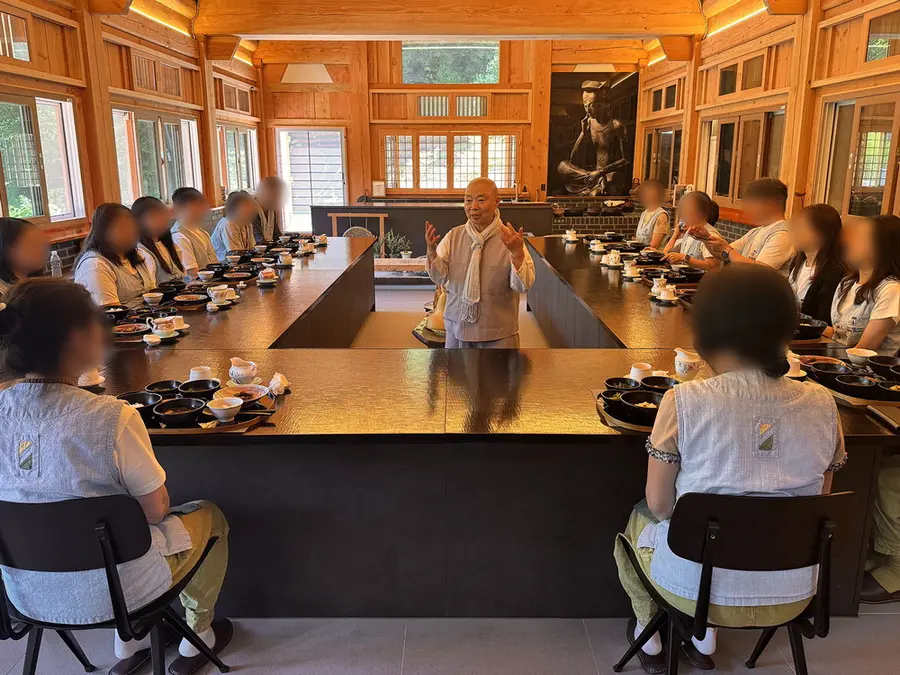
As dawn fog slowly blanketed the slopes of Naejangsan, a tea set sat in Baekyangsa Temple’s Uhwaro Hall instead of luxury shopping bags. In the final stretch of May, the visitors headed to a mountain temple in Jangseong, South Jeolla—top-tier customers (VIPs) who were accustomed to receiving limited-edition items first. What they held in their hands that day was neither a handbag nor a gallery invitation. It was the quiet of an overnight stay in the mountain grounds—and a neatly arranged table of temple cuisine served with care.
Shinsegae Department Store on Monday wrapped up the two-day VIP premium temple stay “Shinsegae Gourmet Elegy,” held from May 30 to 31. It is a wellness content program that ties together fine dining, meditation, and hands-on experiences of temple culture, setting aside the flash of luxury retail stores for a moment. The assessment that the program won customers’ hearts by offering an experience beyond shopping has been voiced both inside and outside the department store.
What is especially notable is that the scene no longer feels unusual. The space that sells luxury items best has begun to recommend “emptiness.” This small episode of bringing customers to a mountain temple quietly suggests that the language of retail is shifting from consumption to recovery.
Why the department store took customers to the temple grounds
The center of gravity for Shinsegae Department Store’s VIP marketing is moving. A shift is taking hold in how loyalty is managed—away from the previous emphasis on early access to limited editions and lounge benefits, and toward experiences, culture, and wellness. Mental rest is starting to fill the gap that material consumption had not yet been able to fill. Industry watchers say the department stores’ core customer strategy has moved from buying items to spending time, and from ownership to experience.
Shinsegae Department Store did not design this program as a lodging-type temple stay that simply provides a place to sleep. Instead, it was built as a premium curated content package that stitches together fine dining, rest, and temple culture experiences into a single thread. The attention to detail shows a desire not to disrupt the texture of the journey. Partnering with the premium travel platform “Via Shinsegae,” the company privately mapped out the entire schedule—from getting there, to accommodations, meals, and program operations. It provided dedicated vehicle transport, continuing from the front of the venue to the entrance of the mountain temple grounds, arranged an exclusive rental of the temple, and operated rooms as double-occupancy accommodations to ensure the guests’ peace would not be disturbed.
The insight underlying the planning is that customers at the peak of luxury consumption feel thirsty, above all, for “slow time.” For those who have enjoyed the most dazzling things, the most precious gift was a day that required nothing to buy.
The taste shared with the world through “The Chef’s Table,” with Monk Jeonggwan
At the center of this itinerary was Monk Jeonggwan, a master of temple cuisine. Jeonggwan, the head monk at Baekyangsa Temple’s Cheonjinam Hermitage, is widely regarded as the person who helped bring the value of Korean temple food to the world after appearing on Season 3 of the Netflix food documentary “The Chef’s Table” in 2017. His dishes, presented alongside Michelin-star chefs’ fine dining, left an even deeper impression not through showy technique, but through a refined simplicity that does not go against nature.
A heavy set of descriptors follows his name. The New York Times once praised Monk Jeonggwan’s temple cuisine as the rarest food in the world. Later, he received the prestigious James Beard Award, and was also named to this year’s Icon Award, given by Asia’s 50 Best Restaurants. His philosophy of cooking—vegetarian dishes without the use of five pungent vegetables (oisinchae), seasonal ingredients harvested directly from kitchen gardens and mountainside slopes, and dishes that bring out the natural flavors of ingredients—is why foodies worldwide seek out Korea’s secluded mountain temples.
That is also why VIP customers showed high interest even before the event. It was a promise that they would encounter one person’s food and philosophy at the mountain temple where he would be staying—something not easily reachable anywhere else.
From a tea chat to balu gongyang, two days that flowed slowly
The first day of the itinerary began with a tea chat at Uhwaro Hall, where guests conversed with the head monk. Over tea and refreshments, stories about practice and everyday life were shared. As fragrance and warmth spread gradually, even hearts accustomed to the pace of the city likely loosened their grip little by little. In the evening, hands-on experiences followed to help guests learn the temple’s time with both fingertips and bodies. They included a bell-ringing experience in which guests rang a heavy temple bell themselves, 108 bows (108배) to empty the mind one breath at a time, and a bead-making session in which guests threaded the rosary bead by bead. For people used to grabbing things quickly, the time spent slowly making each item offered a form of unfamiliar comfort on its own.
On the second day, the time spent with Monk Jeonggwan was singled out as the highlight of the whole journey. In a private dining space not open to general visitors, a course of temple cuisine reinterpreted balu gongyang in a modern way was served. Bowl after bowl featured deep flavors characteristic of temple food, made from seasonal greens and vegetables and painstakingly prepared sauces. The experience of having the natural aroma of ingredients clearly come through once intense flavors had been removed told guests something the tongue could feel: it is harder to subtract than to add.
What went beyond the table was not only food. Within the attitude of balu gongyang—preparing one meal with sincerity and receiving it with gratitude—there were traces of the texture of life that guests would return to and savor long after going back to daily routines.
Mandala, a handwritten sign, and a jar of jang
Between fine dining and meditation, the program also reserved time for crafting with one’s hands. In a Tibet mandala class conducted as customer-participation content, participants drew and stacked mandalas themselves, revisiting what the temple stay meant. Watching precise patterns come together was also a practice of mindfulness that stayed with the process rather than fixating on the result.
The program’s lingering afterglow did not end with empty hands. After finishing the schedule, guests received a special gift package that included a book bearing Monk Jeonggwan’s handwritten sign, along with jang and pickles that he brewed himself. The fact that the department store’s gift was not a luxury branded good but a jar of jang captured the value the program aimed to convey in the sharpest possible way. The carefully designed experience ensured that, back home on the dining table, guests could meet those flavors again—so that the two days sent at the mountain temple naturally carried over into everyday life.
From “consumption” to “recovery,” wellness becomes the language of retail
Shinsegae Department Store’s move cannot be read as a one-off event by a single department store. In 2026, wellness has taken root as the standard for consumption beyond a specific category. The question of whether people had gotten enough rest shifted into how they were living. Meditation, breathing exercises, and slow recovery moved into the rhythm of everyday life. Behind the fastest-moving luxury industry’s attention to the quiet of a mountain temple are the thirsts of this era.
Shinsegae Department Store is also strengthening its competitiveness by steadily expanding premium programs that combine fine dining, travel, and culture content, with the aim of embracing customers’ entire lifestyles. Lee Jae-hwan, an executive managing director in charge of Shinsegae Department Store’s sales strategy, described the “Shinsegae Gourmet Elegy” as premium content planned so customers could deeply experience Korean traditional culture, temple cuisine, and rest, and said it would continue boosting the loyalty of excellent customers with content tailored to new lifestyles.