

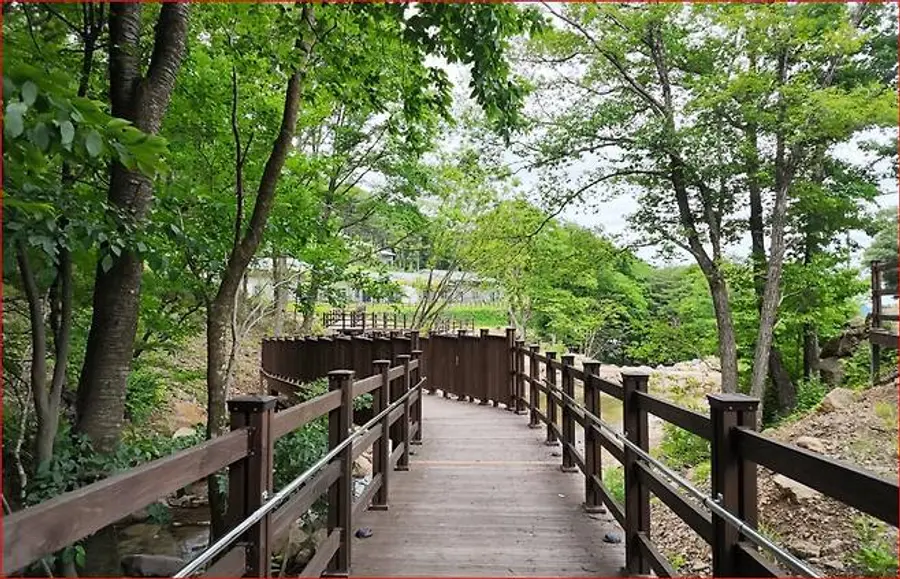
The National Jinan Highlands Forest Therapy Centre has opened its doors in the Baegundong Valley in Baegun-myeon, Jinan-gun, Jeonbuk Special Self-Governing Province. The centre sits on the 650m-high slopes, with Deoktaesan Mountain (1,113m) and Seonggaksan Mountain (1,141m) cradling the valley from both sides. It is the second national forest therapy facility in South Korea, built on a 617-hectare site after the Korea Forest Service and the Korea Forest Welfare Promotion Agency invested a total project cost of 91.1 billion won (71.9 billion won from the national government, 18.2 billion won from local governments). It began full operations on 15 October 2025 and held an opening ceremony on 6 November. It will take on the role of a forest-therapy hub in the south-western region, following Yeongju in North Gyeongsang Province.
The air on the highlands has a different texture from that of the city. Valley water that flows through the bedrock, the breeze that has passed through pine stands, and the negative ions and phytoncides carried within it are the first resources the centre puts forward.
Forest strolls and hammock meditation, an outdoor programme that lets the forest speak first
The outdoor programme is run around six healing-forest trail routes, with a total length of 11km, and eight forest therapy spaces. Each space has its own character, such as the pine-wind forest and the negative-ion meditation forest, and a water-sound resting place, so you can choose your walking route according to the day’s condition.
The forest paths are mixed with Korean red pine and Scots pine, as well as birch-leaf oak and oaks such as shin-gal oak, plus larch. The representative programmes, forest strolls and Nordic walking, are conducted with participants matching their breathing and stride under the guidance of a forest therapy instructor. Hammock meditation is a programme in which you rest in a hammock hung in the middle of the forest and keep your field of view open upwards. You are given time to do nothing at all while the light sways through the gaps between leaves.
Singing-bowl and tea ceremony meditation, indoor meditation opened by sound and fragrance
The indoor meditation programmes are held at the forest therapy centre. Singing-bowl meditation is a process of turning attention inward as you take in the bowl’s resonance and vibrations with your body, using bowls made from quartz and brass utensils. Tea ceremony meditation is a programme that keeps your senses focused on each step of steeping, pouring and drinking tea. Both programmes are set as one-hour courses for adults.
In addition, meditation and healing programmes are operated separately. The Korea Forest Welfare Promotion Agency said it has prepared tailored courses aimed at stress reduction, boosting immunity and improving sleep, as well as specialist courses for people with chronic conditions such as hypertension and diabetes.
Heat equipment and body composition checks, time to confirm your condition
The health promotion room is equipped with a cedar thermal dome, a spine thermal heating unit and a water-pressure massage machine. The one-hour course for adults is designed to be easy to stitch together, with the order set to follow a forest-path walk and then loosen stiff muscles. In the smart healing room, health measurements are carried out using advanced equipment. The package includes body composition tests using InBody and OutBody devices, as well as a hands-on experience of sound-wave equipment, and people of all ages can take part.
Media art and forest therapy diet, a setup for family visitors
The centre does not focus only on adult-centred meditation spaces. In a realistic media-art space designed as an indoor forest, interactive content runs for 30 minutes, in which an animal a child has coloured in moves within the screen.
Meals are also part of the programme. The forest therapy diet is provided in connection with wind (風) healing that makes use of the climate characteristics of the Jinan highlands. Side dishes that reduce stimulation, such as mixed-grain rice and clear sundubu-jjigae-style soup, chicken breast braised side dish, and seasoned cheongpo-muk jelly, are prepared differently every day. A separate window-seat area is set up where you can see the forest through the window, allowing visitors who eat alone to stay comfortably.
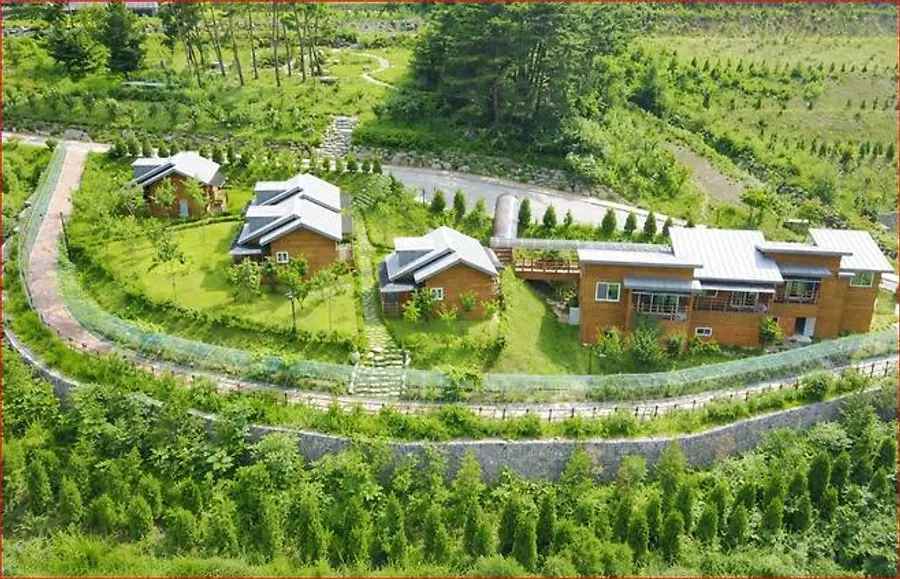
74 accommodation rooms and advance reservation system
The lodging facilities include 57 group-type rooms, 10 family duplex rooms and 7 family-only rooms, for a total of 74 rooms, accommodating up to 270 people. The construction used 576㎥ of domestic timber, which has a carbon-storage effect of 296,345kg of CO₂, equivalent to the amount absorbed over one year by 36,586 pine trees aged 30 years.
The programmes, lodging and meals are all operated on an advance reservation basis. Reservations are accepted via the forest welfare integrated platform, the Sume-ryang website (숲e랑). For meals, you must apply by selecting one of breakfast, lunch or dinner up to three days before the day of use, and you cannot purchase on site on the same day. Operating hours run from 9am to 6pm, with facility preparation time from 12pm to 1pm. Every first Monday of the month has a regular closure. As walking on the forest paths and hands-on experiences with heat equipment continue, comfortable trousers and trainers are recommended.
There is no TV or Wi-Fi in the rooms. One night spent leaving your screen behind, getting used to the darkness outside the window and the sound of flowing water is the way of rest prepared by the Jinan highlands.