

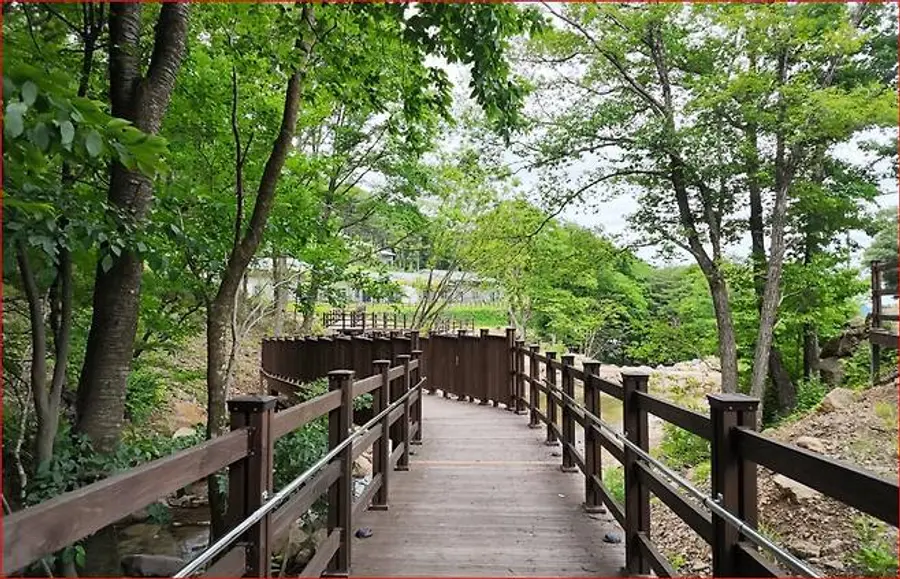
Jeollabuk-do opened the National Jinan Moor Forest Therapy Center at Baekundong Valley in Baegundong-myeon, Jinan County. It sits on a 650-meter-high stretch of land, with Deoktaesan (1,113 m) and Seonggaksan (1,141 m) flanking the valley. The country’s second national forest healing facility—built on a 617-hectare site with a total project cost of 91.1 billion won (72.9 billion won in national funds, 18.2 billion won in local funding)—began full-scale operations on Oct. 15, 2025, and held an opening ceremony on Nov. 6. It will serve as the forest healing hub for the southwestern region after Yeongju in Gyeongbuk Province.
The air on the plateau is different in texture from that of the city. Valley water that flows through bedrock, the breeze that passes through pine woods, and the negative ions and phytoncides carried in it are the first resources the center highlights.
Forest strolls and hammock meditation: Outdoor programs that let nature speak first
Outdoor programs run around six routes of healing forest trails totaling 11 km, and eight forest healing spaces. Each space has its own character—such as the pine-wind forest and the negative-ion meditation forest, and the water-sound resting area—so visitors can choose the path based on their condition that day.
The forest paths are mixed with Korean nut pines, pines, birches, shin oak (Quercus sinensis), and Korean oaks, along with larch. The flagship programs—forest strolls and Nordic walking—are conducted by matching breathing and stride under the guidance of a forest healing instructor. Hammock meditation is a program in which participants lie back in a hammock suspended in the middle of the forest and keep their field of view lifted. During the time when the light flickers between the leaves, visitors get the opportunity to do nothing at all.
Singing-bowl meditation and tea ceremony meditation: Indoor sessions opened with sound and fragrance
Indoor meditation programs take place at the Forest Healing Center. Singing-bowl meditation is a process in which participants receive the bowl’s resonance and vibrations with their body, then turn their attention inward. It uses bowls made of white agate and bronze-ware materials. Tea ceremony meditation is a program that keeps your senses attached to each and every step—brewing, pouring, and drinking tea. Both programs are set as one-hour courses for adults.
In addition, other meditation and healing programs are also run separately. The Korea Forest Welfare Promotion Agency said it has prepared customized courses aimed at stress relief, boosting immunity, and improving sleep, as well as professional programs for people with chronic conditions such as high blood pressure and diabetes.
Heat equipment and body-composition checks: Time to confirm how your body is doing
In the health promotion room, there are a cedar-heated heat dome, a spine-heated device, and a water-pressure massage machine. Designed as a one-hour course for adults, it is easy to string together with a sequence that starts with walking the forest trail and then loosening stiff muscles afterward. In the smart healing room, health measurements are carried out using advanced equipment. The experience includes body composition testing using InBody and OutBody, as well as trying out an ultrasonic-sound equipment setup, and participation is open to all age groups.
Media art and forest healing meal sets: A setup for family visitors
The therapy center does not stay only in adult-centered meditation spaces. In a simulated-media art area designed like an indoor forest, interactive content runs for 30 minutes, allowing a child to color animals and watch them move on the screen.
Meals are also part of the program. In connection with wind (風) healing that draws on the climate characteristics of the Jinan plateau, forest healing meal sets are provided. Side dishes that reduce stimulation, such as mixed-grain rice, clear doenjang-soon tofu soup, braised chicken breast, and seasoned cheongpo-muk, are prepared differently every day. There is also a separate window-seat area where guests can eat while looking out at the forest, so even visitors who dine alone can stay comfortably.
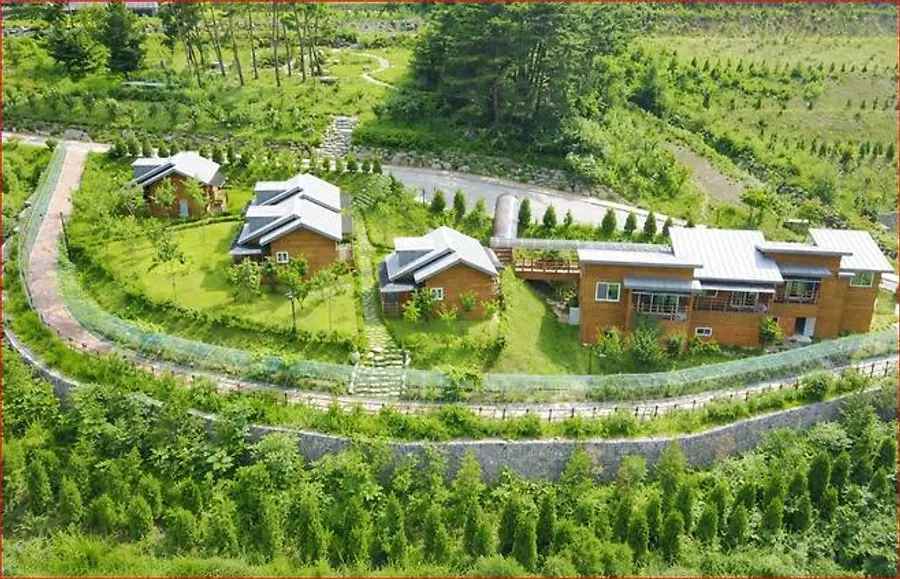
74-room lodging building and advance reservation system
The lodging facilities include 57 group rooms, 10 family duplex units, and 7 private family units—74 rooms in total—accommodating up to 270 people. The construction used 576 ㎥ of domestically produced wood, which has a carbon storage effect equivalent to 296,345 kgCO₂—based on the amount absorbed over a year by 36,586 pine trees that are 30 years old.
The programs, lodging, and meals are all run with an advance reservation system. Reservations are made on the Foreste&arang integrated forest welfare platform website, or the Soe-rang site. For meals, visitors must apply by choosing among breakfast, lunch, and dinner up to three days before the day of use; same-day onsite purchases are not available. Operating hours are from 9 a.m. to 6 p.m., and from 12 p.m. to 1 p.m. is facility preparation time. The first Monday of every month is a regular closing day. As forest-trail walking and heat-equipment experiences follow one another, comfortable pants and sneakers are recommended.
There is no TV or Wi-Fi in the rooms. It is Jinan’s plateau’s way of a comma—spending one night getting used to the darkness outside the window and the sound of water, with the screen set aside.