

Jo Woo-seok, the operator of BooktuberTV and head of Nabi School, is a voracious reader who would be hard to rival anywhere in South Korea. I recently learned that he had begun offering unconscious insight coaching, bringing together the wealth of experience and know-how he has accumulated over many years. I had always wondered whether coaching focused on the unconscious might be heavily influenced by the reader’s interpretation or personal outlook, as in tarot or spiritual counselling. But after experiencing Coach Jo’s unconscious coaching for myself, I realised that assumption was completely wrong.
The five whys that began before the coaching
Once the coaching date had been set, I was given an assignment to complete over the preceding two weeks. I had to choose the one thing I most wanted to achieve in life and ask myself “why?” five times. At first, I regarded it as little more than a simple warm-up. But as I held on to the question each day, I began to feel something inside me shifting.
The answer to the first “why?” was always a familiar phrase I had used before. I kept asking “why?” about that answer, and by the third and fourth questions, something quite different from what I had initially written began to emerge. I could hardly remember when I had last questioned so deeply what I truly wanted. Then I started to become confused. “Do I really know clearly what I want?”
Looking back, those two weeks were already part of the coaching, before the session itself had even begun. I had learnt in advance that the most important thing was to realise things for myself and spend time talking to myself. I meditated on the question each day, and gradually began looking back over the years that had passed. Even before the formal coaching began, I was already starting to encounter what lay inside my unconscious.
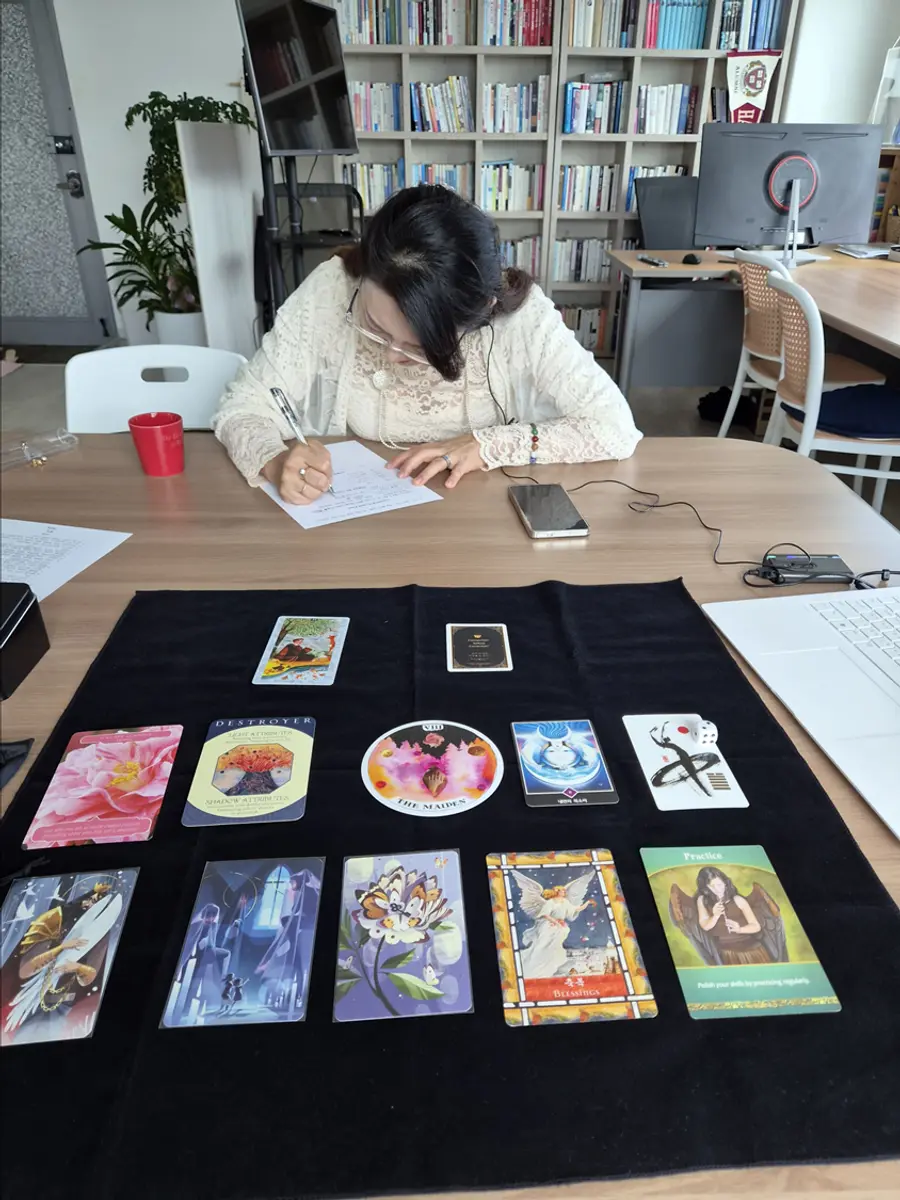
A session room where cards sit alongside a heart-rate monitor
The first thing I did when the coaching began in earnest was switch off my mobile phone. It was important first to secure time entirely for myself, free from external distractions. On the table were several types of tarot cards, a small heart-rate monitor worn on the ear and the accompanying software.
With the monitor clipped to my ear, we began with a light board game to help me relax. We then took the issue I had brought with me and narrowed the question down, repeatedly asking why it was a problem. What was interesting was that, although the narrowed-down question seemed to produce similar answers each time, the final conclusion shifted slightly. It felt as if my unconscious self was gradually rising to the surface.
I turned over a card. I described the image that flashed through my mind. The graph on the screen shot up. The coach asked:
“What were you just thinking about?”
The programme continued recording my heart as I experienced each stage of the process, and I watched the graph on the screen rise and fall.
Why the heart? — The heart knows the answer!
People do not notice when they have moved away from their usual perspective. That is the biggest trap. The more familiar a story is, the more comfortable it feels when we tell it. That is why the judgement that “it feels right, so it must be right” is often wrong.
The heart does not beat as regularly as a clock.
The interval between one beat and the next changes subtly from moment to moment. The measure of that change is heart-rate variability, or HRV.
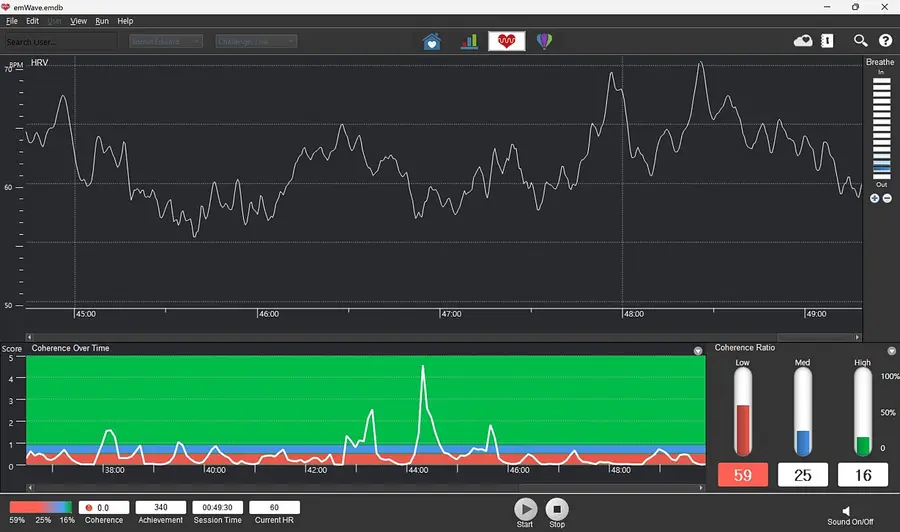
The pattern of these intervals changes according to a person’s state. When we are tense or unsettled, it becomes irregular and jagged; when we are relaxed and composed, it settles into an even, wave-like pattern. And this pattern cannot simply be manufactured at will. We can arrange our facial expressions, but we cannot fake the intervals between heartbeats.
Why is it reliable? The reason is simple: it is not a newly devised measurement. HRV is an indicator used in hospitals. In 1996, international cardiology societies met and standardised the way it was measured, and the same method is still used in cardiology and psychophysiological research. The HeartMath Institute in the United States has studied the link between this measure and emotion for more than 30 years.
Its effects have also been confirmed beyond the institute. A research team at Boston University in the United States gathered studies using the method and reassessed them. The data covered 24 studies from several countries and 484 participants. Academia has a common benchmark for measuring how effective a method is, and the results fell into the category described as having a “large effect”. They went beyond merely establishing whether an effect existed.
The trust created by a visible unconscious — neither tarot nor counselling
Up to that point, I had thought it was not especially different from other methods. Drawing a card and describing the image that comes to mind is familiar from tarot. The difference came next.
In tarot or spiritual counselling, the reader interprets what a card means and where the emotion that has arisen comes from. How much we trust that interpretation depends on our faith in the person’s intuition or experience. Counselling and coaching are not entirely different. No matter how impressive the insight, I had no way of knowing whether it had genuinely emerged from my unconscious or whether it was an interpretation coloured by the other person’s perspective.
In this coaching, that process of verification took place before my eyes. When I talked about familiar stories I had already organised several times, the graph settled gently. But when I meditated, and when a particular thought suddenly occurred to me, the graph rose sharply. Of course, it was a thought about something I liked, but I was genuinely surprised to see a stronger reaction than to the goal I had thought I wanted to pursue with my whole life. The coach merely asked what I had been thinking; he did not interpret its meaning for me. It was my heart that confirmed the meaning, and I myself was the one who noticed it.
The unconscious already knows the answer.
You cannot solve thought with more thought. The key to solving a problem is how quickly you can step outside your own perspective.
Jo Woo-seok, who developed unconscious insight coaching, explains this state as follows.
“When I look at people who cannot solve a problem, they have something in common. They keep going round and round within the limits of their own thinking. However hard they work within that space, the answer they produce is one that was already there.
There is an old story that illustrates this structure precisely.
One night, an old woman was searching intently beneath a street lamp in a park. A passer-by asked, “Did you lose a diamond ring here?” The old woman replied:
“No, I lost it over there in the grass. But it is too dark there, so I am looking here.”
That is usually how we try to solve problems. The answer lies in the dark, but we always search the bright side. The bright side is made up of familiar thoughts, explanations we have tried repeatedly and methods we always use. It is bright and comfortable. The only problem is that the ring is not there.
Two sentences attributed to Albert Einstein pinpoint the issue.
“We cannot solve problems with the same level of consciousness that created them.”
“Insanity is doing the same thing over and over again and expecting different results.”
That leaves us with a single central question in problem-solving.
How quickly can I leave the confines of my own thinking and look at this problem from a different perspective?
Why is that so difficult?
This is where most people get stuck. We have heard countless times that we should change our perspective. The problem is that the person telling us to change our perspective is also speaking from conscious thought. Trying to escape the conscious framework through consciousness simply sends us round in circles.
Sigmund Freud, the founder of psychoanalysis, compared the human mind with an iceberg. The part above the water is consciousness; the much larger part beneath the surface is the unconscious. He wrote:
“When making a decision, I carefully consider the advantages and disadvantages of the possible consequences. Yet when it comes to genuinely important matters, it is the unconscious, located somewhere in my mind, that makes the decision.”
Some researchers have put figures on the balance. Gerald Zaltman, a Harvard Business School professor and pioneer of unconscious marketing, estimates that the unconscious accounts for 95 per cent of human cognitive activity, with consciousness accounting for 5 per cent. Timothy Wilson, a psychology professor at the University of Virginia, offers a more specific explanation.
“Every second, people receive 11 million bytes of information, while the amount consciousness can process is about 40 bytes. Our consciousness is no more than a snowball on top of an iceberg.”
A sentence by Carl Jung, the founder of analytical psychology, describes the outcome.
“Until you make the unconscious conscious, it will direct your life and you will call it fate.”
And M. Scott Peck, a psychiatrist and the author of 《The Road Less Travelled》, left the story that gave this article its title.
“The unconscious knows our true selves. (…) Our unconscious about everything possesses greater wisdom than our consciousness.”
To put it simply, the place where we struggle with a problem accounts for 5 per cent of the whole. We are digging in the same spot while leaving the remaining 95 per cent untouched.
So if we want to change our perspective, we must open the door from the unconscious rather than consciousness.
Changes brought about by unconscious coaching
A businessman in his 40s who received unconscious coaching said: “I realised my heart cannot lie.”
A television producer who had tried everything from dream interpretation to hypnosis said that, for the first time, he heard the voice within himself while looking at the graph. A businessman in his 60s who arrived after suffering insomnia for several months reportedly slept soundly that night for the first time in a long while.
“I really had tried everything there was to try.”
People who have carried one question for a long time are often those who have wandered from place to place looking for answers.
Counselling gave me a better understanding. But even after I understood, my life did not change.
The analysis in consulting was flawless. But although the analysis was correct, my heart did not move.
Tarot, saju and shamanic divination were refreshing. But before long, I was wondering again.
I understood everything in the books and lectures. But understanding something and changing are different matters.
Meditation and practice brought peace of mind. But when I opened my eyes, reality was unchanged.
All of these are good methods. Each has areas in which it excels. Logic is powerful when a problem must be analysed precisely; meditation creates a state in which wisdom can be sensed in stillness; images and symbols draw up unconscious messages beyond the reach of language; and gamification helps turn knowledge into action.
Each of these methods, however, also has limitations when it comes to solving problems.
The biggest problem Coach Jo Woo-seok encountered, from counselling to meditation — after having “really tried everything there was to try” — was above all the amount of time it took to change perspective.
Modern society is a race against the clock. Changing our perspective on life must also happen faster if we are to keep pace with the world.
That is why Coach Jo’s unconscious coaching was created. It was built on all the philosophy and spirituality he had accumulated, with the aim of making it possible to change perspective through a single coaching session rather than over several months.
Unconscious insight coaching, created by someone who followed logic to the end
The early part of Coach Jo Woo-seok’s career, as the developer of unconscious insight coaching, was rooted in logic. After studying business administration, he completed an MPA at Harvard Kennedy School and worked as an executive at a consulting firm, leading consultancy projects for large companies and training their employees. He is also the author of the bestsellers 《A Six-Day Course for Achieving Your Dreams》 and 《How to Use Good Fortune》, as well as 《Intermittent Immersion》, a steady seller. He now runs BooktuberTV, which has 430,000 subscribers.
His move towards the unconscious was not a matter of personal taste. It came from having taken logic as far as it could go.
“Logical thinking, logic trees, MECE and SWOT, which were mainly used in corporate consulting, are all useful. But that is exactly where they stop. I experienced countless times that logic alone could not solve the problem.”
He confirmed through conversations with countless people that this was not just his own problem. Their jobs, ages and circumstances differed, but the point at which they became stuck was strikingly similar. As long as they tried to solve problems within the framework of what they could think of, they could spend as long as they liked within that pattern and still get nowhere.
“So everything came down to one conclusion. The key is how quickly we can help people step outside their own perspective. And that cannot be achieved by persuading them through logic. I concluded that there had to be a process that enabled them to move beyond the pattern from the unconscious side.”
To test that conclusion, he studied tarot and saju, the I Ching and hypnosis, psychoanalysis and depth psychology, counselling and coaching, meditation and spiritual practice, Harvard’s theories of change and MIT’s U Theory, Columbia’s strategic intuition, and the self-transformation game developed by the Findhorn community in Britain. He has read more than 10,000 books alone.
The conclusion he drew from all this was unexpectedly simple: consciousness and the unconscious operate according to entirely different logics. Consciousness weighs, compares and calculates, while the unconscious speaks through images, emotions and bodily sensations. That is why, however long we hold on to something in the language of consciousness, the unconscious does not answer.
Unconscious insight coaching was built on that conclusion. It takes the strengths of each technique and rearranges them in the order most likely to produce the quickest shift in perspective. Rather than simply joining the techniques together, it is a design rebuilt around what works best at each point.
In particular, it makes the unconscious conscious at remarkable speed. What emerges at the end is not information but a choice: not a decision based solely on the head or solely on feeling, but an optimal decision supported by the combined data of logic, intuition and the heart.
You do not have to say what you do not want to say
There is one concern I hear most often about this coaching. If it deals with the unconscious, will things we want to hide also be dragged out into the open?
No. You only need to share what you want to share. You do not have to say everything that comes to mind when you look at the cards. The session continues in the same way even if you do not say aloud what arose. You alone need to know what you chose not to say. The coach does not press you.
Paradoxically, this sense of safety is what allows the unconscious to emerge. Nothing opens up in a place that does not feel safe.
What became clearer after the coaching — and the action plan
As I left the office after the coaching, I could not say that the problem itself had disappeared. But it was enough to realise that I needed to act quickly on something I had wanted to do but had been putting off for months, and that I no longer needed to keep striving at something I had already been working hard on.
The most important thing at the end, however, was the action plan that had to follow the coaching.
The idea was to set a deadline, write down what I would definitely do by when, and then carry it out. People do not change easily. If you realise something, you must act on it immediately, because resolutions tend to fade with time.
Who should try unconscious coaching?
It may be worth trying for people wandering before a future blurred by fog, people who have to make decisions alone, or people who have been holding on to one old question for months. But this coaching is not a place to obtain a predetermined answer quickly.
One participant who had received psychoanalytic counselling said: “It was useful to be able to observe my consciousness and unconscious so effectively in such a short time.”
Participants generally leave with one of two things.
The first is an option they had not previously considered. A path that had never before been put forward as a candidate appears in a problem they have circled for years.
The second is the true meaning of something they thought they already knew. It is a story they have heard countless times and repeated to themselves more than once, but that day they see for the first time where those words are lodged in their own life.
A participant’s words immediately after a session precisely illustrate the second case. “I realised I had actually known the things I kept ignoring and avoiding by saying I did not know.”
Not everyone who applies is accepted
There is an unusual procedure for this coaching. After an application is received, a decision on whether to proceed is made following a telephone interview. Not everyone who applies is accepted.
“It is to avoid wasting each other’s time, money and energy.”
The criterion is not the weight of someone’s story but their attitude.
“Some people arrive having already decided what answer they want and become disappointed if that answer does not emerge. They are looking for a quick solution or a jackpot. But the unconscious does not work that way.”
“Sometimes what the unconscious tells you sounds very ordinary. But it is a story you must hear.”
That makes the intended participants clear: people who are prepared to respect whatever answer emerges, listen to it and willingly put it into practice. That is what determines the outcome.
The people Coach Jo Woo-seok wants to meet through the programme are clearly defined.
They include people in positions where they must make decisions alone, such as executives and leaders; people who have been carrying one old problem for months; and people who return to the same place the more they think.
“I hope these people will experience, even just once, what it is like to step outside the framework of their own thinking. Once they know what that feels like, they will be able to do it on their own.”
As I left the session, I thought again of the old woman beneath the street lamp. We have generally lived by searching only the bright side. We repeated the same story and called it self-understanding. But our bodies did not respond to that story.
Not the answer we already know, but a thought we have not yet tried.
The unconscious already knows the answer.
Participant information
Unconscious insight coaching is offered as one-to-one sessions or small groups of between two and four people. Further details, including the format and application process, are available at the link below.