

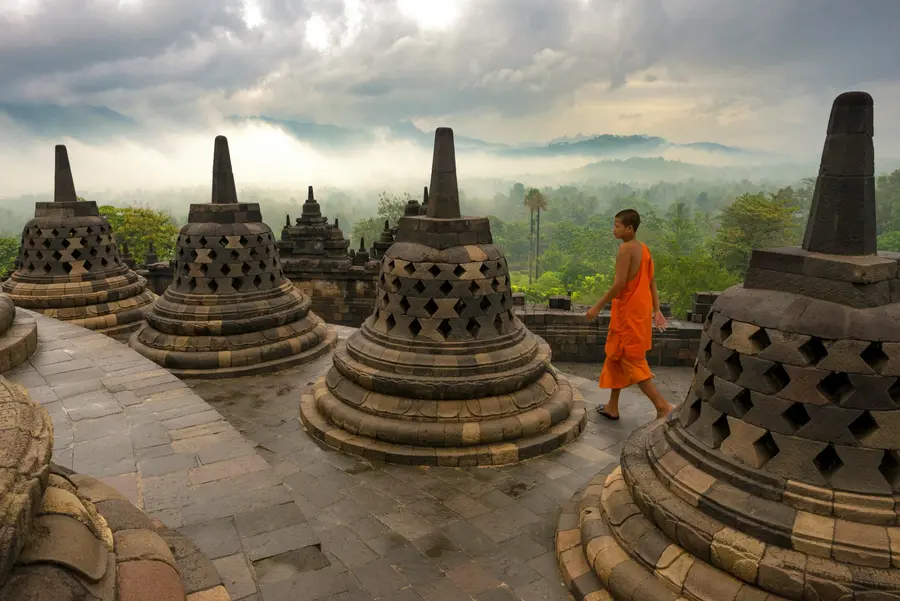
Walking the Hwaeom path carved in stone: Borobudur, Indonesia
The eighth- to ninth-century monument in Magelang, Central Java… visits to the upper levels are capped at 1,200 people a day, who climb with a guide wearing special sandals.
Dawn in Central Java begins with mist. A thin veil of vapour drifting down from Mount Merapi covers the fields, and above it a dark mass slowly emerges into view. It is Borobudur, a stepped hill of stone, often described as the world’s largest Buddhist monument.
Most people who visit remember not the architecture but the act of walking. Borobudur is not a tower to look up at, but a path to be climbed by circling upwards.
Desire below, formlessness above
Borobudur consists of six square terraces and three circular courtyards. The structure replicates the three realms of the Buddhist view of the universe.
At the bottom is Kamadhatu, the realm of desire. It is now hidden from view by the monument’s base. Above it lies Rupadhatu, the realm of form. Around the walls of the four square terraces, about 2,672 relief panels are carved into the stone. As visitors walk along the walls, the reliefs unfold in narrative sequence.
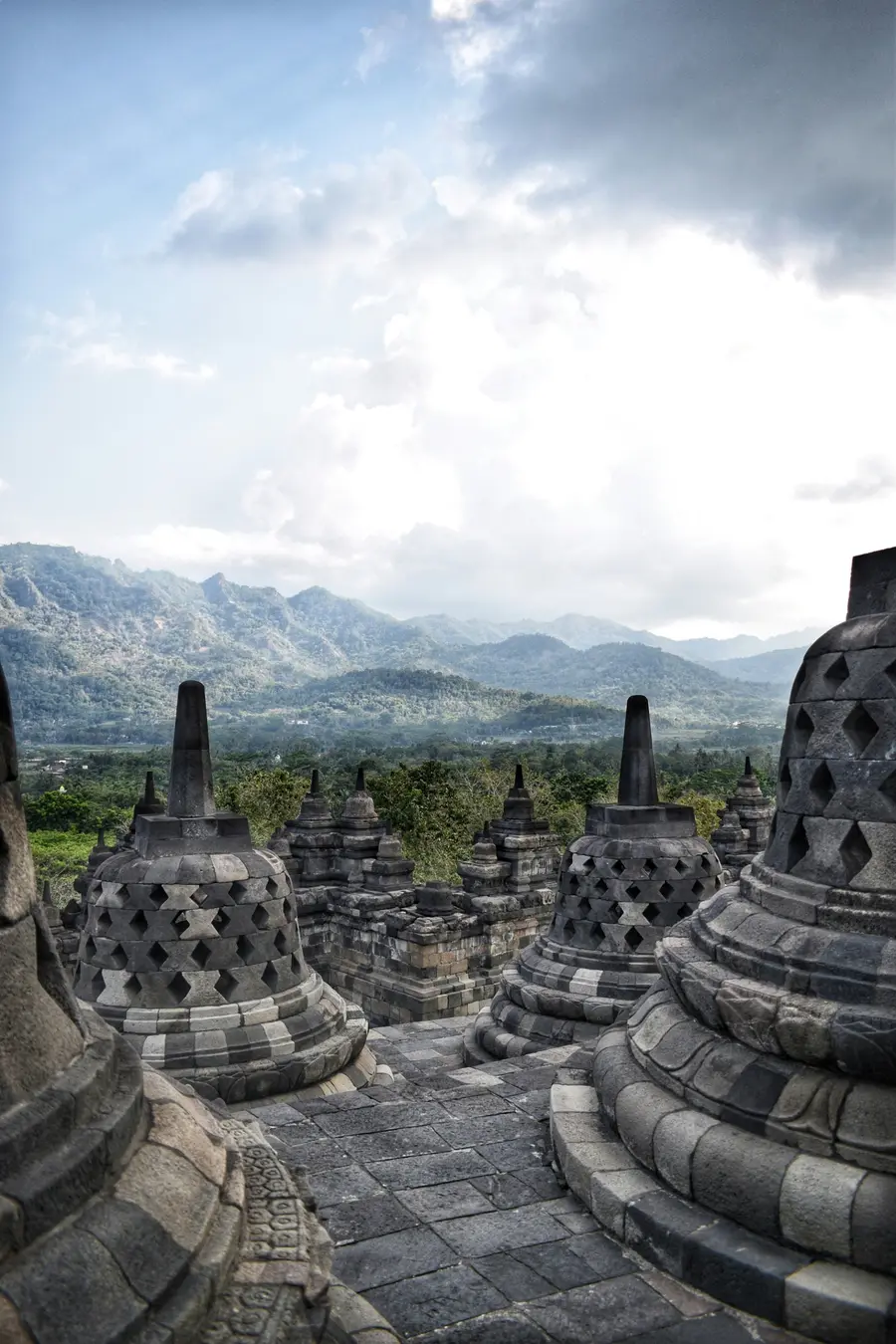
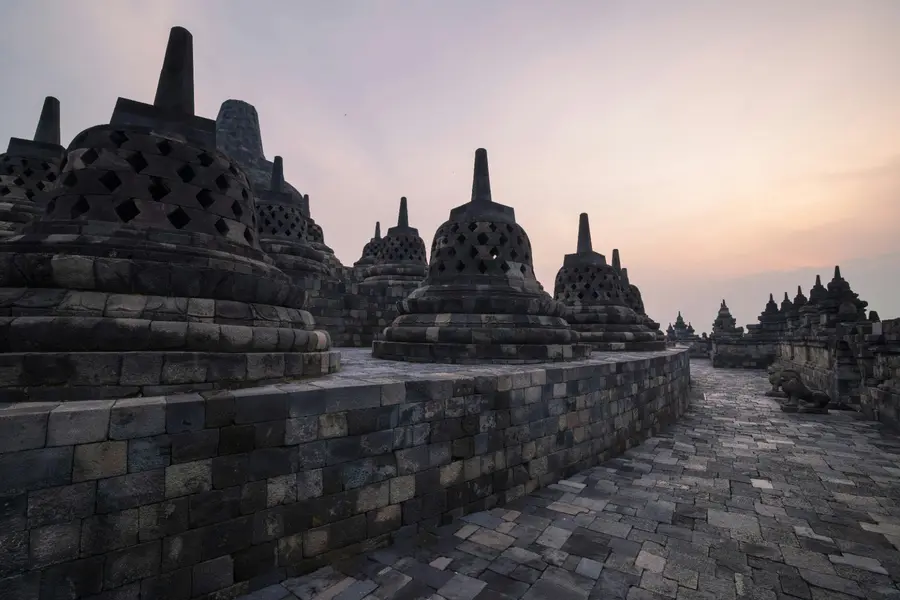
Climb higher and form disappears. This is Arupadhatu, the formless realm. With neither walls nor reliefs, only circular courtyards remain, while 72 perforated, bell-shaped stupas stand facing the sky. Across the temple are 504 Buddha statues, each displaying a different mudra.
From desire to form, and from form to formlessness. Pilgrims pass through this sequence on foot.
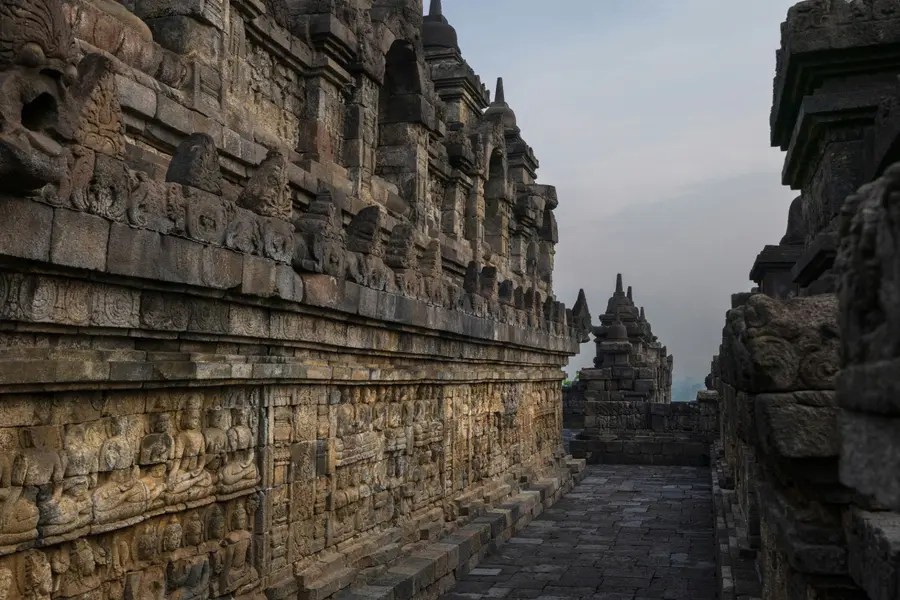
A temple buried in volcanic ash and brought back to life
Borobudur was built between the eighth and ninth centuries, during the Shailendra dynasty. It was later buried under volcanic ash and forgotten for centuries before being rediscovered in the 19th century.
Major restoration work took place in the 1970s and 1980s with support from Unesco. It involved dismantling and documenting each stone before rebuilding the monument. Borobudur was inscribed on the Unesco World Heritage List in 1991.
Visitors need a booking to climb to the upper levels
The first thing visitors to Borobudur need to know is that access to the upper levels of the temple is restricted. The measure is intended to reduce wear on the stone steps.
According to the visitor information, climbs to the upper levels are limited to 1,200 people a day, with timed slots requiring advance reservations. During peak season, bookings are recommended one to two weeks ahead. The upper levels are closed on Mondays for maintenance, although the park remains open.
According to the official booking page, visits to the temple structure begin at 8.30am. Visitors are advised to arrive 30 to 45 minutes early to allow for entry procedures and preparation.
Tickets for the upper levels include permission to enter the temple structure, a wristband ticket, special sandals called 'Upanat', and the accompaniment of a tour guide. Upanat are woven sandals designed to protect the ancient stonework, and wearing them is compulsory. Visitors cannot climb alone without a guide.
Bookings can be made at borobudurpark.com. Enquiries are handled via WhatsApp (+62811 2688 000) or email (info@injourneydestination.id).
The line linking Mendut and Pawon
Visitors who see only Borobudur and turn back have seen only half of what the area offers. Nearby are Mendut Temple and Pawon Temple, both built around the same period. The three temples stand in a straight line, and pilgrims have traditionally walked from Mendut through Pawon to Borobudur.
Further afield are Prambanan, a Hindu temple complex, and Sewu, a Buddhist temple complex. Together they offer a glimpse of Java’s religious history, where the architecture of the two faiths has long coexisted in close proximity.
According to the visitor information, the combined ticket for foreign visitors is being phased out from 2025, meaning tickets must be bought separately for each temple.
A story of spiritual seeking carved into the galleries
The fact that the reliefs in the Rupadhatu galleries are more than simple decoration is key to understanding the temple. The Buddhist newspaper Beopbo Shinmun has called Borobudur a 'stone-carved Avatamsaka Sutra', reporting that the galleries depict the 53 spiritual friends from the Avatamsaka Sutra. It is the journey of Sudhana, who seeks enlightenment by visiting 53 teachers in succession.
The structure of the story mirrors the structure of the building. Pilgrims circle the galleries in the order in which Sudhana meets his teachers, and when that walk ends they ascend to the formless level. Half a day is not enough to read every relief one by one, but even walking slowly while taking in a few scenes conveys what the temple was intended to say.
A Vesak night lit by thousands of rising lanterns
The busiest time of year at Borobudur is Vesak. On this day, which commemorates the Buddha’s birth, enlightenment and death, thousands of devotees and visitors gather for a torchlit procession and release thousands of lanterns into the night sky.
The procession sets out from Mendut and heads towards Borobudur. Night unfolds at an entirely different pace from daytime sightseeing.
A structure where walking itself becomes a spiritual practice
Borobudur has no main worship hall. It was never designed as a prayer space in which visitors enter, take a place and face an altar.
Instead, there are walls. As visitors follow the reliefs clockwise and climb one level at a time, their gaze remains fixed on the walls and their feet keep moving. The design itself resembles walking meditation. Slow the pace and settle the breath, and the rhythm of the scenes passing across the reliefs begins to merge with the rhythm of the steps.
At the upper levels, the walls disappear. The space opens in every direction, leaving only distant mountain ranges and sky in view. Whatever the designers intended, anyone who has walked this structure is briefly left speechless on the final level.
Getting there and when to go
The nearest transport hub is Yogyakarta. According to the official information, the temple is about a 1-hour 30-minute drive away. The address is Jl. Badrawati, Borobudur, Magelang Regency, Central Java.
The rainy season is considered to run from November to March, and visits are recommended between May and September. Wet stone steps are slippery and make access to the upper levels more difficult. Booking the first slot at 8.30am can help visitors avoid the midday humidity and crowds.
It is also worth allowing time to walk through about 1 kilometre of souvenir-market passage between the entrance and the car park.
Travelling from South Korea
Borobudur has also begun to be promoted as a pilgrimage destination by Buddhist organisations in South Korea. Aje Tour is running a four-night, six-day 'Hwaeom Great Stupa Borobudur & Jakarta Pilgrimage' from 10 to 15 October. The itinerary begins in Yogyakarta and continues to Jakarta.
The programme includes visits to the 53 spiritual-friend reliefs from the Avatamsaka Sutra carved into Borobudur’s galleries; Pawon and Mendut temples; Prambanan and Sewu temple complexes; and a jeep tour of Mount Merapi. In Jakarta, the itinerary takes in the old town, the National Museum, Istiqlal Mosque and Monas.
What to know before climbing
The stone steps are steep and narrow. Visitors with knee problems should check in advance where handrails are available instead of relying on walking sticks.
The special sandals are provided on site. People with broad feet may need extra time to put them on, so it is best not to arrive at the last minute. Java’s midday sun can be intense, making a hat and water essential.
The temple remains a place of worship. During Vesak in particular, practitioners stay on site to pursue their spiritual practice. Visitors should refrain from touching the reliefs or climbing on the stupas.
Borobudur as a meditation destination
When people name meditation destinations in south-east Asia, Bali and Chiang Mai often come first. Retreat centres are concentrated there and their programmes are well established.
Borobudur is different. There is no training programme here; the structure itself is the practice. Today’s visitors retrace, in their own footsteps, a path in which people a thousand years ago translated the journey towards enlightenment into stone. It is less a place to learn meditation than somewhere to experience physically what meditation is directed towards.
Since the journey from South Korea to Java is not short, it is best to plan an itinerary of at least five days, combining Prambanan, Mount Merapi and the royal culture of Yogyakarta.
For article enquiries: fare3041@naver.com