
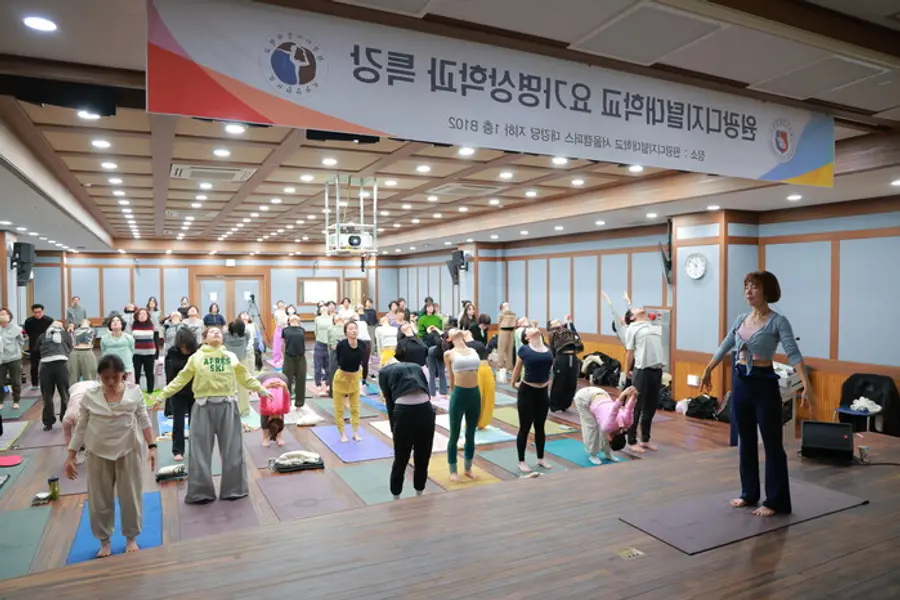
The Energy Yoga Workshop held by the Yoga Meditation Department of Wonkwang Digital University on March 7. This practical program, which integrates Vini Yoga, Asana Flow Meditation, breathing, and Qigong training in one day, received high praise from both current students and graduates.
On a Friday in March, just as spring was beginning, the sound of yoga mats quietly spread through the large lecture hall at the Seoul campus of Wonkwang Digital University. The doors to the 'Energy Yoga Workshop' held on the 7th had opened. It was an unusual gathering where the three branches of Eastern practice—Vini Yoga, Asana Meditation, and breathing and Qigong—came together in one day.
Awakening the Chakras in the Morning — The Delicate Approach of Vini Yoga
The morning lecture was led by Professor Kwak Ji-hye. She is a professor at the Yoga Meditation Department of Wonkwang Digital University and also teaches at the Graduate School of Buddhist Studies in Seoul, and serves as the representative of the Korea Yoga Conference. She is one of the researchers who deeply understands the field of energy yoga education in Korea.
The practice method she presented that day was Vini Yoga. Vini Yoga applies the same asanas differently according to the individual's body condition and purpose. Starting with chakra awareness, moving to breathing practice, asana practice, and leading to a deep state of relaxation through Prana Nidra—participants followed the sensation of energy awakening within their bodies step by step.
Starting from Kanda in the Afternoon — Integration of Asana, Mudra, and Meditation
In the afternoon, Department Head Park Seung-tae took the stage. The topic he chose was 'Asana Flow Meditation'. At the center of the practice was Kanda. Kanda is said to be the source point where the energy channels, known as Nadi, converge in traditional Indian practice, located deep within the abdomen. By being aware of this point while performing asanas and practicing a sequence that combines mudras, participants experienced firsthand that meditative focus is possible even while moving their bodies.
The following 'Breathing and Qigong' session was one of the highlights of the day. Pranayama and the traditional Korean Dantian breathing—though they may seem different on the surface, both practices are deeply connected in that they govern the energy within the body through breath. As the practice continued, exploring the similarities and differences transformed the encounter between Eastern and Western practices into a living experience beyond mere comparison.
"The Practice Experience Deepened" — Voices Filling the Venue
The workshop was attended by both current students and graduates. The feedback from the participants was not just simple satisfaction. Voices expressed, "I was able to systematically understand how yoga, breathing, and energy practices are connected," and "The practice-centered lectures deepened my experience of training." These reactions illustrated how different it is to know something intellectually versus experiencing it in the body.
Department Head Park Seung-tae shared, "This Energy Yoga Workshop was a meaningful opportunity to experience the core of yoga practice, which is the integration of breath and energy flow," and mentioned plans to continue offering practice-centered special lectures in the future.
The starting point of energy practice is not far away. Knowing where my breath is at this moment—that is the first door to all practice.