

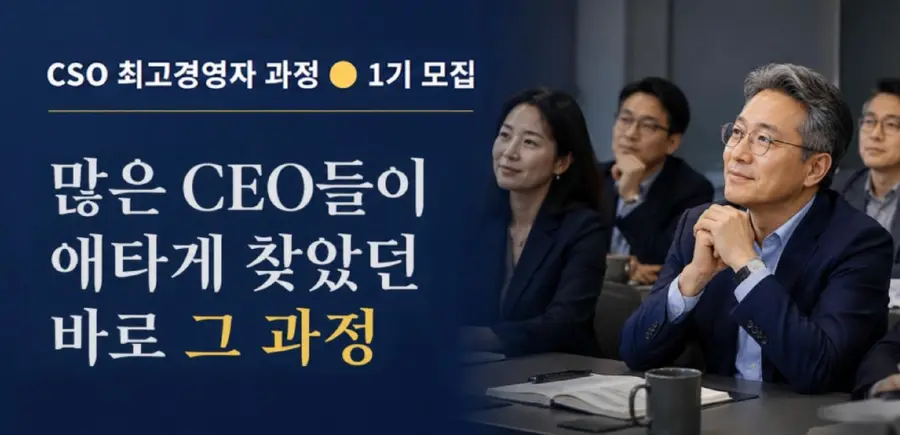
There are countless executive programmes run by universities, institutions and companies. They offer plenty of opportunities to learn about business strategy and the latest trends, and to expand professional networks, but few executives say their company has truly changed after completing one. How to apply what they have learnt to their own organisation, and what kind of leader they should become, remain questions each executive must answer alone.
A very different kind of executive programme has now emerged.
It is the CSO Executive Programme. CSO does not stand for Chief Strategy Officer here, but Chief Spiritual Officer. Rather than business techniques, the programme focuses on the executive’s inner world. Its starting point is that the consciousness and mindset of a leader must change if the organisation and business are to grow together — an area of vital importance to building a company, but one that executive programmes have so far done little to address.
The CSO Executive Programme has a curriculum that differs from conventional executive programmes.
Classes begin with meditation, with further meditation and reflection sessions before and after the lectures, making them experiential rather than one-way presentations. An executive who has spent 25 years building a company, a psychiatrist, a sports medicine expert and a meditation practitioner share the teaching, addressing executives’ organisations, minds and bodies together.
Places are limited to 15, with one-to-one meetings with the faculty also available. After completing the programme, participants will stay connected through a growth community rather than golf or travel outings.
The first cohort begins today (29 October) in Itaewon, Seoul. It will run for eight weeks, with classes every Thursday from 5pm to 9pm until 17 December, before concluding with a three-day, two-night workshop in Jeju. The organisers’ central message is a single sentence: companies and organisations succeed only to the level of their CEO’s consciousness. Healing News takes a closer look at this new initiative, which brings meditation beyond personal wellbeing and into the world of business.
Four hours on a Thursday evening, beginning with meditation instead of drinks and golf
An organiser said the programme’s starting point was the AI era. The concern is that technology-led management is not enough, and that the role of people and spirituality has grown. Existing executive programmes and MBAs are designed around technology and networking, and often end up revolving around drinks and golf. The diagnosis is that they have failed to give executives answers on how to lead their organisations and deliver results.
That is why the scene on a Thursday evening is different from the outset. Participants gather at 5pm for a meal, then, on entering the classroom, sit quietly and focus their minds through meditation. It is a chance to set aside thoughts made noisy by a full day of work and enter a different kind of space. The organisers have shaped the setting as a place of rest and empathy, including through aroma meditation, and classes conclude with a sharing session in which participants talk about what they felt that day.
“We want to make this a place where we listen to participants’ stories and share their concerns, rather than simply delivering lectures,” the organiser said. Being an executive can be lonely, making it all the more important to spend time sharing one’s thoughts with people in the same position.
1,026% versus 122%: the figures the organisers cite for conscious management
The evidence for spiritual management cited by the organisers comes from research by Professor Rajendra Sisodia of Babson College in the US. Sisodia views companies that put purpose and values at their centre, while considering employees, customers and communities, as conscious businesses, and has tracked their performance. The first edition (2007) of his co-authored book 『Firms of Endearment』 reported that the cumulative share-price returns of listed companies in this group reached 1,026% over the 10 years to June 2006, far exceeding the S&P 500’s 122% over the same period. The 2014 revised edition put their cumulative return over 15 years at 1,681%, compared with 118% for the S&P 500.
Several points should be borne in mind when interpreting these figures. The research compared the share prices of companies selected by the authors according to their own criteria, looking back after the fact. It shows a correlation between conscious management and high returns; it does not prove that conscious management causes share prices to rise, still less that taking this programme will produce any particular results. The organisers’ stated ambition of achieving tenfold growth should also be understood as their own goal and slogan, inspired by the figures in this research.
The organisers also cite examples of conscious management in South Korea and overseas. In South Korea, these include JENNIFER SOFT (autonomy and dignity), CARROT Global (entelechy and a learning organisation), Midas IT (people are the answer), Toss (autonomy and responsibility) and HanmiGlobal (employee happiness); overseas examples include Patagonia, Southwest Airlines and Whole Foods Market. They are cited to illustrate a shared principle: organisations grow when they respect employees’ dignity and autonomy rather than relying on top-down instructions, and when employees share in the mission and culture. These companies were selected by the organisers as examples of conscious management; they have neither taken part in nor commented on the programme. CARROT Global is the company of guest lecturer Professor Noh Sang-chung, who also serves as its chair, and is the venue for the classes.
From three employees to average annual growth of 15% over 25 years: executives, a doctor and a trainer in one classroom
The programme was created by two executives who shared a common purpose: Professor Ra Ui-hyeong, an adjunct professor of CSO management and founder of O2Hill, who overcame a crisis while building his company through meditation, and Professor Noh Sang-chung, who built a self-managing organisation on the basis of meditation. They designed the programme for the next generation of executives, and brought in a psychiatrist and a sports medicine expert to cover both mind and body.
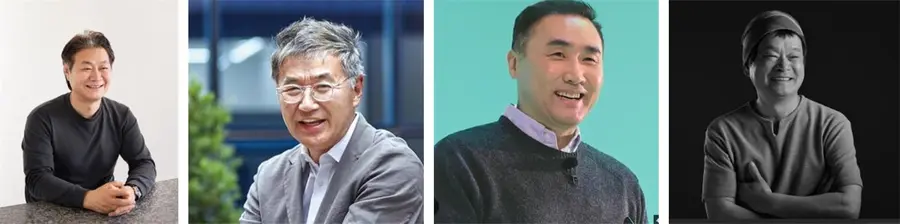
Professor Noh Sang-chung is chair of CARROT Global and founder of the Center One Meditation Center. He wrote 『The Carrot Farm Story: A Spiritual Workplace』 and 『The Path to Management Found in Meditation』. According to the organisers, he grew a company that started with three employees by an average of 15% a year over 25 years. His lectures cover hypercommunication’s molecular structure, a model for a flat organisation with transparent communication without job titles; the amoeba organisation, which divides and grows on its own, and its 80:20:30 principle; and management by ‘borrowing strength’ (借力), which makes use of an external management committee. An organiser said this approach of drawing on outside support can be especially useful for small and medium-sized businesses with limited internal resources.
Professor Chae Jeong-ho, an adjunct professor of CSO management, is a psychiatrist, professor in the Department of Psychiatry at Seoul St Mary’s Hospital, College of Medicine, The Catholic University of Korea, director of the Korean Institute for Mindfulness Education and Research, and founder of Positive School. Drawing on the OPTIMA 9 Project, which combines cognitive therapy, psychotherapy and behavioural techniques, and the ABC method of positivity used by the Optimist Club, whose members share their progress each month, he addresses the mental health of executives and employees, as well as organisations’ psychological capital.
Professor Hong Jeong-gi, an adjunct professor of CSO management, is dean of the Graduate School of Sports Medicine at CHA University and president of the Korea Association of Athletic Trainers. He earned a PhD in exercise science from Oregon State University in the US and has worked on conditioning for athletes including skeleton racer Yun Sung-bin, footballer Ki Sung-yueng and professional golfer Choi Hye-jin. From the perspective of ‘survival muscle’ — the idea that maintaining muscle, which declines year on year after the age of 35, is directly linked to health — he offers fitness routines for busy leaders.
Professor Ra Ui-hyeong is founder of O2Hill, which works with inner consciousness and energy, and has led inner transformation workshops for employees of companies including Hyundai Motor, LG, Hyundai Department Store, POSCO, SK and Nexon. The organisers describe him as an executive who has run companies for 35 years, as well as a meditation practitioner. He will lead the opening class, ‘Immersion’, and the session ‘Manage like a festival’.
Associate professor Lee Kwan-young, who worked for many years at the Samsung Foundation of Culture and the Hansol Cultural Foundation, and held executive roles at a number of companies and organisations including the Korea Mecenat Association, Oricom, Dongbu Group and Hanwha Life, is responsible for overall management of the programme.
Nine sessions, from an energy reset to three days and two nights in Jeju
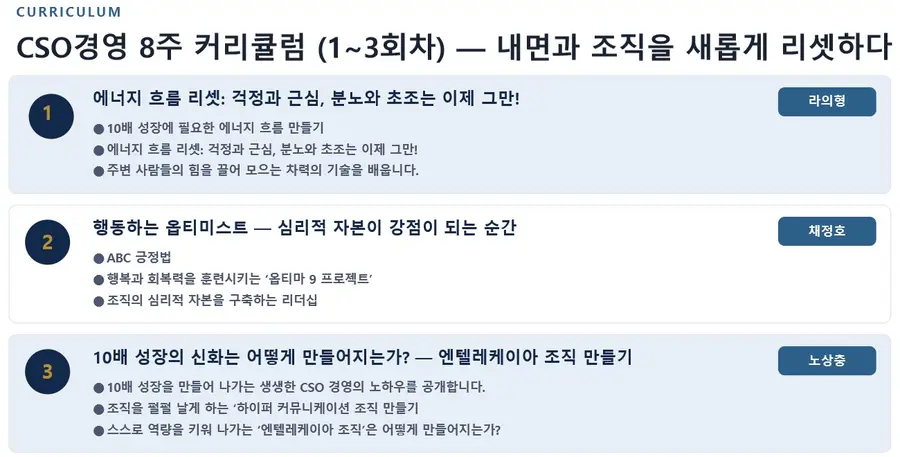
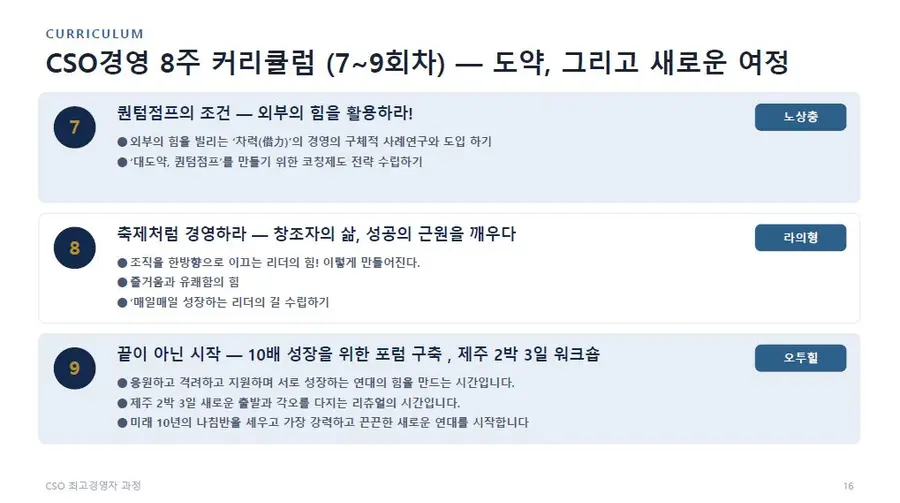
The curriculum consists of eight lectures and a workshop in Jeju. Sessions one to three focus on renewing the executive’s inner world and organisation. Today’s opening class, ‘Resetting the Flow of Energy’ (Ra Ui-hyeong), addresses the worries, concerns, anger and anxiety commonly experienced by business leaders. Session two, ‘The Action-Oriented Optimist’ (Chae Jeong-ho), covers psychological capital and resilience, while session three, ‘Building an Entelechy Organisation’ (Noh Sang-chung), explores the principles behind an organisation that develops its own capabilities.
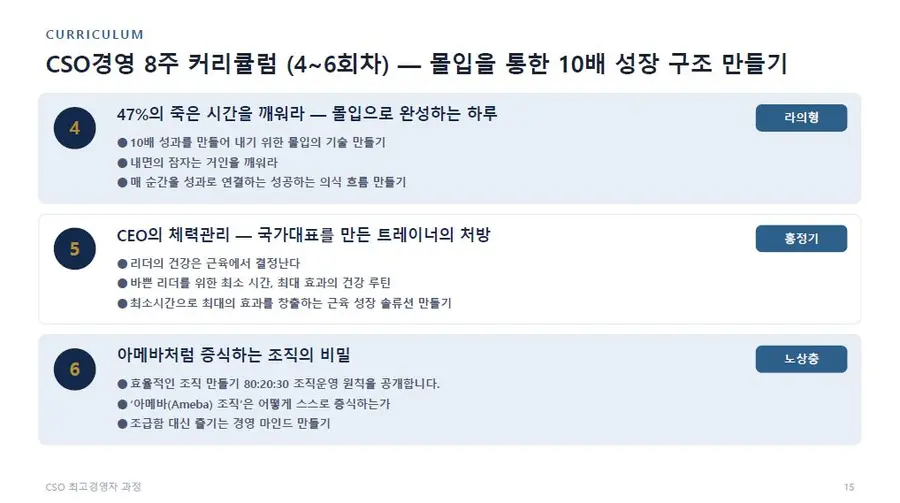
Sessions four to six focus on building the structures for growth. ‘Awaken the 47% of Dead Time’ (Ra Ui-hyeong) is about immersion; ‘Fitness Management for CEOs’ (Hong Jeong-gi) covers healthy routines to maintain muscle with minimal time; and ‘The Secret of Organisations that Multiply Like Amoebas’ (Noh Sang-chung) explores the 80:20:30 principles of organisational management.
Sessions seven to nine prepare participants for a leap forward. ‘The Conditions for a Quantum Leap’ (Noh Sang-chung) covers management by borrowing strength and coaching systems, while ‘Manage like a Festival’ (Ra Ui-hyeong) discusses leadership that brings an organisation together through enjoyment and positivity. The programme concludes with a three-day, two-night workshop in Jeju, where participants will build solidarity by supporting one another and set a direction for the next 10 years.
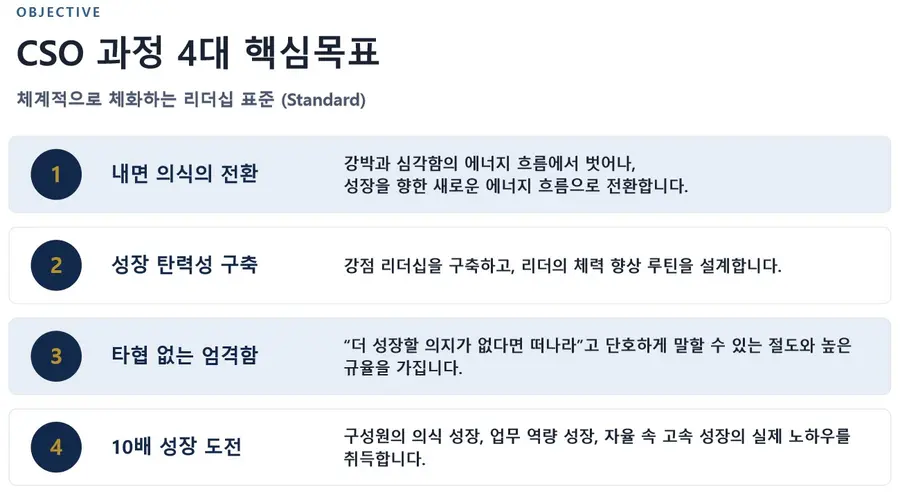
The programme has four key objectives: transforming inner consciousness, building resilience for growth, uncompromising rigour and pursuing tenfold growth. The organiser’s explanation is steeped in the language of meditation. Transforming inner consciousness means letting go of the pressure to succeed at all costs and taking everything too seriously. Change begins when we feel grateful and accept things as they are; the organisation changes when that transformation is shared with its members. Uncompromising rigour is explained through the analogy that a bus can move forward only when people heading in the same direction are on board.
After graduation, participants will stay connected through an alumni forum. The organisers said it would operate as a growth community, rather than as a golf or travel group.
Why meditation for executives now?
In the world of business, where information pours in and decisions never stop, a leader’s mind is often the first to tire. It is not easy to recommend that executives sit for long periods in meditation, as in a traditional retreat. Instead of teaching meditation as a separate subject, this programme weaves it into the beginning and end of classes, the scent of the space and conversations with peers. Placing a fitness lecture alongside one on mental health also reflects meditation’s holistic view of mind and body. For executives new to meditation, familiar business topics may offer an accessible way in.
The programme can be seen as an attempt to translate into the language of Korean business the movement known overseas as conscious management. If more domestic examples emerge of combining management and meditation, K-meditation may expand beyond individual practice and into workplaces and organisations.
The organisers have designed the programme for company CEOs, founders and senior executives. They said they particularly hope to offer practical help to younger leaders in their thirties and forties who run ventures and small and medium-sized businesses, rather than executives at large corporations. Executives grappling with people-related challenges as they grow their organisations, and leaders looking for ways to care for themselves under pressure to deliver, may find it worth considering.
Plans for two cohorts next year and one-day classes after the first cohort
Associate professor Lee Kwan-young said: ‘Following the first cohort this year, we plan to run the programme once in the first half of next year and once in the second half.’
A one-day class is also in preparation for business leaders and start-up founders interested in spiritual management. Executives who find an eight-week programme difficult to commit to may have the option of trying it first through a shorter programme.
First CSO Executive Programme cohort: 29 October–17 December (Thursdays, 17:00–21:00)
Venue: 6th floor, CARROT Global, 268-20 Itaewon-ro, Yongsan-gu, Seoul
Places: 15
Course fee: KRW 2 million
Media enquiries: fare3041@naver.com
Apply: forms.gle/ob3vjnSkfNCN7Bug7
Enquiries: 02-2006-0567, 010-3030-3721