

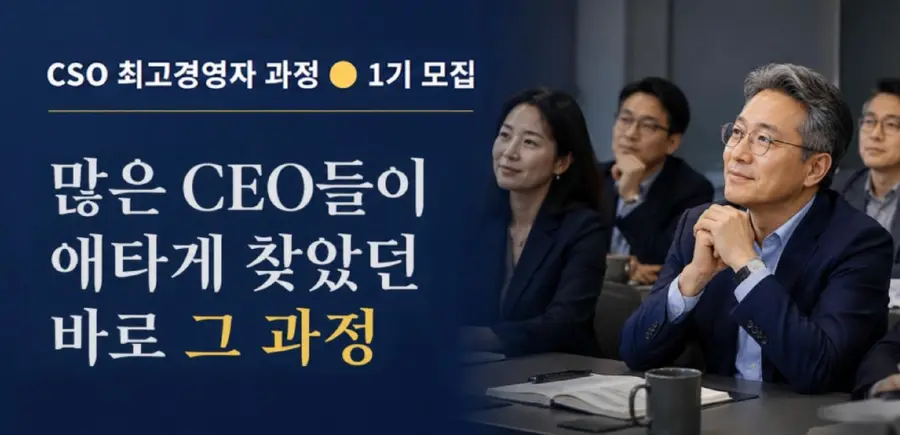
Universities, institutions and companies offer countless executive programs. They can be useful for learning business strategy and the latest trends, as well as building professional networks. But few executives say their companies have truly changed after they completed one. How to apply what they learned to their own organizations—and what kind of leader they should become—are questions executives are still left to answer on their own.
A very different kind of executive program has emerged.
It is the CSO Executive Program. CSO stands not for chief strategy officer, but for Chief Spiritual Officer. The program focuses less on management techniques than on executives’ inner lives. Its premise is that the most important factor in growing a company—one that executive programs have not adequately addressed—is the need for a leader’s consciousness and mindset to change if the organization and business are to grow together.
The CSO Executive Program has a curriculum that differs from those of conventional executive programs.
Classes begin with meditation, with meditation and reflection sessions before and after lectures, making them experiential rather than one-way presentations. Business leaders who have spent 25 years growing their companies, a psychiatrist, a sports medicine expert and meditation practitioners share the lectern, addressing executives’ organizations, minds and bodies together.
Enrollment is capped at 15, and participants can also meet individually with faculty. After graduation, they will stay connected through a growth community—not golf outings or travel groups.
The first class meets today, October 29, in Itaewon, Seoul. The program runs for eight weeks, with classes every Thursday from 5 to 9 p.m. through December 17, and concludes with a three-day, two-night workshop in Jeju. The organizers’ central message is simple: Companies and organizations succeed only to the level of their CEOs’ consciousness. Healing News takes a closer look at this new effort to bring meditation beyond personal well-being and into the world of business.
Four Thursday-evening hours that begin with meditation—not drinks or golf
An organizer said the program’s starting point was the AI era. The idea is that technology-centered management alone is not enough, and that the roles of people and spirituality have grown more important. The organizer’s assessment is that conventional executive programs and MBAs focus on technology and networking and often end up revolving around drinks and golf, without helping executives find answers to how they should lead their organizations and deliver results.
That is why the scene on Thursday evenings is different from the start. Participants gather at 5 p.m. for a meal, then sit quietly to meditate and center themselves before entering the classroom. It is a chance to set aside the noise of a day spent dealing with company business and step into a different kind of time. The organizers have shaped the space into a place for rest and empathy, including with aroma meditation. Classes end with a sharing session where participants talk about what they experienced that day.
“We want to make this a place where we listen to participants and share their concerns, rather than simply delivering lectures,” an organizer said. Being an executive is lonely, the organizer added, making it all the more important to have time to speak candidly with people in similar situations.
1,026% versus 122%: The figures organizers cite for consciousness-based management
To support the case for spiritual management, the organizers cited research by Rajendra Sisodia, a professor at Babson College in the United States. Sisodia has tracked the performance of companies that put purpose and values at the center and consider employees, customers and communities. The first edition (2007) of his co-authored book 『Firms of Endearment』 reported that publicly traded companies among these firms delivered cumulative stock returns of 1,026% over the 10 years through June 2006, far outpacing the S&P 500’s 122% return over the same period. The 2014 revised edition reported cumulative returns of 1,681% over 15 years, compared with 118% for the S&P 500.
Several points should be considered when interpreting these figures. The research retrospectively compared the stock prices of companies selected by the authors according to their criteria, showing a correlation between consciousness-based management and strong returns. It did not prove that consciousness-based management causes stock prices to rise, much less that participants in this program will achieve any particular results. The organizers’ phrase “10-fold growth” is best understood as a goal and slogan they have drawn from the research figures.
The organizers also cite examples of consciousness-based management in South Korea and abroad. In South Korea, they name JENNIFERSOFT (autonomy and dignity), CARROT GLOBAL (entelechy and a learning organization), MIDAS IT (people are the answer), Toss (autonomy and responsibility) and HanmiGlobal (employee happiness). International examples include Patagonia, Southwest Airlines and Whole Foods Market. The examples are intended to highlight what the companies have in common: respecting employees’ dignity and autonomy rather than relying on top-down directives, and growing an organization by sharing its mission and culture with its members. These companies were selected by the organizers as examples of consciousness-based management; they are not participating in or commenting on the program. CARROT GLOBAL is the company of instructor Noh Sang-chung, a CSO management adjunct professor and the company’s chair, as well as the program’s venue.
From three employees to 15% average annual growth over 25 years: Business leaders, a doctor and a trainer share a classroom
The program was created by two business leaders who shared a common purpose: Ra Eui-hyung, a CSO management adjunct professor and founder of O2Hill, who used meditation to overcome a crisis while growing his company, and Professor Noh Sang-chung, who built a self-managing organization grounded in meditation. The two designed the program for the next generation of business leaders. A psychiatrist and a sports medicine expert joined the faculty to address both mind and body.
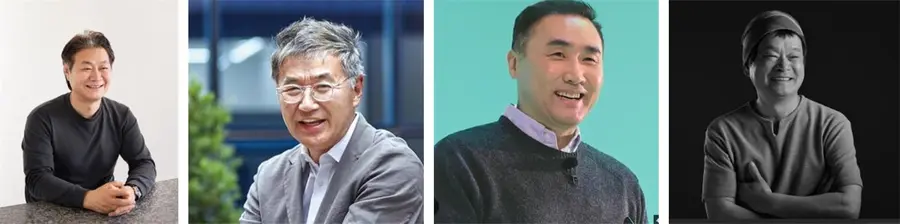
Professor Noh Sang-chung is chair of CARROT GLOBAL and founder of the Center One Meditation Center. He wrote 『The Carrot Farm Story: A Spiritual Workplace』 and 『Finding a Path to Management Through Meditation』. According to the organizers, he grew a company that began with three employees at an average annual rate of 15% over 25 years. His lectures cover a “hypercommunication molecular structure,” a horizontal organizational model where communication is transparent without job titles; the amoeba organization, which divides and grows on its own, and the 80:20:30 principle; and “borrowed-strength management,” which makes use of an outside management committee. An organizer said borrowed-strength management can be especially useful to small and midsize businesses with limited internal resources.
Chae Jeong-ho, a CSO management adjunct professor, is a psychiatrist, professor of psychiatry at Seoul St. Mary’s Hospital, College of Medicine, The Catholic University of Korea, director of the Korean Academy of Meditation in Medicine, and founder of Positive School. Drawing on the Optima 9 Project, which combines cognitive therapy, psychotherapy and behavioral techniques, and the ABC Positive Method of the Optimist Club, where members share their monthly results, he addresses the mental health of executives and employees and an organization’s psychological capital.
Hong Jeong-gi, a CSO management adjunct professor, is dean of the Graduate School of Sports Medicine at CHA University and president of the Korean Society of Athletic Training. He earned a doctorate in exercise science from Oregon State University and has worked on conditioning for skeleton athlete Yun Sung-bin, soccer player Ki Sung-yueng and professional golfer Choi Hye-jin, among others. From the perspective of “survival muscles”—the idea that preserving muscle, which declines each year after age 35, is directly linked to health—he will suggest fitness routines for busy leaders.
Professor Ra Eui-hyung is the founder of O2Hill, which focuses on inner consciousness and energy. He has led inner-transformation workshops for employees of companies including Hyundai Motor, LG, Hyundai Department Store, POSCO, SK and Nexon. The organizers describe him as a business leader who has run a company for 35 years and as a meditation practitioner. He will lead the program’s first class and sessions on immersion and “Manage Like a Festival.”
Lee Gwan-young, the lead adjunct professor, oversees the program. He worked for many years at the Samsung Cultural Foundation and Hansol Cultural Foundation, and served as an executive at numerous companies, including the Korea Mecenat Association, Oricom, Dongbu Group and Hanwha Life.
Nine sessions, from an energy reset to three days and two nights in Jeju
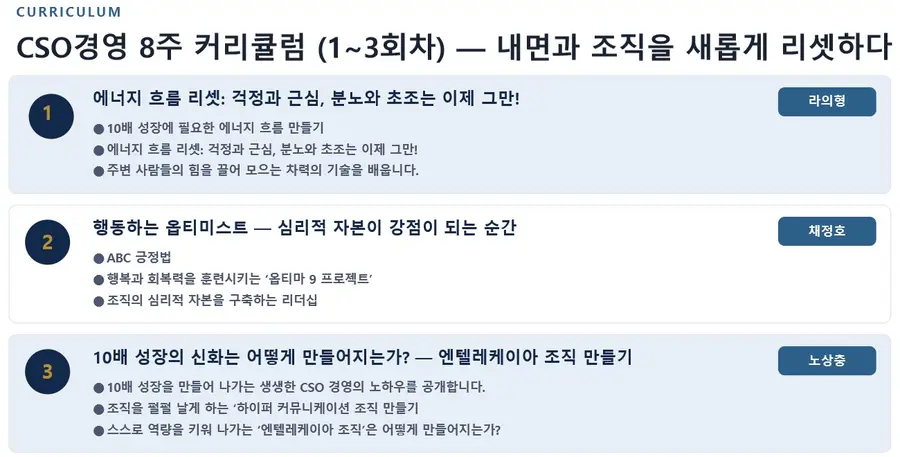
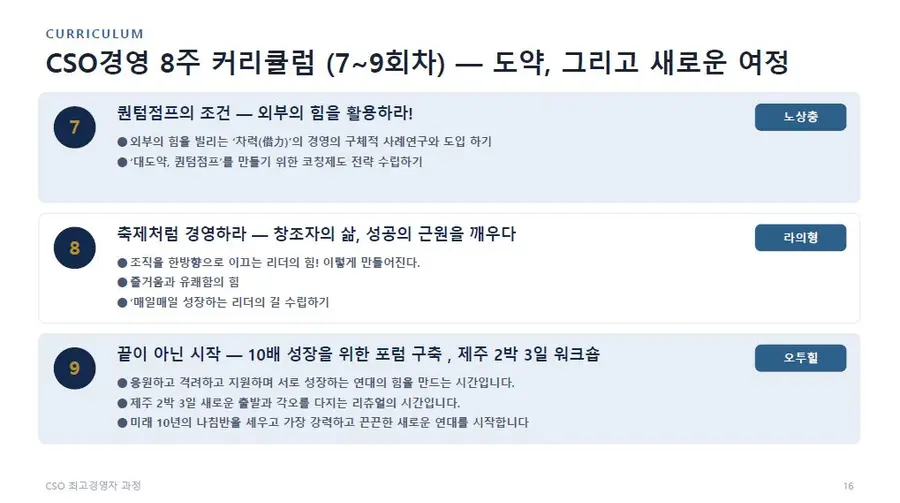
The curriculum consists of eight lectures and a Jeju workshop. Sessions 1–3 focus on renewing executives’ inner lives and organizations. Today’s opening session, “Resetting the Flow of Energy” (Ra Eui-hyung), addresses the worries and concerns, anger and impatience that business leaders commonly experience. Session 2, “The Optimist in Action” (Chae Jeong-ho), covers psychological capital and resilience. Session 3, “Building an Entelechy Organization” (Noh Sang-chung), explores how organizations can develop their capabilities on their own.
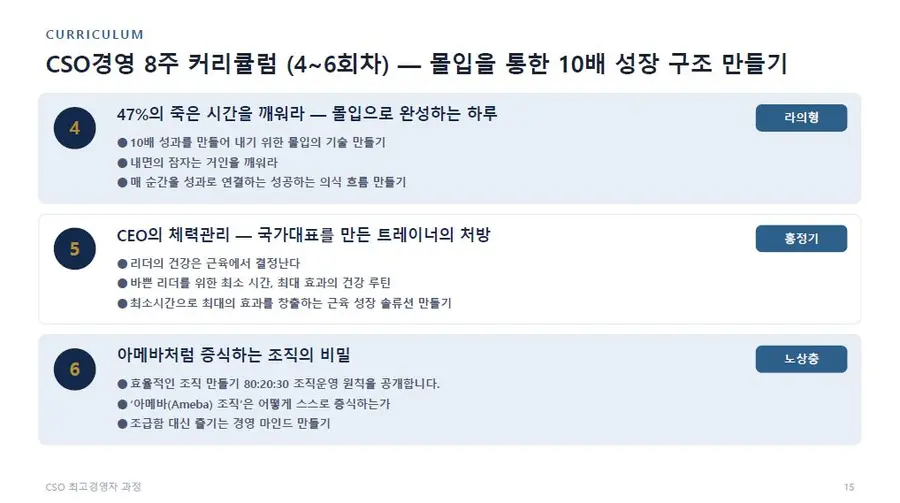
Sessions 4–6 focus on building a framework for growth. “Awaken the 47% of Dead Time” (Ra Eui-hyung) covers immersion; “CEO Fitness Management” (Hong Jeong-gi) offers a health routine to preserve muscle in minimal time; and “The Secret of an Organization That Multiplies Like an Amoeba” (Noh Sang-chung) covers the 80:20:30 principles of organizational management.
Sessions 7–9 prepare participants for a leap forward. “Conditions for a Quantum Leap” (Noh Sang-chung) covers borrowed-strength management and coaching systems, while “Manage Like a Festival” (Ra Eui-hyung) explores leadership that guides an organization in one direction through enjoyment and enthusiasm. The program concludes with a three-day, two-night workshop in Jeju, where participants will strengthen bonds of mutual support and set a course for the next 10 years.
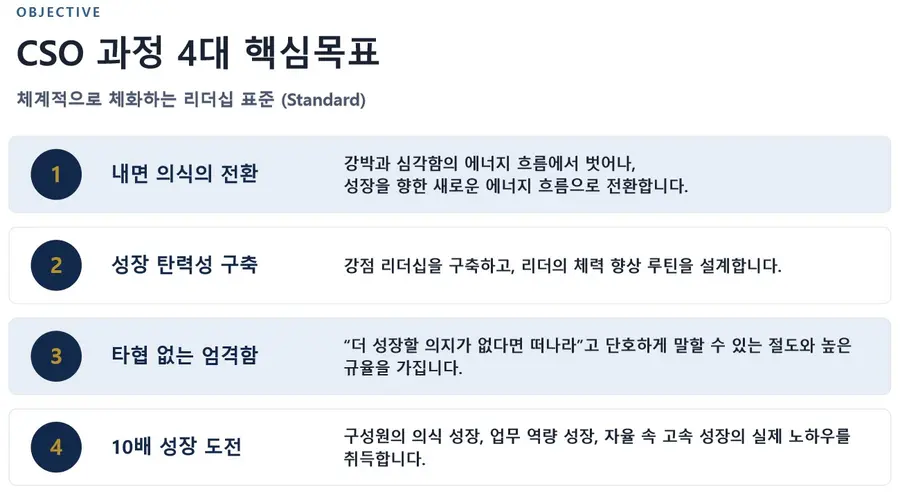
The program has four core goals: transforming inner consciousness, building growth resilience, uncompromising rigor and pursuing 10-fold growth. The organizer’s explanation reflects the language of meditation throughout. Transforming inner consciousness means letting go of the pressure and seriousness of believing one must succeed, and recognizing that change begins with gratitude and accepting things as they are—and that organizations change when people share that transformation with their colleagues. “Uncompromising rigor” is explained through the metaphor that a bus can move forward only when people headed in the same direction are on board.
After graduation, participants will stay connected through an alumni forum. The organizers said they intend to run it as a growth community, not a golf or travel group.
Why meditation for business leaders now?
In the business world, where information pours in and decisions never stop, a leader’s mind is often the first thing to wear down. It is not easy to ask executives to meditate for long periods, sitting facing a wall. Rather than teaching meditation as a separate subject, this program weaves it into the start and end of class, the scent of the space and conversations with peers. Placing physical fitness lectures alongside sessions on mental health also reflects meditation’s perspective of caring for mind and body together. For executives new to meditation, the familiar subject of business may offer a way in.
The program can be seen as an effort to translate into the language of Korean business leaders a movement known abroad as consciousness-based management. If more domestic examples emerge that combine management and meditation, K-meditation may expand beyond individual practice into workplaces and organizations.
The organizers have designed the program for company CEOs, founders and key executives. An organizer said they particularly hope to provide practical help to younger leaders in their 30s and 40s who run startups and small and midsize businesses, rather than executives at large corporations. It may appeal to leaders grappling with people-related challenges as they grow their organizations, or seeking ways to care for themselves under pressure to deliver results.
Plans for two more programs next year and a one-day class after the first cohort
Lead adjunct professor Lee Gwan-young said, “After the first cohort this year, we plan to hold the program once in the first half of next year and once in the second half.”
A one-day class is also in the works for business leaders and startup founders interested in spiritual management. Executives who find an eight-week program too demanding may have the option of trying a shorter program first.
First CSO Executive Program cohort: October 29–December 17 (Thursdays, 5–9 p.m.)
Location: 6th floor, CARROT GLOBAL, 268-20 Itaewon-ro, Yongsan-gu, Seoul
Class size: 15
Tuition: 2 million won
Press inquiries: fare3041@naver.com
Register: forms.gle/ob3vjnSkfNCN7Bug7
Inquiries: 02-2006-0567, 010-3030-3721