
Dongguk University WISE Campus Child Character Education Research Institute
Experts from various fields including over 170 attendees showed high interest in meditation education
Exploring ways to introduce meditation education into public education… significant response in the education sector
As the mental health crisis among youth in modern society becomes severe, the Dongguk University WISE Campus Child Character Education Research Institute is showing meaningful movements to introduce meditation education into public education.
Dongguk University Child Character Education Research Institute presents a new direction for future education
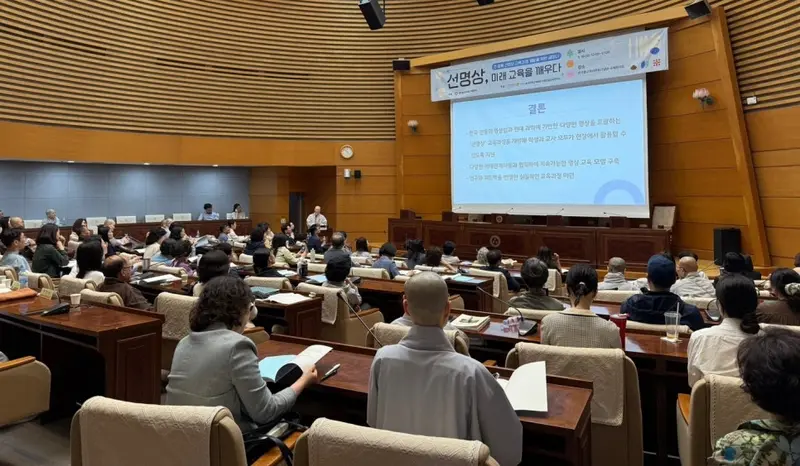
The Dongguk University WISE Campus Child Character Education Research Institute (Director Monk Hyeju) successfully held a seminar on May 18th at the International Conference Hall of the Korean Buddhist History and Culture Memorial Hall in Jongno-gu, Seoul, under the theme ‘Zen Meditation Awakening Future Education’. Dongguk University WISE Campus is a branch of Dongguk University located in Gyeongju, aiming to cultivate creative and convergent talents through innovative education.
The Child Character Education Research Institute is dedicated to developing and researching character education programs based on the compassion and wisdom of Buddhism, particularly focusing on systematic educational methodologies for the emotional growth and character development of children and adolescents. This institute, led by Monk Hyeju, presents a new educational model that combines the wisdom of traditional Buddhist education with the scientific approach of modern pedagogy.
The necessity of Korean-style social-emotional education presented by experts
Over 200 participants, including policy officials from the Ministry of Education, elementary and middle school teachers, and meditation experts, attended the seminar, showing great interest. Organized by the Future Headquarters of the Korean Buddhist Jogye Order and hosted by the Dongguk University Child Character Education Research Institute, this event deeply explored the possibility of introducing meditation education into public education.
The background and necessity of Korean-style social-emotional education
Professor Seo Wan-seok from the Department of Psychiatry at Yeungnam University Hospital explained the background of developing Korean-style social-emotional education. He pointed out, “Currently, South Korea has one of the highest youth suicide rates in the OECD, and 50% of the youth who committed suicide showed no abnormalities in pre-examinations,” emphasizing the urgent need for education that enables children to manage their own minds.
Professor Seo stated that as a result of the proposal for the necessity of social-emotional education by the School Mental Health Association and the Korean Meditation Medicine Association to the Ministry of Education in November 2023, a new division for ‘Social-Emotional Growth Support’ was established in 2024. The developed Korean-style social-emotional education consists of four areas (self, relationships, community, mental health) and six core competencies (self-awareness, self-management, relationship awareness, relationship management, awareness and management of community values, mental health awareness and management).
Scientific evidence-based meditation education program
Professor Won Seung-hee from Kyungpook National University Hospital introduced the development process of the MSEG (Mindfulness-Based Social-Emotional Growth) program. This program was jointly developed by the Korean Meditation Medicine Association and the KAIST Meditation Science Research Institute over three years, and it has been proven effective in enhancing children's emotional regulation and resilience through a non-religious and scientific approach.
Professor Won stated, “When teaching meditation to children, it should be approached like a game in short sessions of less than 5 minutes,” adding, “Children tend to meditate better than adults, and it shows three times greater effects, especially for children who need special assistance, such as those with ADHD or autism.”
Vivid examples and practical methods from the education field
Actual meditation education in elementary schools
Teacher Choi Yong-soo from Jeju Bomok Elementary School presented a case of Zen meditation classes in a 6th-grade classroom. He explained, “Introducing meditation from the first day of the new semester is the most effective,” stating that “children can accept it with high expectations and an open mind.”
Teacher Choi introduced the use of the **‘Clear Water Pouring Experiment’** to help children understand. He shared specific educational methods, saying, “By dropping ink into a beaker to visualize the stress in their hearts and pouring clear water to show the effects of meditation, children can easily understand.”
He also emphasized, “Children do not accept meditation religiously,” and that “meditation education linked to the curriculum is important.” In fact, most of his 17 students identified ‘improved concentration’ as the biggest change after a year of meditation classes.
Zen meditation education methods for middle school students
Teacher Kim Yoon-kyung from Dongguk University’s affiliated Garam Middle School explained the uniqueness of Zen meditation education for middle school students. “Middle school students are in a period of psychological remodeling, making it difficult to produce educational outputs,” he suggested, stating that “resilience, self-regulation, stress management, and systemic thinking are key.”
Based on his experience running the SEE Learning (Social-Emotional Character Education) program for three years, Teacher Kim emphasized the need for long-term education, stating, “1st graders are chaotic, 2nd graders are focused, and 3rd graders reach a stage of stability.”
Policy support and institutionalization methods
Chief Policy Advisor Cheon Woo-jung from the National Assembly Education Committee presented policy support measures for Zen meditation education. He stated, “Zen meditation is the ultimate form of meditation education,” and that “budget support linked to the Character Education Promotion Act is possible.”
Chief Advisor Cheon explained, “In a situation where the special grant for AI digital textbooks has been abolished, this budget can be utilized for character education,” and that “support for Zen meditation education is possible through various channels, including solving youth gambling issues and budgets related to the gambling industry.”
He particularly noted, “There may be concerns due to its Buddhist connotation, but Zen meditation can also be interpreted as the ‘Sun’ of the sun rather than the ‘Seon’ of the Zen,” suggesting the possibility of a non-religious approach.
A new educational paradigm towards the future
During this seminar, a consensus was formed that Zen meditation education should aim for fundamental healing and growth, not just simple technique transmission. Participants shared the opinion that “we must first understand what children truly want and develop programs accordingly.”
Monk Hyeju emphasized, “We aim for education that feels, experiences, and grows together,” stating, “It is important for teachers to first experience Zen meditation, so that the peace can naturally be conveyed to the children.”
Plans for continuous development
The Dongguk University Child Character Education Research Institute plans to hold a Zen meditation workshop for teachers in August, following this seminar, and in October, they will expand exchanges with overseas meditation education experts through an international conference.
They are also in the process of developing a systematic Zen meditation curriculum and workbook for elementary and middle school students, and are exploring practical application methods in collaboration with the education office.
In the face of the mental health crisis faced by the digital native generation in modern society, Zen meditation education, which combines traditional wisdom with modern approaches, is gaining attention as a new alternative. It remains to be seen what changes the direction presented in this seminar will bring to actual educational settings.
Written by: Oh Ji-hyun, Editor