

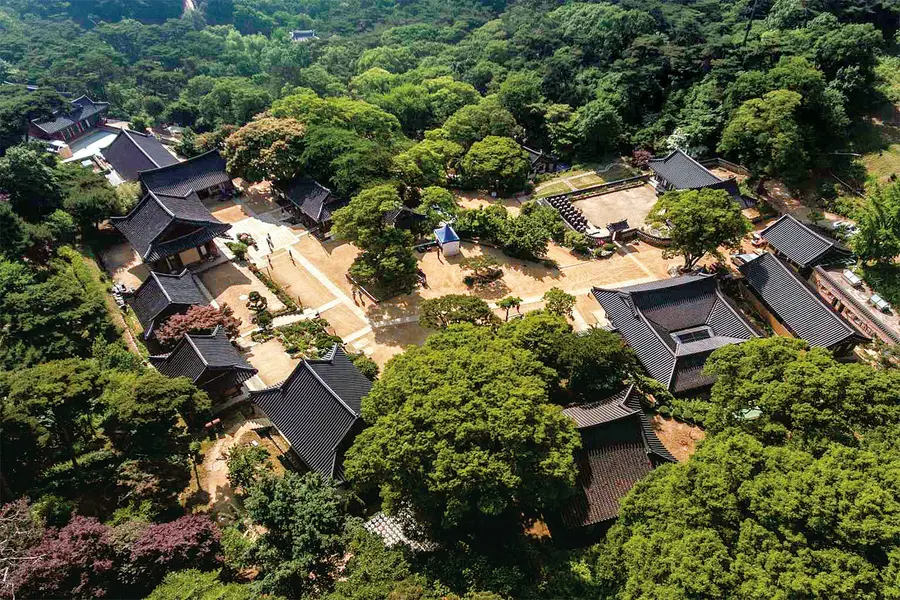
The morning in Ganghwa arrives first with the smell of water. As the island sits where the sea and the river meet, the air always carries a faint hint of salt. When you step into the foothills of Jeokjusan Mountain, that scent slowly shifts into the smell of earth and trees. After passing through the gate and walking a little along the dirt path, the tile roofs of the temple emerge between the trees. This is Jeondeungsa (傳燈寺).
A temple that has endured for 1,600 years
Jeondeungsa is said to have been founded in 381 during the reign of King Sosurim of Goguryeo by the monk Ado Hwasang. Its original name was Jinjongsa (眞宗寺). If the record is accurate, it would make Jeondeungsa the oldest temple among those still standing in South Korea today. The temple itself introduces the site as “the oldest surviving temple where nature, history, myths, and legends live on.”
Just reading the number makes it sound like more than 1,600 years have passed, but when you stand in the temple courtyard, that span feels strangely quiet. The zelkova tree in front of the main hall casts a wide stretch of shade, and a wind chime occasionally sways at the very end of the eaves. Nothing here looks especially remarkable because it is old. It is simply there. That first impression is what Jeondeungsa gives visitors.
One jade lantern that gave the temple its name
The current name traces back to Jeonghagu Palace Lady (鄭和宮主), the wife of King Chungnyeol of Goryeo. It is said that the name “Jeondeungsa” came about because Palace Lady Jeonghagu brought a lantern made of jade (玉燈) to this temple. The name, meaning “to pass on lantern(s),” also overlaps with the meaning of continuing Buddhist teachings.
But the jade lantern itself is no longer at the temple. During the 1866 Byeong-in Yangyo campaign, French troops are said to have looted it. The object that gave the name is gone, leaving only the name behind. According to a report by the Kyungin Ilbo, the temple still has a bronze water basin 112 centimeters in diameter and 72 centimeters in height, and 『Ganghwa-sa』 published in 1976 explains that Palace Lady Jeonghagu used the basin.
A woman supporting the eaves
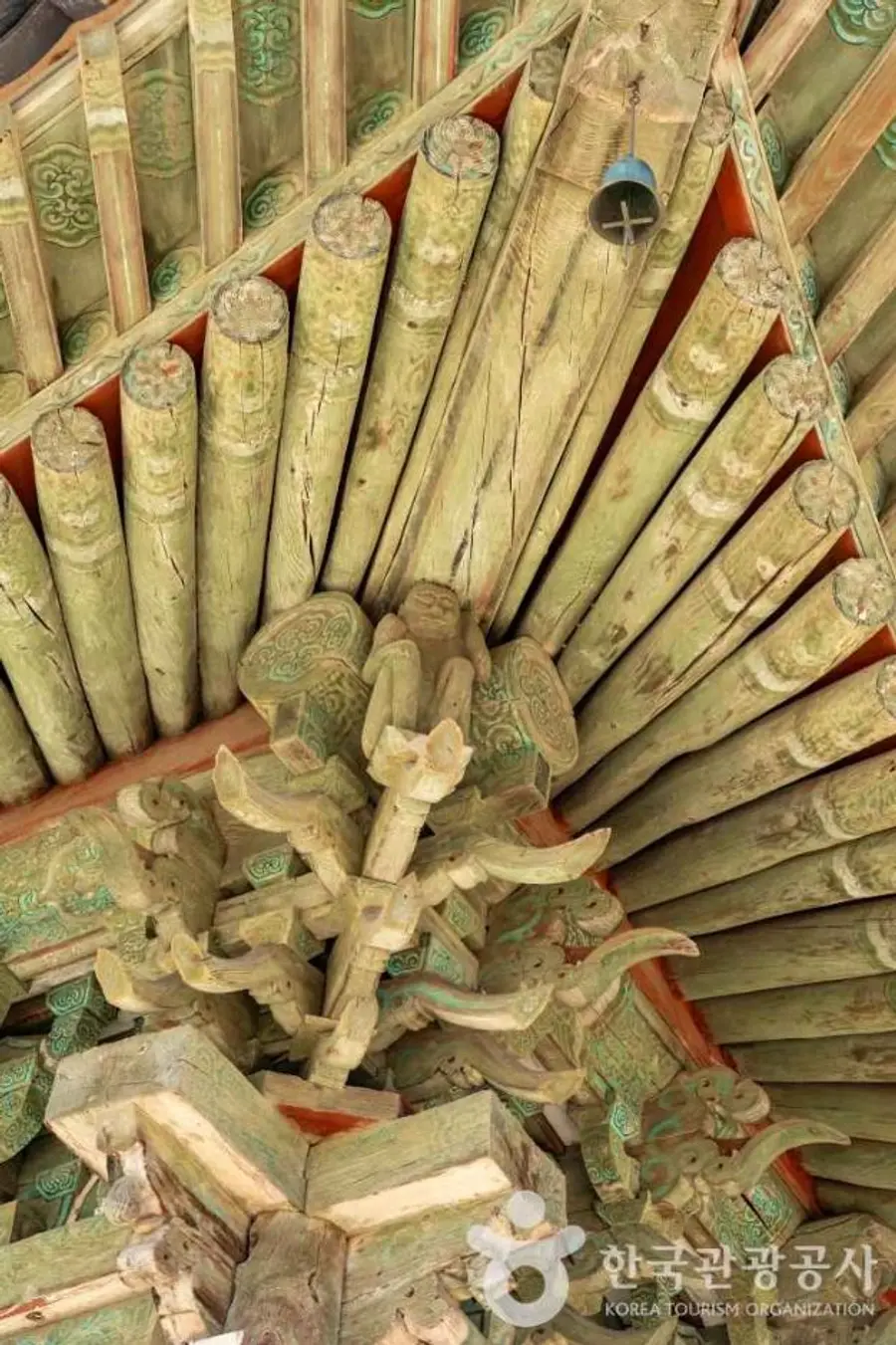
At Jeondeungsa, the place people look up at the longest is the four corners of the eaves of the Daeungbojeon Hall. A na-bu statue (裸婦像)—a nude woman huddling in a tight posture and bracing the roof—sits there.
Stories about how this carving came to be are said to involve a carpenter foreman (the head carpenter) and a woman, tangled together during the time when the Daeungbojeon Hall was repaired and rebuilt in the 17th century. It is not a story you can verify as true. Still, the premise itself—that the carpenter carved his feelings into the underside of the roof and made the structure carry his weight for nearly 400 years—is a passage that people who come to the temple have kept turning over for a long time. In front of this carving, the questions naturally arise: Where do you put your mind, and how do you set it down?
A temple that guarded the annals
Jeondeungsa served not only as a space for spiritual practice, but also as a place that helped preserve the nation’s records. During the Joseon Dynasty, this temple took on the role of guarding the Jeokjusan Sago, where the 『Annals of the Joseon Dynasty』 were stored. The dynasty’s records were moved to an island to escape fire and other disasters, and this mountain became the last stronghold.
The Samrangseong fortress (Jeokjusan Fortress) that surrounds the temple is a stronghold said to have been built by Dangun’s three sons. Its layout includes a gate and then a path into the temple, so visitors are naturally separated from the outside world by a single layer during the walk. It was not a device created specifically for meditation, yet in the end it functions that way.
A day of sitting, walking, and eating
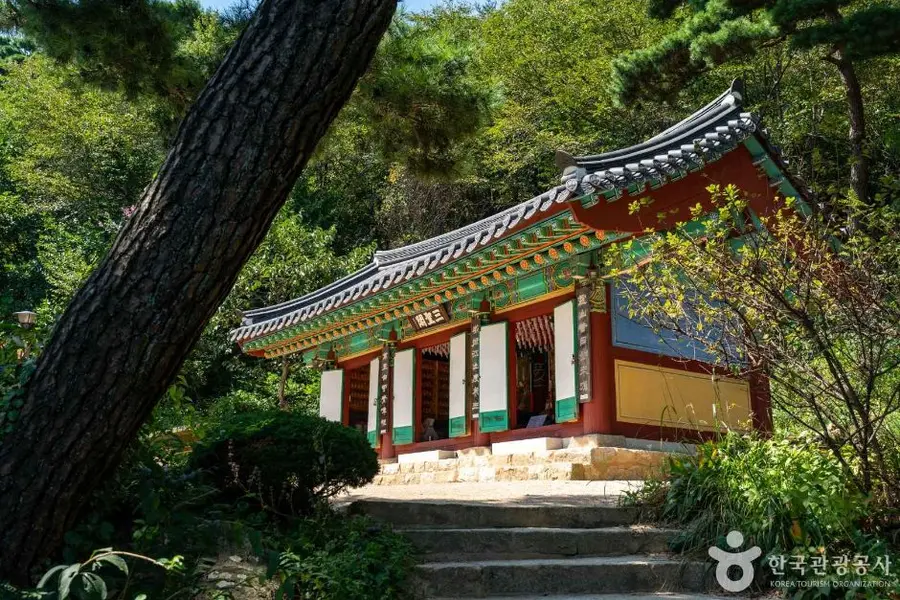
Jeondeungsa runs temple stays. The experiences the temple offers include dawn services, seated meditation, receiving meals in bowls, tea tasting, temple-site tours, and work practice (ulryeok)—six categories in all.
Dawn services begin in the darkest time of the day. It is the time when you physically receive the sound of bells and the wooden knock (moktak). For first-timers, the experience is closer to opening the senses than to meditation. Seated meditation comes next. You sit after setting your posture and follow your breathing. For people who are not used to it, it can also be a time when your legs go numb.
Bowls meal service (balwoo gongyang) is a method of receiving rice in four bowls, not leaving any behind, and then rinsing everything with water at the end—drinking even that rinse water. It is a process that teaches with your body how many hands and how much time the food takes to reach you. The tea tasting experience slows your hands as you pour and drink the tea. Work practice (ulryeok) is the time you share in doing labor like sweeping the courtyard or trimming vegetables. The schedule combines meditation while sitting and meditation while moving, both of which are woven into a single day.
When is the best time to go?
Ganghwa is an island with distinct expressions across the four seasons. In spring, fresh green climbs along the fortress paths. In summer, the forest thickens and shade reaches down even into the temple courtyard. During autumn’s peak maple season, visitor numbers are at their highest. If you want quiet time, late fall to early winter—or weekdays in early spring—are better. In winter, sea winds blow over Jeokjusan and make it feel colder, so it’s best to pack enough warm layers.
The fact that you can make a day trip from the Seoul Capital Area is also an advantage of this temple stay. For people who can’t clear an entire day, places that offer half-day quiet are rare in terms of accessibility.
Visitor information
Address: Ganghwa-gun, Incheon, Gil-sang-myeon (inside the Jeokjusan Samrangseong)
Temple stay office: 032-937-0152
Office for temple administration (Jongmu-so): 032-937-0125
Temple stay reservations: the integrated reservation site for temple stays (templestay.com) or the Jeondeungsa website (jeondeungsa.org)
How to get there: For public transportation, take a route via Ganghwa Terminal, move toward Onsu-ri in Gil-sang-myeon, and then use either walking or local buses. Because service intervals vary by season and day of the week, it’s a good idea to check Ganghwa-gun’s public transportation guidance in advance.
Schedules by program, participation fees, and whether activities run year-round or only on weekends are not published separately on the temple’s website. For exact details, you can contact the temple stay office.
A place for meditation travel
While Korean meditation travel was imagined only as long practice deep in the mountains, places like this one—within half a day’s distance from the Seoul Capital Area—were talked about less. Jeondeungsa brings together, all in one place, the 1,600-year history of the temple, the historical records of a dynasty, the fortress tied to the Dangun legend, and practice programs that are still running today. That means it can compress Korea’s time into a short window, and the same condition holds true even when introducing Korean-style wellness to foreign visitors.
There are trips in which what remains is not what you came to see, but what you came to put down. In the short span of time climbing a dirt path after passing through the gate, half of the journey already begins.
For article inquiries: fare3041@naver.com
