

The morning on Ganghwa Island arrives first with the smell of water. As the island sits where sea and river mingle, the air always carries a faint hint of salt, and when you step into the foothills of Jeongjoksan, that scent gradually shifts to the smell of earth and wood. After passing through the gate and climbing a little along the dirt path, the monastery’s tiled roof appears between the trees. This is Jeondeungsa (傳燈寺).
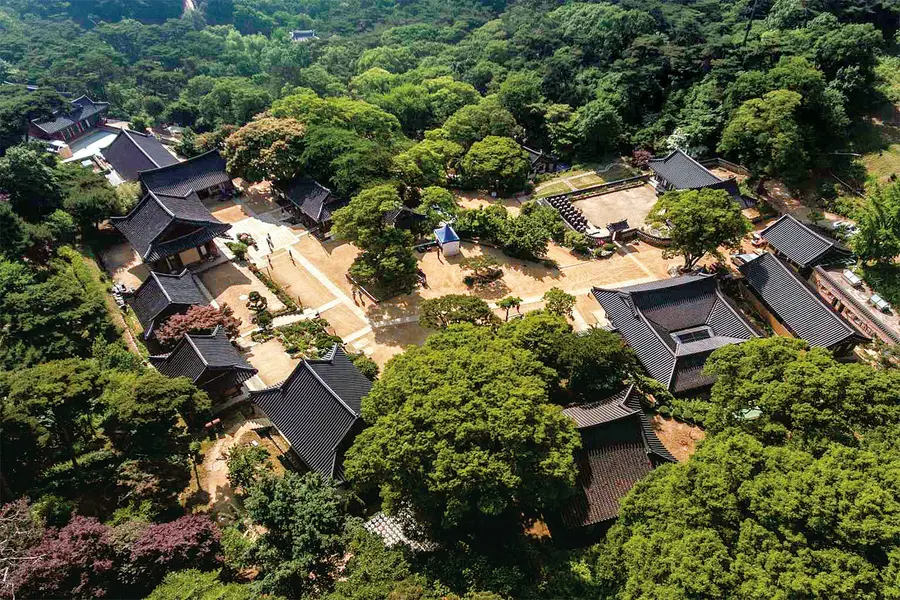
A monastery that has crossed 1,600 years
Jeondeungsa is said to have been founded in 381, during the reign of King Sosurim of Goguryeo, by Ado Hwasang. Its original name was Jinjongsa (眞宗寺). If the record is accurate, it would be the oldest monastery still standing in South Korea today. The monastery introduces itself as “the oldest monastery that holds nature and history, myth and legend”.
Read as a number, the monastery spans more than 1,600 years, but when you stand in the temple courtyard, that time feels surprisingly quiet. The zelkova tree in front of Daeungbojeon casts a wide canopy of shade, and from the eaves a wind chime can occasionally be heard swaying. Nothing here looks especially remarkable in itself; it simply sits there. That is the first impression Jeondeungsa gives visitors.
One jade lamp that became the name
The current name comes from Jeonghunguja, the queen of King Chungryeol of Goryeo. It is said that the name Jeondeungsa was given because Jeonghunguja presented the monastery with a lamp made of jade (玉燈). The meaning of the name—“to pass on a lamp”—also overlaps with the sense of “continuing the Buddhist Dharma”.
But that jade lamp is not left in the temple. It is said that during the 1866 Byeongin Yangyo, French troops looted it and took it away. The object that gave rise to the name has vanished, leaving only the name behind. According to a report by Kyungin Ilbo, the temple has a bronze water jar measuring 112cm in diameter and 72cm in height, and a 1976 publication, 『Ganghwa sa』, explains that this water jar was used by Jeonghunguja.
A woman supporting the eaves
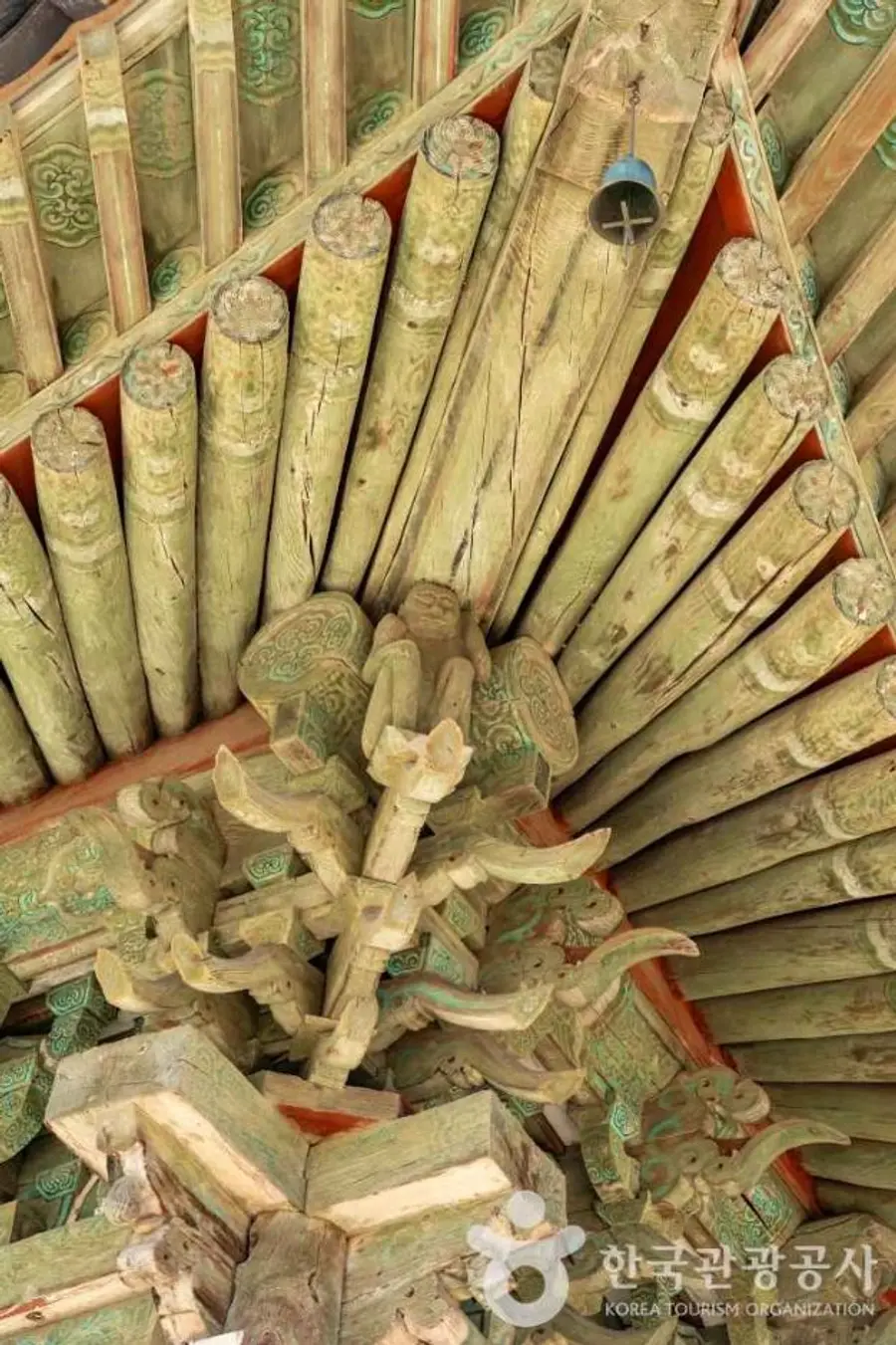
The place people in Jeondeungsa look at for the longest time is the four corners of the eaves of Daeungbojeon. A nude female figure, Nabusa (裸婦像), crouches in a hunched position, holding up the roof.
A story about a carpenter master, the do-pyeonsu, and a woman intertwined when Daeungbojeon was repaired and rebuilt in the 17th century is said to be the origin of this sculpture. It is not a tale that can confirm whether it is true. Still, the very premise—that the carpenter carved his feelings under the roof and made the sculpture carry a weight for nearly 400 years—is precisely the sort of detail visitors return to and dwell on for a long time. In front of this sculpture, a natural question arises: where to place one’s mind, and how to set it down.
A temple that kept the annals
Jeondeungsa was not only a space for spiritual practice; it also played a role in preserving the nation’s records. During the Joseon period, this temple took on the responsibility of guarding the Jeongjoksan 사고 (repository) that stored the 『Annals of the Joseon Dynasty』. The kingdom’s records were moved to the island to avoid war and fire, and this mountain became the last stronghold.
Samrangseong, the fortress that surrounds the temple (Jeongjoksanseong), is a wall said to have been built by three sons of Dangun. Because the layout requires visitors to pass through the gate and enter the temple, while they walk they are naturally separated from the outside world by an extra layer. It does not come from a device created specifically for meditation, yet in practice it works that way anyway.
A day of sitting, walking and eating
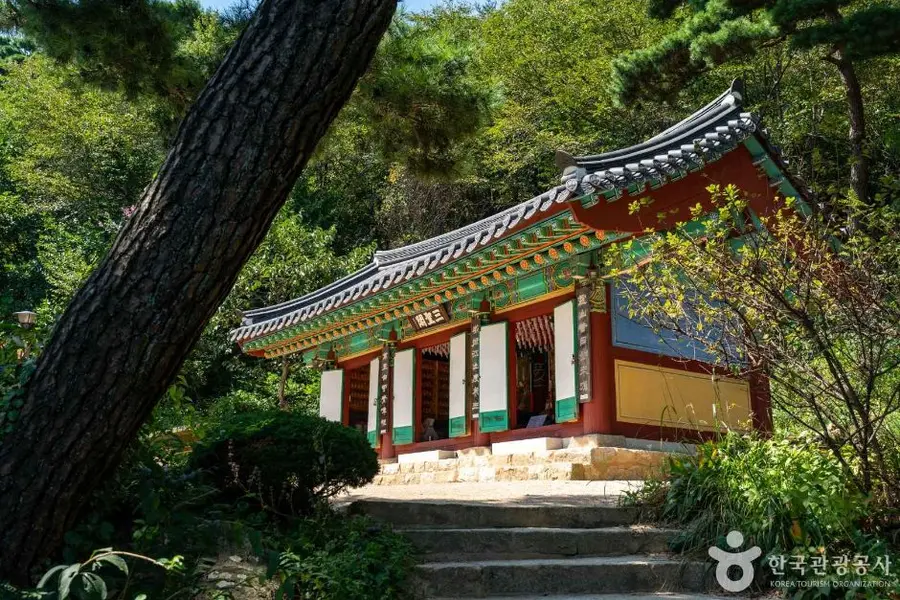
Jeondeungsa runs its temple stay programme. The six activities the temple offers are dawn ritual prayer, seated meditation practice, bowl-meal offering (balwoo gongyang), tea ceremony experience, temple-courtyard pilgrimage, and ulryeok.
Dawn ritual prayer begins at the darkest time of the day. It is a period in which you receive the sound of the bell and the wooden moktak drum with your body, and for people experiencing it for the first time it feels less like meditation and more like an experience that opens the senses. Seated meditation practice follows. You set your posture and sit, then follow your breathing; for those who are not used to it, it can also be a time when the legs grow numb.
Balwoo gongyang is done by receiving your rice in four bowls, not leaving anything behind, and then rinsing your mouth with water at the end—drinking even that water. It is a procedure that teaches with your body just how many hands and how much time are required for food to reach you. The tea ceremony experience slows your hand movements while you brew and drink the tea, and ulryeok is a time spent together on labour such as sweeping the courtyard or trimming vegetables. Sitting meditation and moving meditation are both woven into the day’s schedule.
When is the best time to go?
Ganghwa Island is a place where each season shows a distinct character. In spring, a pale green hue climbs along the fortress pathways, and in summer the forest thickens, casting shade all the way into the temple courtyard. In the autumn leaf-peeping season, visitors arrive in the greatest numbers. If you want a quieter time, late autumn into early winter, or weekdays in early spring, are better choices. In winter, sea winds blow past Jeongjoksan and the perceived temperature drops, so it is best to pack generously warm clothes.
The fact that it is within day-trip distance from the Seoul metropolitan area is also a strength of this temple. For people who find it difficult to clear a whole day, it offers rare accessibility for a place that gives you half-day stillness.
Visitor information
Address: Gilsang-myeon, Ganghwa-gun, Incheon (within Jeongjoksan Samrangseong)
Temple stay office: 032-937-0152
Temple affairs desk: 032-937-0125
Temple stay reservations: through the integrated reservation site for temple stays (templestay.com) or via the Jeondeungsa website (jeondeungsa.org)
How to get there: For public transport, take a route via Ganghwa Terminal and then travel towards Onsu-ri in Gilsang-myeon before walking or using a bus within the county. Because the frequency varies by season and day of the week, it is advisable to check Ganghwa-gun’s public transport guidance in advance.
A schedule table by programme, participation fees, and whether it runs year-round or on weekends are not published separately on the temple’s website. For exact details, you can contact the temple stay office for guidance.
A place for a meditation trip
While meditation trips in South Korea are often imagined as long practices deep in the mountains, such a place—just half a day’s distance from the Seoul metropolitan area—has been talked about less. Jeondeungsa brings together, in one place, 1,600 years of history, the fortress of the Dangun legend, and practice programmes that still run today. It means you can show South Korea’s time in a compressed form in a short period—and it remains a valid condition when introducing “Korean-style wellness” to foreign visitors.
Some trips leave behind more than what you saw: they leave behind what you set down. During the brief time you pass through the temple gate and climb the dirt path, you already begin—before you even realise it—you’ve arrived at the midway point.
For article enquiries: fare3041@naver.com
