

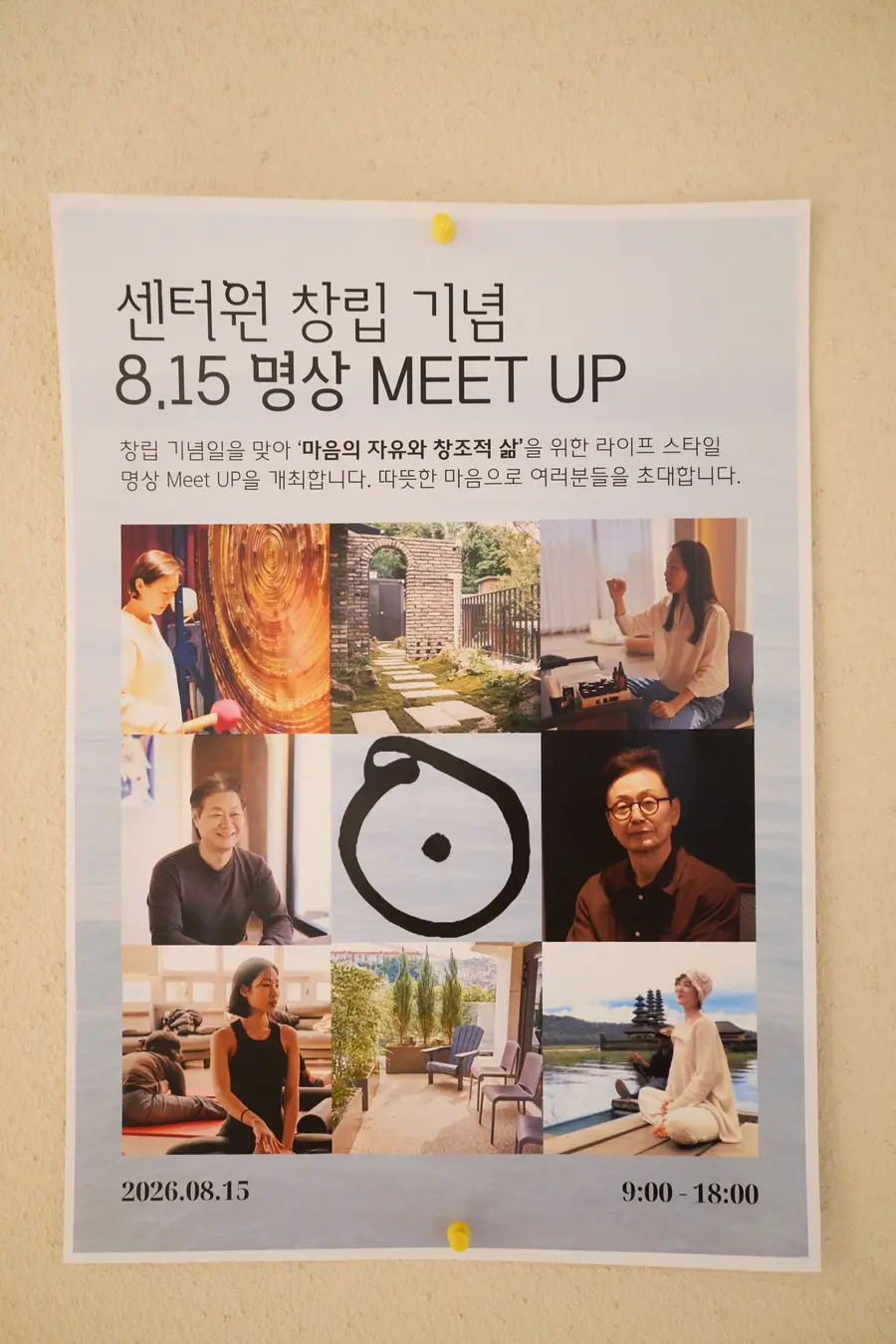
On the morning of Liberation Day, Center One in Haebangchon held an “Aug. 15 Meditation Meetup” to mark its second anniversary. Under the theme of freedom of the mind and a creative life, a variety of events ran from morning through afternoon.
Singing bowls and a cup of tea—starting the morning
On the first basement level’s Gallery Sa:yoo, a wellness market was open all day alongside the exhibition works. In the lobby tables on the first floor, in honor of the opening, were placed sirutteok (steamed rice cake), fruit skewers, lemon tea, and congratulatory potted plants.
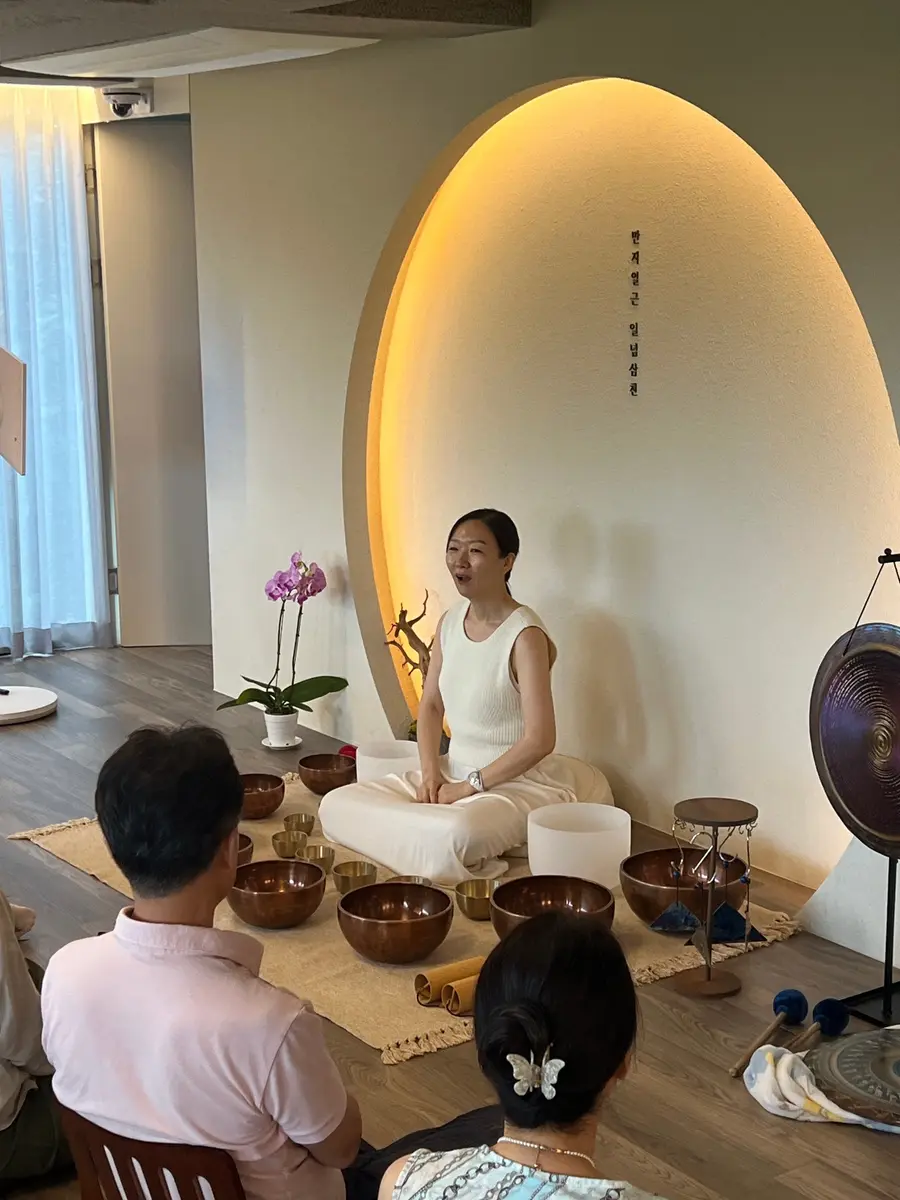
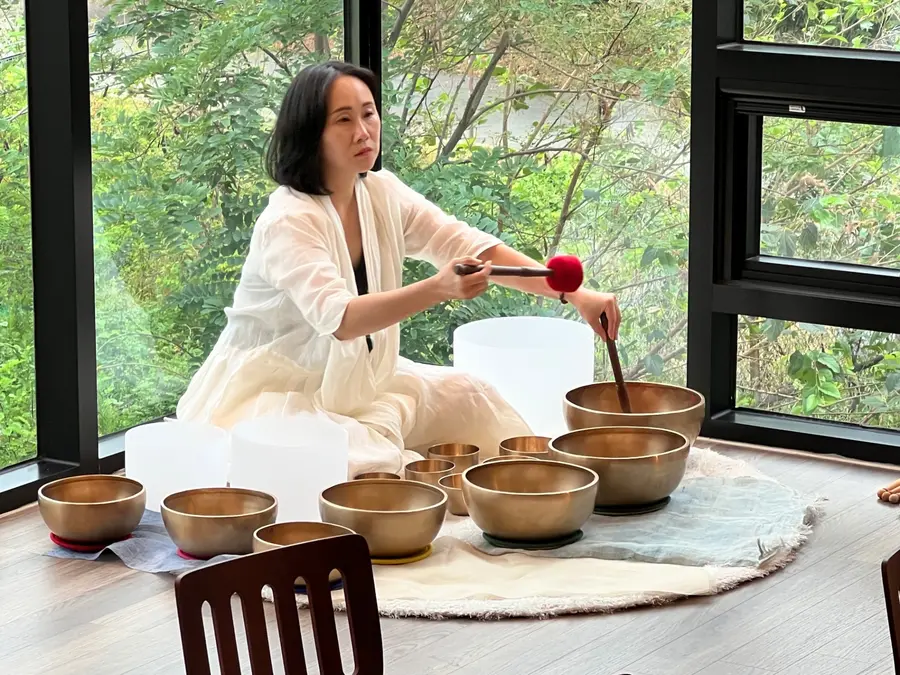
At 10:30 a.m., two sessions began at the same time. In a spot where the trees outside the window came in as-is, there was a singing bowl performance by Kim Ja-hye, director of the Raum Art Center. Because brass singing bowls made by hand make it almost impossible to match the musical notes exactly, I had always thought. But Director Kim, who is a pianist, filled the room with singing bowls tuned to the correct notes. Together with Choi Seon-hee, a professional singing-bowl instructor, the harmonious singing-bowl performance—something that created a space far different from singing-bowl meditation, which had previously been led by one person—deeply resonated in the hearts of the attendees as the meditation room felt filled with balance.
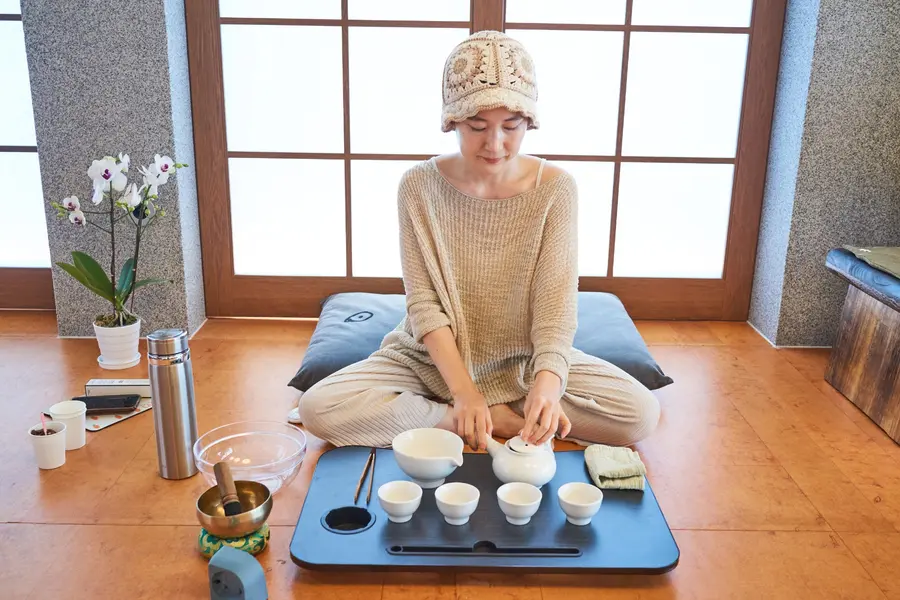
In an adjacent space, Park Dan-a’s tea meditation continued. The sound of water boiling, hands warming the cup, pouring the tea, and then pausing in stillness—silence that settles in for a moment. It was a time of full focus on the five senses: the sounds and the stillness, and the sight of the dawan (tea bowl), as well as aroma.
Dhamma talk “In the AI Age, Talk About Meditation”
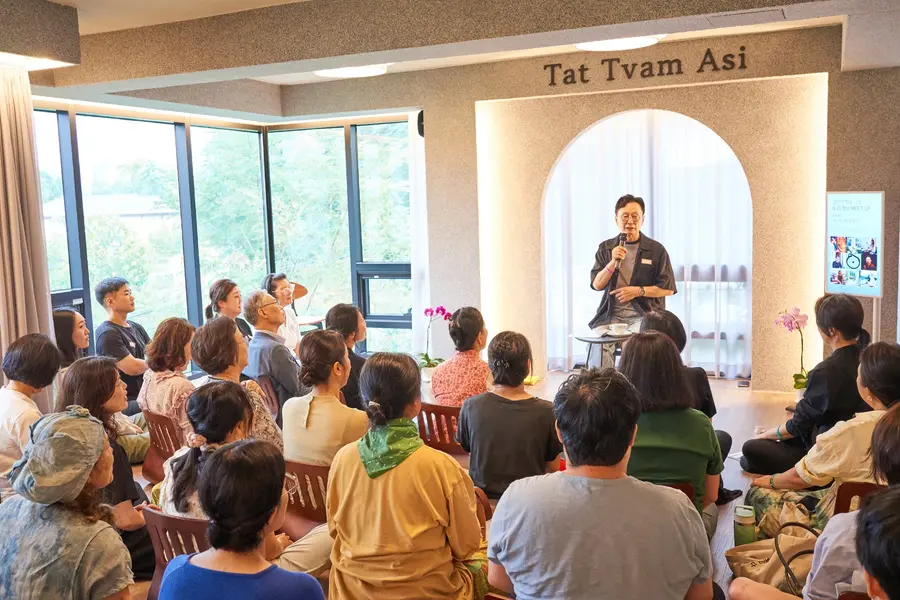
At 2 p.m., the sitting meditation room on the fourth floor was packed with not a single gap left. It was a Dhamma talk featuring Jeong Sun-il, emeritus professor at Wonkwang University, and Center One founder Asi (No Sang-chung, CEO).
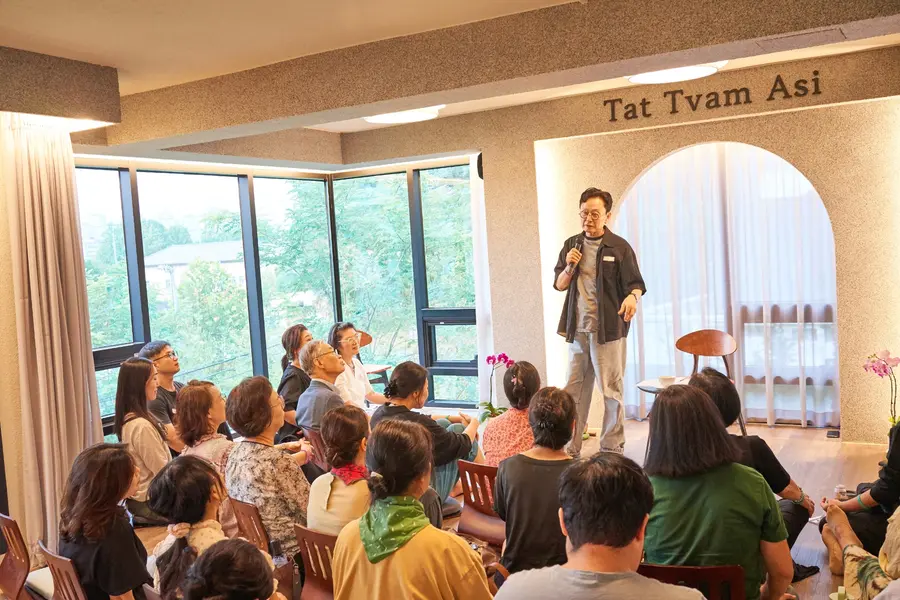
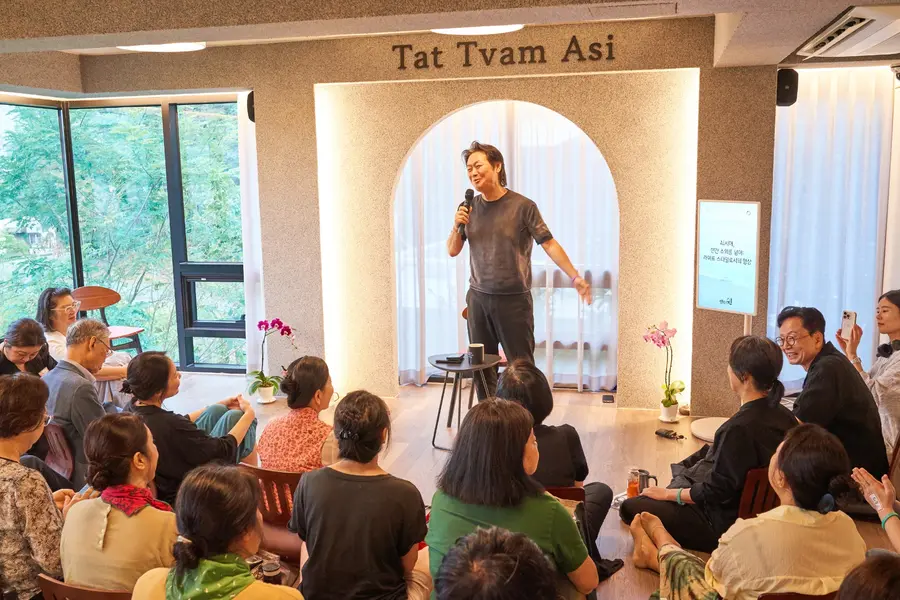
Speaking on the theme “AI that seeks answers, humans that seek themselves,” Professor Jeong introduced himself as someone who has lived through all four stages—from the first to the fourth industrial revolution—and said he believes that the coming fifth stage will be a spiritual revolution. He said the experience he had at age 17 at his hometown train station became a lifelong topic for reflection. After majoring in Buddhist philosophy and searching for sutras and teachers, he said it took 20 years to gather those insights into a book. The book is set to be published two weeks after this lecture.
The starting point for his reasoning was the proposition that “I am a microcosm.” Even the Earth, rotating at 100,000 kilometers per hour, is only a single speck of dust within the solar system. Yet humans are a part that retains the properties of the greater universe as a whole, he said. If the universe expands from one point and then returns to that one point again—breath that turns back—he called that samsara. Then the birth of the human microcosm becomes “small bang,” and death becomes “small crunch.” Professor Jeong divided the flow of life into two types: passive samsara, living as life simply passes by, and active samsara, a way of living that reduces the total amount of suffering and aligns with the greater universe.
The longest-lasting part was the story about the cheetah. Even when the brain remains still, it consumes 20% of the energy that the body uses. Zebras stop responding to crises once cheetahs disappear from their sight, but people live on even after the threat is gone, keeping that system running at full capacity. He said this is the reason worries become peptic ulcers—and also why the mind cannot escape the circuits of unwanted thoughts even in a safe state. He added that smartphones further fuel that tendency.
He also made a clear distinction about concentration. Concentration in excitement—cling to games and social media up until just before falling asleep—was likened to showering with adrenaline, far from practice. True concentration, like being fully absorbed in reading meditation, is what takes the lead from deep within one’s consciousness. Professor Jeong said meditation is “erasing the cheetahs of the past and the future,” and that the method is “sati,” which places attention on breathing rather than on thoughts. He ended his lecture with the line that meditation is no longer a choice but a necessity.
“Retreat is not a place—it’s a lifestyle”
CEO No Sang-chung’s story started from his personal history. He said that before he encountered meditation at 15, he was a boy who would try to force a smile in front of a mirror even though his body would stiffen. He said that these days, he often hears that he smiles a lot, and he recalled that once he learned the principles of the mind, his facial expression would naturally relax.
He found the risks of the AI age in human alienation. It was his diagnosis that the old concept—being subordinated to what humans have made themselves, and moving away from one’s own nature—becomes a problem again in an AI age where time surplus accumulates. He said that it is not about whether you have material things; rather, the quality of life is determined by how you take the lead in how your remaining time is used. The solution he presented was retreat as a lifestyle. He said that the era in which practice only begins when you go somewhere is over. Instead, the commute, the time in the morning with a cup of tea, and the ride home after work are all—just as they are—retreat. He emphasized the power to observe your mind and stay with it, whether it is for one minute or ten minutes, and to turn the light inward through a “returning radiance” that shines your own mind back at you.
From the tips of your toes back into your body—and then into the wellness market
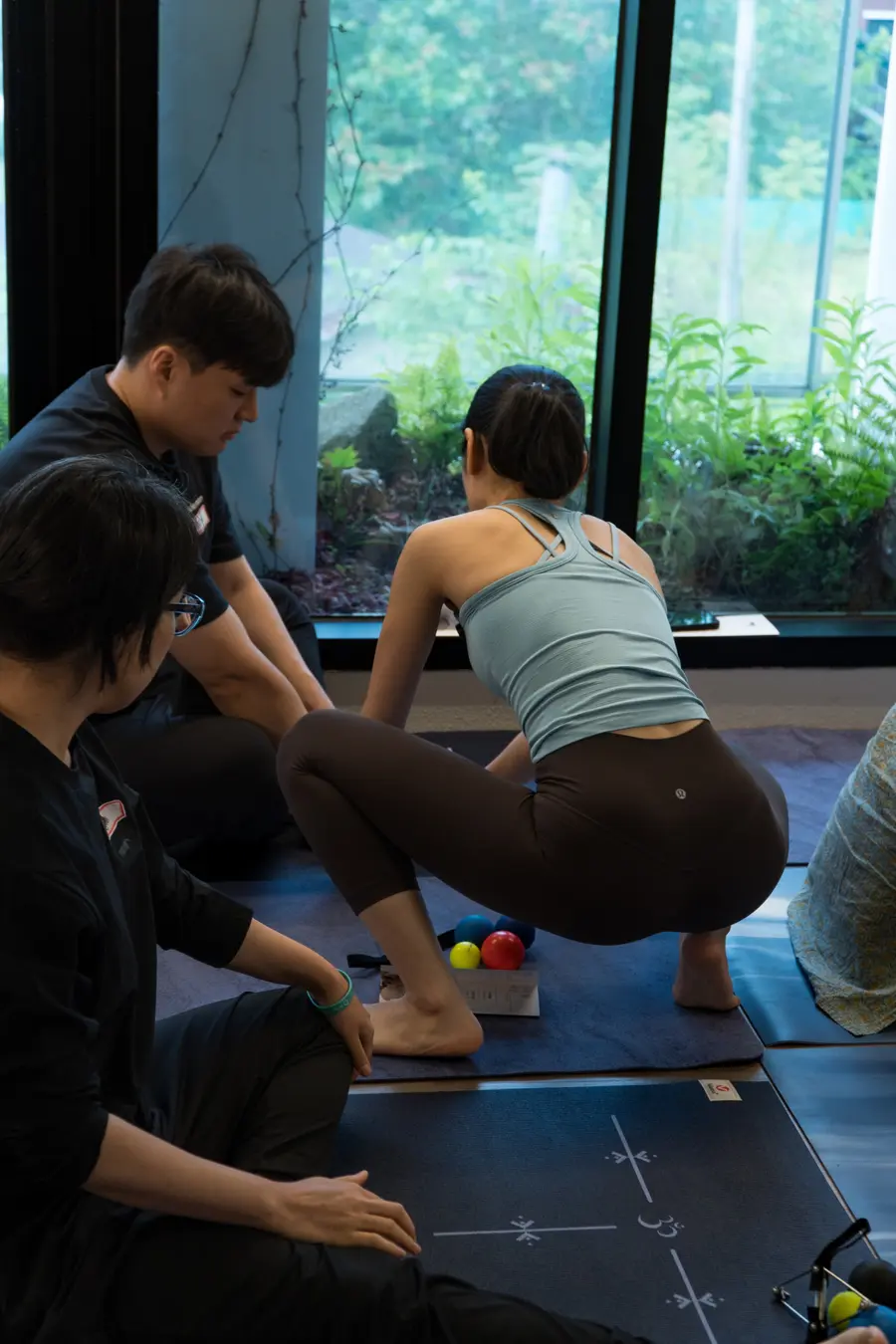
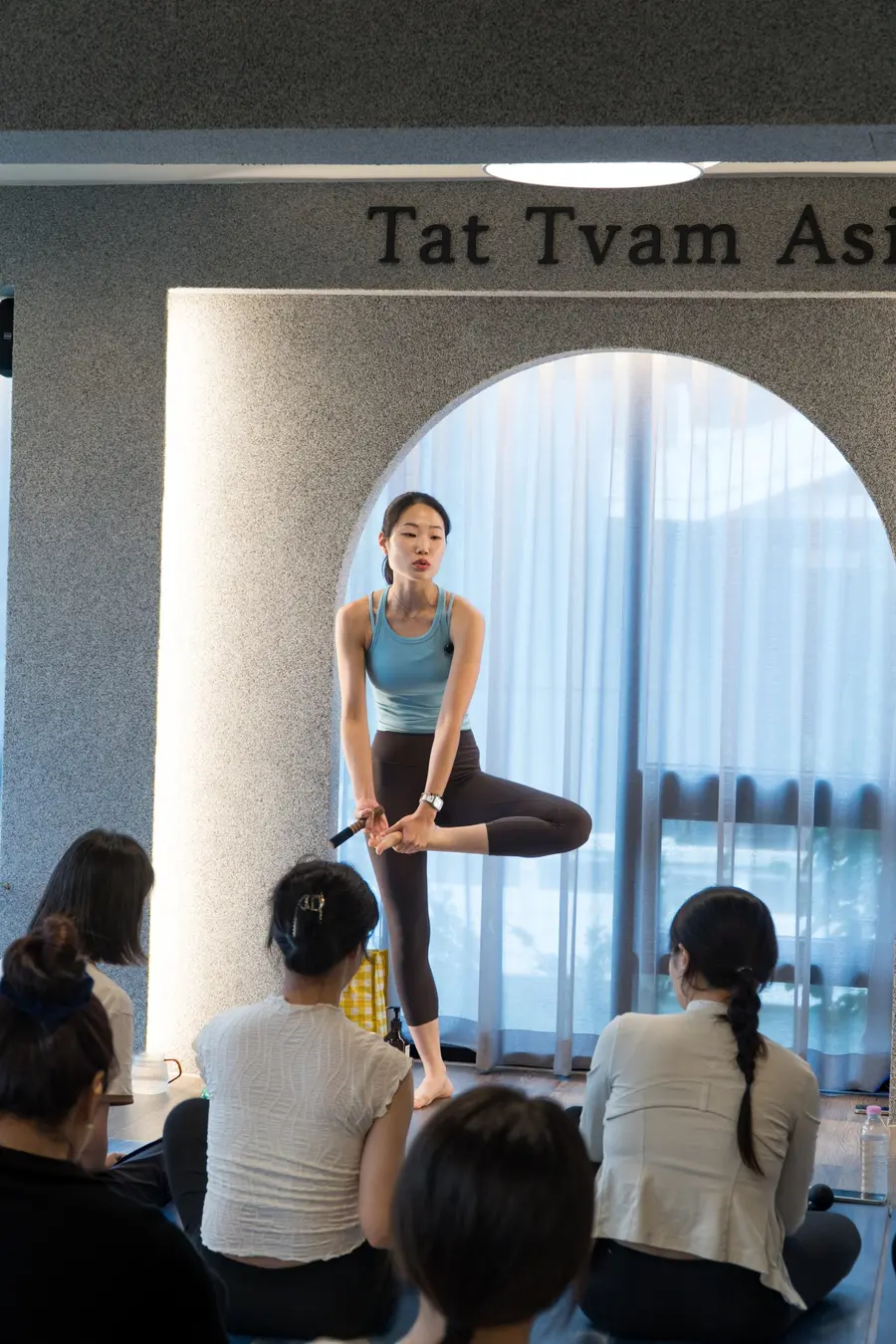
At 3:30 p.m., a toe yoga session with teacher Jeong Hyeon-hee began. As participants lay side by side on the mat and lifted their knees, following the sensations in their toes, the only sound left in the room was breathing. The approach of returning to the body from the farthest end was especially striking. At the same time, teacher Park Hye-jin also led an aroma meditation session.
Turning a special day into everyday life
I felt that the real value of Liberation Day was not limited to understanding it with your head from just one session and the lectures. It depended on how much you could reflect it in daily life and blend it into a lifestyle. AI can produce answers in seconds, but finding yourself still requires time and repetition. The message both speakers delivered in different words that day was that you should carry out that repetition not in a special place, but in your everyday spot.
With Center One aiming to train leaders, it is taking shape for members as “a place they want to visit often.” It was a day filled with anticipation for the diverse events Center One will continue to hold about “meditation to incorporate into daily life,” which it plans to expand in the future.