

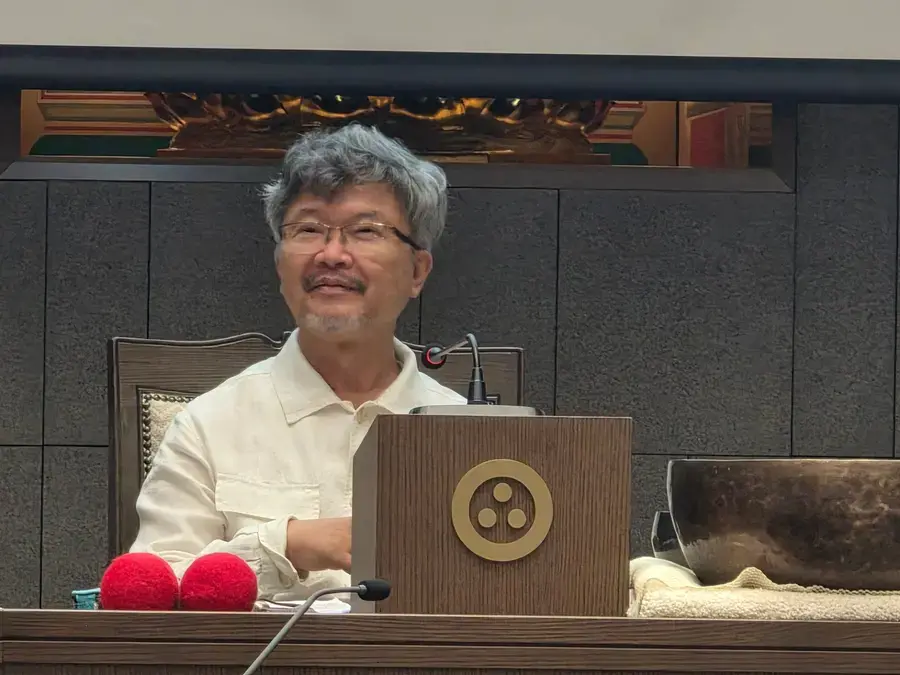
Ahn Hee-young, director of the Korea MBSR Institute, outlined five challenges facing Korea’s meditation community in a presentation titled ‘Asking which direction Korean meditation should take’ at the meditation conference held as part of the 7th Seoul International Meditation Expo at Dongguk University on 18 September.
Claims about benefits that go beyond the evidence
The first issue Director Ahn raised was commercialisation and exaggerated marketing. He warned that claims about benefits beyond what has been verified, along with pseudoscientific marketing, could damage the reputation of the meditation community as a whole. As research into meditation’s effects has grown, the boundaries of what that research actually shows have become clearer. The concern is that promotional language is crossing those boundaries.
‘A proliferation of certificates is not a market problem but a safety problem’
The second issue he identified was the training of instructors. He said fast-track instructor courses were becoming more common without requirements for personal practice or supervision. ‘A proliferation of certificates is not a market problem but a safety problem,’ Director Ahn said. He also pointed to the absence of ethical standards to verify instructors’ competence and protect participants in vulnerable states.
He added fragmentation, with different camps—including Zen Buddhism, Vipassana and MBSR—operating in isolation from one another, and a research-practice gap in which small-scale, short-term studies fail to connect with what happens on the ground, bringing the total to five challenges.
Adverse effects are already being reported in the numbers
Participant safety is not merely an abstract concern. A review published in 2020 analysed 83 studies involving 6,703 participants and found reports of negative experiences in 55 of them, according to ‘Meditation and Mindfulness: Effectiveness and Safety’, a resource compiled by the US National Center for Complementary and Integrative Health (NCCIH). About 8% of participants in the review experienced negative effects from meditation, most commonly anxiety and depression. The NCCIH also notes in the same resource that relatively few studies have examined the potential harmful effects of meditation and mindfulness. The page was last updated in June 2022.
The NCCIH cites evidence that meditation and mindfulness may help with anxiety and depression, symptoms of post-traumatic stress disorder, psychological distress among cancer patients, chronic pain, insomnia and cravings associated with substance use disorder. However, it distinguishes these from high blood pressure, attention deficit hyperactivity disorder, acute pain and migraines, where findings are mixed or the evidence is insufficient. This distinction between areas where benefits have been established and those where they have not yet been confirmed reflects the measured language Director Ahn is calling for.
Five practical tasks
Director Ahn did not stop at identifying the problems; he also proposed practical tasks. The first is to establish training standards for instructors covering minimum training periods, personal-practice requirements and supervision criteria. The second is an ethical code and quality-control system to protect vulnerable participants, establish a culture of reporting adverse effects and embed trauma-sensitive approaches. The third is to make regular a dialogue platform where traditional Buddhism, modern mindfulness, and the medical and education sectors can meet on an ongoing basis. The fourth is research involving practitioners in the field and the testing of cultural suitability among Koreans. His fifth proposal was to incorporate adult education, saying it was necessary to understand not only ‘what to teach’ but also ‘how people learn’.
‘Three gates’ linking tradition and modernity
In the latter part of his presentation, Director Ahn proposed ‘three gates’ as a framework encompassing both traditional and modern meditation. The first is the entry gate, represented by accessible modern meditation programmes; the second is the deepening gate, where intensive practice and systematic instruction take place; and the third is the ultimate gate, corresponding to advanced practices such as non-duality and investigating a hwadu, or kōan. He explained that the gates represented distinctions based on practitioners’ capacities and needs, rather than a hierarchy, and that the Dharma was complete at each gate.
As the number of people meditating grows and programmes become more diverse, the proposal is to examine the foundations of trust before prioritising the speed of growth. Because no single institution can establish training standards and an ethical code for instructors on its own, the third task—making the dialogue platform a regular fixture—becomes a prerequisite for the others.
Who will judge whom?
These developments in Korea’s rapidly growing meditation community are an essential step towards making healthy meditation part of everyday life. If certificates become little more than a means of making money, it will be difficult for any of them to win public trust.
But deciding who should judge whether someone is qualified to teach is no easy matter either. It is difficult even to assess what standards should determine who is qualified to make that judgement.
These developments are nevertheless a necessary part of the growing pains, and I hope they become an opportunity to consider how to build a wiser system, rather than focusing on who is more qualified or enjoys greater social recognition.
Article enquiries: fare3041@naver.com